

100%Brazilian company
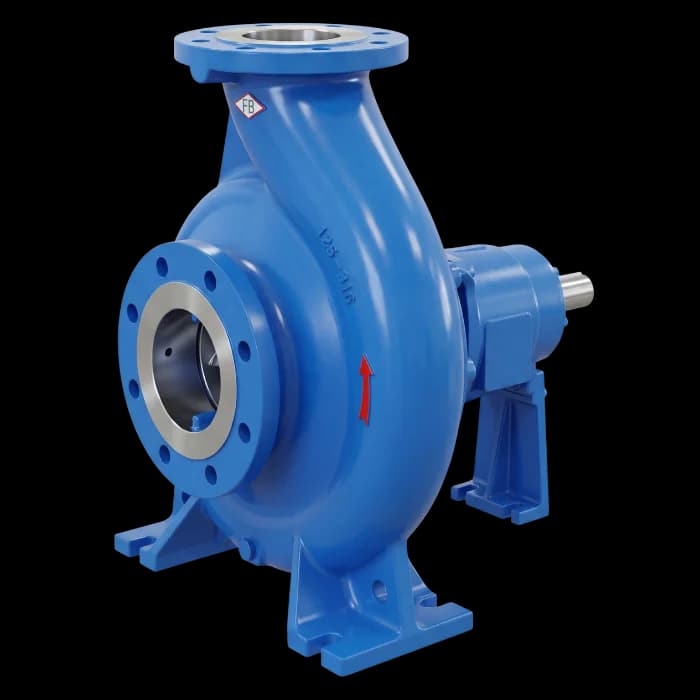
Standardized centrifugal pump FBCN Series
Normalized horizontal centrifugal pumps for industrial applications with clean or turbid liquids. Mechanically compliant with ASME B73.1.
Select your model FBCN
Choose a discharge diameter or go straight to a model. See versions in the same size group and explore neighboring diameters.
Your selection updates the models below. Open the specifications to check dimensions and curves.
54 catalog models · 12 sizes
DN 32
Discharge diameter- FBCN 32-125Suction DN 50 · Discharge DN 32
- FBCN 32-125.1Suction DN 50 · Discharge DN 32Variant .1
- FBCN 32-160Suction DN 50 · Discharge DN 32
- FBCN 32-160.1Suction DN 50 · Discharge DN 32Variant .1
- FBCN 32-200Suction DN 50 · Discharge DN 32
- FBCN 32-200.1Suction DN 50 · Discharge DN 32Variant .1
- FBCN 32-250Suction DN 50 · Discharge DN 32
- FBCN 32-250.1Suction DN 50 · Discharge DN 32Variant .1
DN 40
Discharge diameterDN 50
Discharge diameterDN 65
Discharge diameterDN 80
Discharge diameterDN 100
Discharge diameterDN 125
Discharge diameterDN 150
Discharge diameterDN 200
Discharge diameterDN 250
Discharge diameterDN 300
Discharge diameterCatalog values are not simultaneous maxima. Selection depends on the fluid, speed, duty point and configuration.
Built around your process
FBCN is the FB Bombas standardized centrifugal pump line, with mechanical construction to ASME B73.1. Its back pull-out assembly allows the bearing section to be removed from the volute without disconnecting the piping. For replacements, dimensions, baseplate, motor and duty point must be checked for each model.
From pump to complete assembly
FB Bombas supplies complete motor-pump sets: welded structural steel baseplate, flexible coupling with or without spacer, coupling guard and electric motor — all factory-aligned and tested. We customize baseplate, guard and automation per client specification.
- Volute Casing: Spiral-shaped casing, cast as a single piece and supported on its own feet. Suction-side wear ring.
- Back Pull-Out: The bearing assembly can be removed from the volute without disconnecting piping. Easy assembly, disassembly and maintenance.
- Single Stage: Radial-type impeller, single suction, with pressure-side wear ring. Horizontal installation.
- ASME B73.1: Mechanically, the pump follows ASME B73.1 (manual MTEC-03/00, p.1); interchangeability with an existing pump is confirmed on the drawing.
Applications
Chemical and petrochemical
Process liquids, with materials and sealing specified for the fluid.
Pulp and paper
Processes with clean or turbid liquids; consult engineering for suspended solids.
Water treatment
Pumping applications in water treatment systems.
Steel and mining
Transfer and circulation according to the duty point.
Textile and pharmaceutical
Materials and configuration selected for the process.
Sugar and ethanol
Process liquid pumping with review of temperature and suction conditions.
Technical information for an informed choice
Review construction and operating criteria. The series manual is the reference for installation, use and maintenance.
Technical manual FBCN
Technical source: MTEC-03/00 · 460 KB · PDF in Portuguese
Operating data
- Flow
- Up to 2,200 m³/h
- Total head
- Up to 135 m
- Temperature (operating data)
- Up to 260 °C
- Temperature without cooling chamber (Table 1)
- Packing from −50 to 105 °C; mechanical seal as recommended by the manufacturer
- Temperature with cooling chamber (Table 1)
- Packing up to 350 °C and mechanical seal as recommended by the manufacturer, in sizes 25-150 to 150-315 (100-500 included); no value from 150-400 upward
- Maximum discharge pressure curves (Figures 1 and 2)
- From −30 to 160 °C for the cast iron casing and from −50 to 260 °C for the carbon steel and stainless steel casing
- Speed
- Up to 3,500 rpm
- Max. suction pressure
- 10 bar
- Hydrostatic test
- ANSI B73.1
Catalog values are not simultaneous maxima. Selection depends on the fluid, speed, duty point and configuration.
How to read a model code
- FBCN
- Standardized Centrifugal Pumps
- 150
- Nominal discharge diameter (mm)
- 400
- Nominal impeller diameter (mm)
- .1
- Variant .1
Pressure and temperature
| Sealing | Temperature | ANSI B16.1 · 125 lb | ANSI B16.1 · 250 lb |
|---|---|---|---|
| Packing | -28–65 °C | 12 bar | 16 bar |
| Packing | 93 °C | 11 bar | 16 bar |
| Packing | 105 °C | 10 bar | 16 bar |
| Mechanical seal | 90 °C | 10 bar | 10 bar |
| Impeller material | Max. peripheral speed |
|---|---|
| Cast iron | ≤ 40 m/s |
| Ductile iron | ≤ 60 m/s |
| Carbon steel | ≤ 60 m/s |
| Stainless steel | ≤ 80 m/s |
Flange Types
- Cast iron
- ANSI B16.1 · 125 lb FF / 250 lb FF
- Carbon steel / Stainless steel / Ductile iron
- ANSI B16.5 / B16.42 · 150 lb RF
Sealing configurations
- ST - Standard
- Lubrication by pumped fluid / internal sealing. For clean, non-aggressive fluids. Up to 160 °C.
- S1 - External Source
- Sealing by external clean liquid. For toxic, aggressive, foul-smelling fluids or vacuum suction. Up to 105 °C.
- S2 - External Lubric.
- External lubrication and sealing. For fluids with solid particles or fibers in suspension. Up to 105 °C.
- S3 - Flushing
- Flushing with external clean liquid. For fluids with abrasives or crystallization risk. Up to 105 °C.
- S4 - Thermal Oil
- Pure graphite and/or graphite with carbon fiber packing. No connections. Above 260 °C.
- S - Mechanical Seals
- Per application requirements and manufacturer consultation.
(*) External source applications cannot use a cooling chamber. The arrangement temperatures are those in section 10 of the manual; in Table 1, with packing and without a cooling chamber, the range is −50 to 105 °C.
Components and installation
- Casing (Body)
- Spiral-shaped casing, cast as a single piece and supported on its own feet. Features a suction-side wear ring.
- Impeller
- Radial type, single suction, with pressure-side wear ring. Except models 25-150, 32-125 and 32-125.1.
- Shaft
- Assembled with protective sleeve in the sealing area. Packing or mechanical seal for sealing. For fluids with solids, consult FB.
| Connection | Function |
|---|---|
| D1 | Pump drain |
| D2 | Support drain |
| D3 | Support drip |
| D4 | Base drain |
| L1 | Lubrication (Ø20 mm) |
| M1 | Pressure gauge |
| M2 | Vacuum gauge |
| Re/Rs | Cooling: inlet/outlet |
| Se/Ss | Sealing: inlet/outlet |
| R | Recirculation |
| Pump power (metric hp) | Motor reserve |
|---|---|
| ≤ 2 | ≈ 20% (min. 1.5 cv) |
| 2–20 | ≈ 15% |
| > 20 | ≈ 10% |
| Stainless impeller passage | Efficiency reduction |
|---|---|
| ≤ 12 mm | 3 points |
| 12–15 mm | 2 points |
| > 15 mm | No reduction |
Flow and head: preliminary reference
This matrix groups models by flow and head ranges at 1750 rpm. Overlapping catalog limits do not confirm a duty point: check the Q×H curve, speed, impeller and NPSH. Large-capacity models require engineering consultation.
| Head (m) / Flow (m³/h) | < 50 | 50–150 | 150–400 | 400–1,000 | 1,000–2,400 |
|---|---|---|---|---|---|
| 100–140 | No model in this range | No model in this range | No model in this range |
|
|
| 60–100 | No model in this range | No model in this range |
|
| |
| 30–60 |
| ||||
| 15–30 |
| No model in this range | |||
| up to 15 | No model in this range | No model in this range | No model in this range |
Speed and supply frequency: the FBCN curves are drawn at 1,750 and 3,500 rpm, the speeds the MTEC-03/00 manual gives for 60 Hz. On a 50 Hz supply the motor runs slower, and a centrifugal pump's performance follows the affinity rules: flow varies with speed (Q ∝ n), head with its square (H ∝ n²) and power with its cube (P ∝ n³). For example, taking a 3,500 rpm curve to 2,900 rpm gives about 83% of the flow, 69% of the head and 57% of the power. This is an estimate: the 50 Hz selection is confirmed on the curve and in the FB Bombas proposal.
Power: preliminary reference
Maximum power printed on each model's curve sheet, valid for clean water at 20 °C and 1,750 rpm. It is a preselection reference, not the motor nameplate rating. Confirm the duty point, fluid and power reserve with engineering.
| Power (metric hp) | kW | Reference models |
|---|---|---|
| up to 5 metric hp | ≤ 3.7 | |
| 5–15 metric hp | 3.7–11 | |
| 15–30 metric hp | 11–22.1 | |
| 30–60 metric hp | 22.1–44.1 | |
| 60–150 metric hp | 44.1–110.3 | |
| > 150 metric hp | > 110.3 |
|
Selection, installation and maintenance
About the series, clear answers
Selection, materials, maintenance and supply: review frequently asked questions before moving forward.
What industries use FBCN centrifugal pumps?
The FBCN technical manual (MTEC-03/00) specifies the series for clean or turbid liquids in the chemical, petrochemical, pulp and paper, steel, mining, food, textile and pharmaceutical industries and in sanitation. For fluids with suspended solids, the manual asks for FB to be consulted before selection, because the seal chamber arrangement changes with the kind of solid: S2 for particles or fibers and S3 for abrasives or fluids that tend to crystallize.
What is the Back Pull-Out design advantage?
According to the FBCN manual, the back pull-out construction lets the bearing assembly be withdrawn from the volute without disconnecting or misaligning the pumping pipework, which the manual credits for easier assembly, disassembly and maintenance. With a spacer coupling, which the manual lists among the accessories, the motor can also stay on the baseplate during removal.
What is the maximum flow rate for FBCN pumps?
The FBCN manual gives these series maximums: flow up to 2,200 m³/h, head up to 135 m, sizes from DN 25 to DN 300 and speed up to 3,500 rpm. They are limits across the range of models and do not occur together in a single pump: each model has its own operating field in the manual's quick selection table and curves. Above 135 m, the FB Bombas option is the FBME, a horizontal multistage centrifugal pump from DN 80 to DN 150, with maximums of 400 m³/h and 300 m per manual MTEC-08/01, which are not simultaneous either.
What is the maximum operating temperature of the FBCN?
The FBCN manual gives temperatures up to 260 °C. In Table 1, with packing, the range is −50 to 105 °C without a cooling chamber and up to 350 °C with a cooling chamber, in sizes 25-150 to 150-315 (100-500 included); from 150-400 upward, the table gives no value with a cooling chamber. With a mechanical seal, the table refers to the manufacturer's recommendation. The seal chamber arrangements have their own limits in section 10 of the manual: the standard ST arrangement, lubricated by the pumped fluid itself, goes up to 160 °C; S1, S2 and S3, with liquid from an external source, go up to 105 °C and cannot use a cooling chamber; S4, for thermal oil, with graphite packing, is the arrangement for temperatures above 260 °C. Allowable pressure falls as temperature rises: the maximum discharge pressure curves run from −30 to 160 °C for the cast iron casing and from −50 to 260 °C for the A216 WCB carbon steel and A743 CF8M stainless steel casing, and the manual has charts for each flange class.
How many models does the FBCN series offer?
The FBCN manual (MTEC-03/00) lists 54 sizes in Table 1: 43 with dimensions in Table 7 and 11 with dimensions on request (the 100-500 and the 10 large-capacity models, 150-500 to 300-340). It states back pull-out construction and mechanical construction per ASME B73.1. Series maximums: 2,200 m³/h, 135 m and 3,500 rpm. Temperature: up to 260 °C in the operating data; in Table 1, with packing, −50 to 105 °C without a cooling chamber and up to 350 °C with a cooling chamber in sizes 25-150 to 150-315 (100-500 included). The maximum discharge pressure curves (Figures 1 and 2) run from −30 to 160 °C for the cast iron casing and from −50 to 260 °C for carbon steel and stainless steel. Each model has its own limits in the table. The designation gives the nominal diameter of the discharge flange and the nominal impeller diameter, in millimeters: the FBCN 150-400 has a DN 150 discharge and a 400 mm nominal impeller.
Is the FBCN used in fire protection systems per NFPA 20?
Yes. In FB Bombas' FBFS fire pump sets, the main pump, electric or diesel driven, is an FBCN sized for the flow and pressure of the project. The set is designed per NFPA 20 or ABNT NBR 16704 when the specification requires it; this is a design declaration by FB, and a product certification is proven only by the certificate issued by the certification body. ABNT NBR 10897 (automatic sprinklers) and NBR 13714 (hydrants and hose reels) govern the system, which is sized by the fire protection design.
Which FBCN casing materials are recommended for water and chemical duty?
The FBCN manual does not tie materials to industries: the choice follows the fluid, the temperature and the pressure. The casing can be cast iron, ASTM A216 WCB carbon steel or ASTM A743 CF8M stainless steel, each with its own maximum discharge pressure × temperature chart; the flange table also covers ductile iron. For clean water, the limit to check is the chart of the chosen casing; for a corrosive fluid, the compatibility of the material with the stated concentration and temperature is checked during selection.
How do I replace a normalized centrifugal pump already in service with an FBCN?
To replace an installed centrifugal pump, FB Bombas supplies the complete FBCN pump and checks, model by model, the dimensions in manual MTEC-03/00 (baseplate, nozzles, flanges and shaft) and the duty point before the order. The manual states mechanical construction per ASME B73.1; dimensional interchangeability with the existing pump is not assumed and is confirmed on the drawing. That is because ASME B73.1 provides for direct exchange between pumps with the same dimension designation of the standard, and the FBCN uses its own designation, made of the discharge DN and the nominal impeller diameter.
Does the FBCN fit the existing baseplate without civil work?
Only when the dimensions match. Engineering compares Table 7 of manual MTEC-03/00 — DN1 and DN2 nozzles, height and length dimensions, foot dimensions and bolt holes, and shaft end, in millimeters — with the drawing or site survey of the current pump. If they match, baseplate, piping and foundation stay as they are; if not, the difference is handled in the design of the set, and the manual lists a welded structural-steel baseplate among the supplied accessories. The duty point and the available NPSH are checked in every case.
What data do I need to confirm the replacement?
Six items close the analysis: flow (Q, in m³/h) and head (H, in m) at the duty point; NPSH available at the installation; temperature and nature of the fluid, including suspended solids; flange class and facing; and the identification of the current pump, read from its nameplate, with its dimensional drawing or dimensions measured on site. With these, application engineering confirms which of the 54 models in the FBCN manual fits, whether the baseplate can be kept and which materials and sealing arrangement apply.
Does the FBCN cover industrial water, effluent and utility duties?
Yes, within the scope of the manual: clean or turbid liquids. That covers clean process and utility water and sanitation, which the manual lists among its applications. For effluent with solid particles or fibers in suspension, the manual provides the S2 seal chamber, with lubrication and sealing by external liquid, and, for abrasive particles or a tendency to crystallize, S3 flushing; in these cases FB is consulted before selection. Selection is made by duty point and available NPSH, among the 54 models of the series.
Which materials is the FBCN manufactured in?
The FBCN manual provides casings in cast iron, ASTM A216 WCB carbon steel or ASTM A743 CF8M stainless steel, and flanges in cast iron (ANSI B16.1, 125 or 250 lb FF) or in steels and ductile iron (ANSI B16.5/B16.42, 150 lb RF). For the impeller, it sets the maximum peripheral speed by material: cast iron up to 40 m/s, ductile iron and carbon steel up to 60 m/s and stainless steels up to 80 m/s, which limits the speed of each combination. A stainless impeller with a passage width of up to 15 mm has the curve efficiency reduced by 2 to 3 points (Table 4). Material is chosen by fluid, temperature and pressure, not by model.
Is the FBCN API 610 or ASME B73.1 compliant?
ASME B73.1, not API 610. The FBCN technical manual (MTEC-03/00) states mechanical construction per ASME B73.1 (Specification for Horizontal End Suction Centrifugal Pumps for Chemical Process), the standard for horizontal, end suction, single stage, centerline discharge pumps for chemical process, with dimensional interchangeability requirements between pumps of the same designation. API 610 (Centrifugal Pumps for Petroleum, Petrochemical and Natural Gas Industries), from the American Petroleum Institute, sets requirements for the design, materials, manufacturing, testing and performance of centrifugal pumps for process services in the petroleum, petrochemical and gas industries, and covers several construction types. When a refining, oil or gas project requires API 610, FB Bombas handles the supply as an engineered-to-order solution, with design compliance defined in the proposal.
Does the FBCN comply with ASME B73.1?
The FBCN technical manual (MTEC-03/00) states that the pump is mechanically compliant with ASME B73.1 and gives the hydrostatic test pressure "per ANSI B 73.1", as the manual refers to the same standard. Flanges are cast iron per ANSI B16.1 (125 or 250 lb FF) or steels and ductile iron per ANSI B16.5/B16.42 (150 lb RF), and the parts list follows DIN EN 24250 numbering. The dimensions of each model are in the manual's own dimension table, and interchangeability with an installed pump is confirmed on the drawing. ASME publishes the standard; it does not certify pumps.
Is the FBCN dimensionally compatible with the European EN 733 standard?
The FBCN manual does not state compliance with EN 733, the European standard that replaced DIN 24255. The FBCN designation (discharge DN and nominal impeller diameter, such as 150-400) and the dimensions of each model are in the tables of manual MTEC-03/00. To replace an installed EN 733 pump, engineering compares the drawings dimension by dimension before recommending a model.
Is FB Bombas registered as a Petrobras supplier (CRC, formerly CRCC)?
FB Bombas reports a registration in the Petrobras supplier registry. Petrobras issues the Certificado de Registro Cadastral (CRC), which replaces the former CRCC, to suppliers that meet one or more criteria of the supply family of interest; it is a supplier registration, not a product certification. Validity and supply families must be checked on the current certificate, provided on request. The legal name is Fabricadora de Bombas Indústria e Comércio Ltda., CNPJ 61.381.240/0001-78, which can be looked up at the Brazilian Federal Revenue Service (Receita Federal).
How is the FBCN delivery time defined?
Delivery time and availability are given in the quotation, because they depend on the model among the 54, the materials, the sealing arrangement, the driver and the tests requested. The FBCN is machined and assembled at the FB Bombas factory in Cabreúva-SP, which has a hydraulic test bench; the tests for each supply are defined in the proposal.
How to request the technical quote and FBCN technical manual in PDF?
The quotation is requested through the sales form, WhatsApp or the sales e-mail, with flow (Q, in m³/h), head (H, in m), available NPSH, fluid and temperature, presence of solids, flange class and desired materials. The FBCN technical manual (MTEC-03/00), with selection table, curves, pressure × temperature charts, sealing arrangements and dimension table, is at /en/technical-manuals/fbcn. The manual page is available in Portuguese, English and Spanish; the PDF is in Portuguese.
Which standards does the FBCN technical manual cite for construction, dimensioning and testing?
The FBCN manual (MTEC-03/00) cites ASME B73.1 for mechanical construction and the same standard, as ANSI B 73.1, for the hydrostatic test pressure; ANSI B16.1 for cast iron flanges (125 or 250 lb FF) and ANSI B16.5/B16.42 for steel and ductile iron flanges (150 lb RF), with allowable pressure × temperature charts per class; DIN EN 24250 for part numbering; and NPT threads on the auxiliary connections. The dimensions of each model are in the manual's own dimension table, available at /en/technical-manuals/fbcn.
Let’s specify your next pump
Send the details you have. Our technical team will review the duty point and configuration to prepare your proposal.
Materials, availability and lead time are confirmed in the proposal. Support for projects in Brazil and abroad.
Useful details for the assessment
- Fluid, viscosity and temperature
- Flow, pressure or total head
- Suction and installation conditions
- Existing model or nameplate photo for replacements
Continue your research with FB Bombas
Pumping principles, comparisons and other solutions for your process.