

How to select a
Everything you need to know about centrifugal pumps: operating principle, characteristic curve, industrial applications and how to specify for your process.

At a glance
- A centrifugal pump is a pump that transfers energy to the liquid through a rotating impeller and converts velocity into pressure in the volute or diffuser.
- Selection between gear and centrifugal pumps depends on flow, pressure or head, viscosity at operating temperature, suction conditions and materials. FBE and FBEI serve viscous fluids; FBCN serves centrifugal applications and FBOT thermal oil circuits. There is no universal 100 cP threshold: compare corrected curves, internal losses and power at the same duty point with engineering.
- BEP is the point of maximum efficiency on the efficiency curve. The operating point results from the intersection of the pump and system Q×H curves.
- FBCN includes standard and large-capacity models. General series limits are not simultaneous: consult the curve and selected configuration.
- Correct selection requires available NPSH above the required value — FB engineering validates the duty point and the cavitation margin before supply.
- FB Bombas manufactures FBCN in Brazil. The manual describes mechanical construction to ASME B73.1; dimensional compatibility requires drawing comparison.
Updated
Answers to guide your selection
What is a centrifugal pump used for in industry?
Centrifugal pumps serve process and cooling water, solvents and chemicals compatible with the model materials and seals. Selection requires fluid composition, solids, temperature and viscosity. For viscous liquids, assess corrected curves and power at the duty point; 100 cP is not a universal cutoff.
What is the difference between a centrifugal and a peripheral pump?
They are distinct hydraulic designs, with different curves and operating ranges. To compare a centrifugal and a peripheral pump, define flow and head, fluid, suction, efficiency and duty. The type name alone does not determine which equipment meets the process requirements.
When to use centrifugal instead of gear pump?
Selection between gear and centrifugal pumps depends on flow, pressure or head, viscosity at operating temperature, suction conditions and materials. FBE and FBEI serve viscous fluids; FBCN serves centrifugal applications and FBOT thermal oil circuits. There is no universal 100 cP threshold: compare corrected curves, internal losses and power at the same duty point with engineering.
What is the operating range of the FBCN Series?
The FBCN manual lists up to 2,200 m³/h, 135 m and 260 °C as general series limits. These values are not simultaneous and do not apply to every configuration. Check the model curve, speed, power, suction, materials and sealing for the requested condition.
What Is a Centrifugal Pump?
Technical definition and energy conversion principle
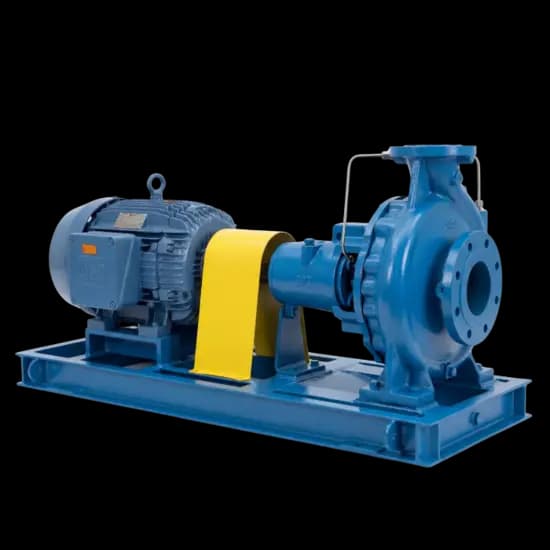
A centrifugal pump is equipment that uses the rotation of an impeller (rotor with vanes) to convert mechanical energy into kinetic energy and then into pressure. Fluid enters through the impeller center and is radially accelerated by the vanes, being directed to the volute (spiral casing) where velocity is converted into pressure.
It is the most widely used pumping technology in the industrial world for low-viscosity fluids. It offers high flow rates with superior energy efficiency, simple construction and easy maintenance — especially in normalized models with back pull-out like the FB Bombas FBCN series.
High flow rates up to 2,200 m³/h
Head up to 135 m
Operating temperature up to 260 °C
Back pull-out — maintenance without disconnecting piping
Which FB Series Fits Your Duty Point
Pre-selection by fluid and head, with each series’ limit and source
| Your duty point | FB series | Reference limit |
|---|---|---|
| Water and low-viscosity liquids, head up to 135 m | FBCNStandardized single-stage centrifugal | Up to 2,200 m³/h, 135 m and 260 °C, not simultaneousManual MTEC-03/00 |
| Head above 135 m, flow up to 400 m³/h | FBMEHorizontal multistage centrifugal, 3″ to 6″ | Up to 400 m³/h and 300 m, not simultaneous; up to 140 °C, depending on sealingManual MTEC-08/01 |
| Thermal oil in a heating loop | FBOTCentrifugal pump for thermal oil | Up to 350 °CManual MTEC-16/00 |
| Viscous fluid: oil, asphalt, resin | FBE · FBEIGear pump (positive displacement), not centrifugal | FBE: up to 100,000 SSU in the 3″ to 6″ sizesManual MTEC-01/01, Table 2 |
Pre-selection only: FB engineering confirms the model on the curve, with flow, head, fluid, temperature and available NPSH. Send your duty point
How Does a Centrifugal Pump Work?
Kinetic energy to pressure conversion cycle
Axial Suction
Fluid enters through the impeller center (eye) by pressure difference. Rotation creates a low-pressure zone at the center that draws liquid through the suction piping.
Radial Acceleration
Impeller vanes accelerate the fluid radially through centrifugal force. The motor's mechanical energy is transferred to the fluid as kinetic energy (velocity).
Volute Conversion
The high-velocity fluid enters the volute (spiral casing), where the cross-section progressively expands. Deceleration converts kinetic energy into static pressure.
Characteristic Curve
How to read the Q×H chart and find the BEP
Q × H Curve
Relates flow (Q) to head (H). As flow increases, head decreases. Each pump has a unique curve defined by its impeller.
BEP — Best Efficiency Point
BEP is the point of maximum efficiency on the efficiency curve. The operating point results from the intersection of the pump and system Q×H curves.
Required NPSH
Suction head required for the specified performance. Compare available and required NPSH across the operating range, with a margin appropriate to the application.
Absorbed Power
Energy consumed by the pump at each curve point. Generally increases with flow. Sizes the required electric motor.
Centrifugal Pump Advantages
Why industry chooses centrifugal for high flow rates
High Flow Rates
Consult the model curve for duty flow and head, including efficiency, power and suction conditions.
Energy Efficiency
BEP is the best efficiency point on the curve. Compare the duty point and allowable operating range using model efficiency and power.
Simple Maintenance
Back pull-out allows removal of rotating assembly without disconnecting piping. Reduces downtime.
Normalized
It is a pump that follows standardized requirements within a declared scope. The FBCN manual describes mechanical construction to ASME B73.1 and back pull-out construction. For replacement, compare drawings, connections and operating conditions; the term standardized does not guarantee pump equivalence or spare-parts interchangeability.
Continuous Flow
The pump and system curves determine the duty point. Control and operating conditions must meet the process flow and pressure requirements.
Cost-Effective
Compare purchase, energy, maintenance and installation at the same duty point. Costs and parts availability must be confirmed in the proposal.
Industrial Applications of Centrifugal Pumps
Sectors that use centrifugal pumps daily
Industrial Water
Intake, distribution and recirculation
Chemical Processes
Solvents, dilute acids and bases
Fire Fighting
NFPA 20 systems, sprinklers, hydrants
HVAC & Building
Air conditioning, cooling towers
Pharmaceutical
Clean process liquids and utilities
Mining
Drainage and process water (solids: consult FB)
Sugar & Ethanol
Juice, vinasse, boiler water
Centrifugal Pump Components
Internal parts and function of each piece in pumping
Impeller (Rotor)
Rotating part with curved vanes that accelerates fluid by centrifugal force. In the FBCN series, it is radial single-suction with wear ring on the pressure side. Impeller diameter defines the pump head.
Volute (Casing)
Spiral casing cast in a single piece that converts fluid velocity into static pressure. In the FBCN, it has a spiral shape with self-supporting feet and wear ring on the suction side.
Shaft
Transmits motor torque to the impeller. Mounted with protective sleeve in the sealing region. Supported by rolling bearings sized for operating radial and axial loads.
Mechanical Seal
Seal between rotating and stationary parts. Prevents leakage of pumped fluid. In the FBCN, can be mechanical seal or packing, depending on application. Seal limit: up to 90 °C and 10 bar.
Wear Rings
Replaceable parts that maintain controlled clearance between impeller and casing. Protect main components against erosion. In FBCN, present on suction side (casing) and pressure side (impeller).
Baseplate & Coupling
Baseplate supports pump and motor in alignment. Flexible coupling transmits power with tolerance to minor misalignment. FBCN back pull-out design allows removal of rotating assembly without disconnecting piping.
Centrifugal Pump Types
Classification by shaft, stages and electrical supply
Horizontal
FBCNFBCN has a horizontal shaft and back pull-out construction. The manual describes ASME B73.1 mechanical requirements; dimensions and interfaces must be checked on the model drawing.
See FBCN seriesSingle-Phase vs. Three-Phase
It refers to the motor, not the pump. Three-phase (220/380/440 V) is the industrial standard; single-phase only covers small ratings where no three-phase supply exists. On the FBCN, coupled to the motor through a flexible coupling, the power comes from the model curve at the duty point.
Single-Stage vs. Multi-Stage
FBCN · FBMESingle-stage: one impeller; on the FBCN, up to 135 m. Multi-stage: impellers in series for higher heads; the FBME, a horizontal multistage centrifugal pump from 3″ to 6″, reaches 400 m³/h and 300 m per manual MTEC-08/01, though not both at once. FB Bombas manufactures both.
See FBME seriesStainless Steel
For corrosive or pharmaceutical fluids. For the FBCN, the manual provides cast iron, ductile iron, A216 WCB carbon steel and A743 CF8M stainless steel, each with its own limits; for another material, consult FB. Material choice depends on chemical compatibility with the pumped fluid.
Centrifugal vs. Gear
When to choose each pumping technology
| Criteria | Centrifugal | Gear |
|---|---|---|
| Viscosity | Evaluate curves corrected for the fluid | Evaluate speed, suction and internal slip |
| Flow range | Model curve at the required head | Table at required pressure and speed |
| Self-priming | According to design and installation | According to design and installation |
| Efficiency | Check the curve at the Q×H duty point | Check performance at the duty point |
| Operating cost | Power, operating hours and maintenance | Power, operating hours and maintenance |
| Applications to assess | Water, solvents, effluents | Oils, resins, asphalt |
How to Specify
Essential data for correct sizing
Flow & Head
Desired flow rate (m³/h) and total head (m). Defines the operating point on the Q×H curve.
Fluid Type
Name, viscosity, density, solids concentration and chemical compatibility.
Temperature
Operating and maximum temperature. Defines seal materials and construction type.
Available NPSH
Absolute reservoir pressure, minimum and maximum levels, suction losses and vapor pressure at pumping temperature. Check the margin throughout the operating range.
Installation
Suction and discharge diameters, flange type, available space and base.
Operating Regime
Continuous or intermittent, start frequency, load variation and applicable standards.
Frequently Asked Questions
What is a centrifugal pump?
A centrifugal pump is a machine that uses centrifugal force generated by an impeller spinning at high speed to convert mechanical energy into kinetic and pressure energy, moving low-viscosity fluids such as water, solvents, and light chemicals.
How does a centrifugal pump work?
Fluid enters through the center of the impeller (the impeller eye) and is accelerated radially by the vanes. The high velocity at the impeller outlet is converted into pressure by the volute (spiral casing). The pressure difference between suction and discharge drives the fluid through the system.
What is the characteristic curve of a centrifugal pump?
The characteristic curve relates flow and head for a defined model, impeller diameter and speed. Efficiency, power and required NPSH curves complete the selection data. BEP is the point of maximum efficiency on the efficiency curve. The operating point results from the intersection of the pump and system Q×H curves.
What fluids are centrifugal pumps suitable for?
Centrifugal pumps serve process and cooling water, solvents and chemicals compatible with the model materials and seals. Selection requires fluid composition, solids, temperature and viscosity. For viscous liquids, assess corrected curves and power at the duty point; 100 cP is not a universal cutoff.
What does normalized centrifugal pump mean?
It is a pump that follows standardized requirements within a declared scope. The FBCN manual describes mechanical construction to ASME B73.1 and back pull-out construction. For replacement, compare drawings, connections and operating conditions; the term standardized does not guarantee pump equivalence or spare-parts interchangeability.
What is the ASME B73.1 standard for centrifugal pumps?
ASME B73.1 covers horizontal, end-suction, single-stage centrifugal pumps for chemical processes. It includes dimensional and design requirements within its scope. The FBCN manual declares mechanical construction to this standard; confirm the edition, configuration and drawing before specifying a replacement.
What is the difference between ASME B73.1 and ASME B73.2?
B73.1 covers horizontal end-suction construction; B73.2 covers vertical in-line construction. This distinction changes the pump arrangement and interfaces. The FBCN presented in this guide is horizontal; a B73.2 requirement must not be met by a nominal substitution without assessing the required construction.
When should I choose a centrifugal pump instead of a gear pump?
Selection between gear and centrifugal pumps depends on flow, pressure or head, viscosity at operating temperature, suction conditions and materials. FBE and FBEI serve viscous fluids; FBCN serves centrifugal applications and FBOT thermal oil circuits. There is no universal 100 cP threshold: compare corrected curves, internal losses and power at the same duty point with engineering.
Can I replace my current centrifugal pump with an FBCN?
FBCN can be assessed as a replacement. Send the current pump's nameplate, dimensional drawing and operating conditions. Engineering compares the curve, suction, materials, sealing, connections, baseplate and power, identifying any modifications in the proposal. Equal rated flow or nozzle diameter does not establish equivalence.
What is the difference between a single-phase and three-phase centrifugal pump?
Single-phase and three-phase describe the electric motor supply, not the pump's hydraulic principle. Provide the available voltage, frequency and number of phases, together with the duty point. Select the motor and starting arrangement for required power, duty and installation conditions; there is no universal power cutoff between these supplies.
What are the main components of a centrifugal pump?
The main components are the impeller, casing, shaft, bearing support and sealing system. Wear rings and other parts depend on the configuration. To identify FBCN parts, use the manual's sectional drawing and parts list, checking the pump's full model code and serial number.
What is a horizontal centrifugal pump?
It is a centrifugal pump with a horizontally arranged shaft. FBCN uses this configuration and back pull-out construction. Select the application from liquid conditions, curve, materials, sealing and installation. For fire protection, also confirm the configuration, tests and documents required by the design.
What is the impeller of a centrifugal pump?
The impeller is the rotating component that transfers energy to the liquid in a centrifugal pump. Its geometry and diameter affect flow, head, efficiency and power curves. For the FBCN, the manual describes a pressure-side wear ring, except on models 25-150, 32-125 and 32-125.1. Consult the model drawing and parts list to identify the assembly; construction is not identical throughout the series.
What is a stainless steel centrifugal pump used for?
A stainless steel centrifugal pump is indicated when the fluid is corrosive or requires purity. Manual MTEC-03/00 lists the FBCN in chemical, petrochemical and pharmaceutical industries, among others (p.1), and provides A743 CF8M stainless steel, in addition to cast iron, ductile iron and A216 WCB carbon steel, each with its own limits; for another material, consult FB.
What power rating should I choose for a centrifugal pump (5 HP, 10 HP, 15 HP)?
Motor power alone does not determine flow. To select 5 cv, 10 cv, 15 cv or another rating, establish flow, total head, fluid density and viscosity and consult the model input-power curve. The drive must cover the intended operating range under the motor manufacturer’s criteria. Table 2 of the FBCN manual uses metric horsepower (cv); cv and HP are not identical units, and each power rating does not correspond to a fixed flow.
What is the manometric head of a centrifugal pump?
Manometric head (H) is the total energy the pump delivers to the fluid, expressed in meters of liquid column. It includes: elevation difference between suction and discharge, friction losses in the piping, and required pressure at the delivery point. The FBCN series from FB Bombas achieves up to 135 meters of manometric head, with Q×H curves published for 53 of the 54 models (43 standard DN25-150 and 10 large capacity, from 150-500 to 300-340); the 100-500 curve is supplied on request.
How to prevent cavitation in a centrifugal pump?
Calculate available NPSH under the most adverse process conditions: absolute reservoir pressure, minimum level, suction losses and vapor pressure at pumping temperature. Compare it with pump required NPSH throughout the operating range and use an application-appropriate margin agreed with engineering. A fixed 0.5 m margin is not a universal rule. Also check air ingress, obstructions, temperature and operation outside the manufacturer’s allowable region.
Is a centrifugal pump self-priming?
Self-priming centrifugal designs exist, but this feature should not be assumed for FBCN. Check how the pump and suction line will be filled and how air will be removed before starting. Priming does not replace available-NPSH verification or permit dry running.
Companies that Trust FB Bombas
Supplying centrifugal pumps to industry since 1944









Need a centrifugal pump?
Send us your process data and operating conditions. Our engineering team will select the ideal centrifugal pump for your application.
Where this line is specified
Sector guides with the criteria for selecting the pump in each application.
Compare before you specify
Side-by-side guides with the criteria behind each choice.
- COMPARISON
FBCN vs FBOT — standardized centrifugal or thermal oil?
FBCN handles process liquids; FBOT was developed for organic thermal oil circulation. Fluid, sealing and duty point guide selection alongside temperature.
See comparison - COMPARISON
Brazilian-made or imported pump: cost and delivery
Compare proposals for an operation in Brazil using the same duty point, scope of supply and evaluation period. Origin, support and spare parts enter the decision through quoted data.
See comparison