

TECHNICAL GUIDE
Pump — Complete Guide
Technical guide on normalized centrifugal pumps: what normalization means, what ASME B73.1 standardizes, back pull-out advantages, and what the standard does — and does not — cover in a replacement.

At a glance
- A normalized centrifugal pump follows standardized construction or dimensional requirements. Check the declared standard and scope for each unit. The FBCN manual describes mechanical construction to ASME B73.1; compatibility with an existing installation must be confirmed using both equipment drawings.
- The FBCN manual describes back pull-out construction, allowing the bearing assembly to be removed from the volute without disconnecting the pumping piping. Service requires safety procedures, suitable access, inspection and reassembly according to the manual; duration depends on scope and actual conditions.
- FBCN can be evaluated as a replacement for the installed pump. Send its nameplate, dimensional drawing and operating conditions. Engineering checks dimensions, connections, performance curve, power, materials, sealing and suction conditions. The proposal identifies reusable components and required modifications.
- The manual gives general series limits of up to 2,200 m³/h, 135 m and 260 °C. These maxima are not simultaneous and do not apply to every configuration. Check the model curve and material, pressure, sealing and temperature limits.
- Specify the inspection and test plan, required curve and documents to accompany the pump in the order. Records must identify the supplied configuration.
- Yes. FB Bombas manufactures the FBCN series in Brazil. The manual describes back pull-out construction and provides selection data. Send the process conditions to confirm the model, configuration, documentation and commercial availability.
Updated
Answers to guide your selection
What is back pull-out?
The FBCN manual describes back pull-out construction, allowing the bearing assembly to be removed from the volute without disconnecting the pumping piping. Service requires safety procedures, suitable access, inspection and reassembly according to the manual; duration depends on scope and actual conditions.
Can I replace the normalized centrifugal pump already installed with a FBCN?
FBCN can be evaluated as a replacement for the installed pump. Send its nameplate, dimensional drawing and operating conditions. Engineering checks dimensions, connections, performance curve, power, materials, sealing and suction conditions. The proposal identifies reusable components and required modifications.
Is there a Brazilian manufacturer of normalized centrifugal pumps?
Yes. FB Bombas manufactures the FBCN series in Brazil. The manual describes back pull-out construction and provides selection data. Send the process conditions to confirm the model, configuration, documentation and commercial availability.
What is the difference between normalized and non-normalized?
Standardization establishes requirements within its declared scope. To compare equipment, identify the applicable standard and check dimensions and performance. The term standardized alone does not establish pump equivalence or spare-parts compatibility.
What Is a Normalized Centrifugal Pump?
Standardized construction, compatibility checked for each project
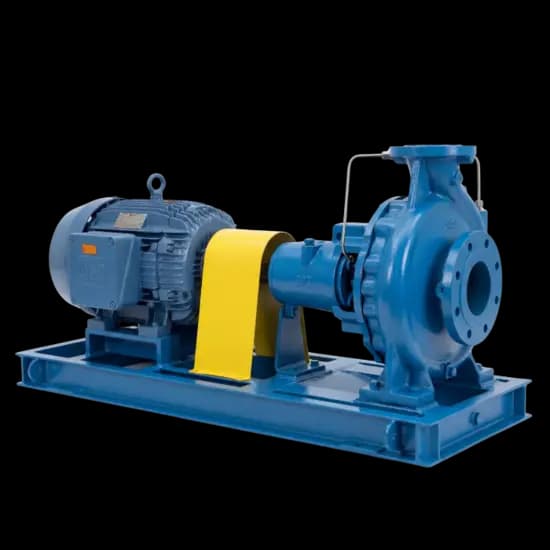
A normalized centrifugal pump follows standardized construction or dimensional requirements. Check the declared standard and scope for each unit. The FBCN manual describes mechanical construction to ASME B73.1; compatibility with an existing installation must be confirmed using both equipment drawings.
The FBCN manual describes back pull-out construction, allowing the bearing assembly to be removed from the volute without disconnecting the pumping piping. Service requires safety procedures, suitable access, inspection and reassembly according to the manual; duration depends on scope and actual conditions.
ASME B73.1 mechanical construction per manual
Back pull-out access to the rotating assembly
Model-specific curves and limits
Materials and sealing by application
What Does the Standard Standardize?
What ASME B73.1 fixes, what remains a design choice — and how to check
Fixed by the standard
Mounting dimensions: suction and discharge nozzle positions relative to the shaft, shaft height, baseplate bolt pattern and dimensions, flange size and class, shaft end. Pumps of the same designation occupy the same footprint in the plant.
Design choice (not fixed)
Q×H curve, efficiency, NPSHr, absorbed power, casing and impeller materials, sealing type (packing or mechanical seal), seal plan and speed. Two pumps of the same designation can perform differently.
How to check
Compare the dimensional drawing and data sheet of the installed pump with the FBCN ones: baseplate and nozzle dimensions, flanges, duty point and NPSH. These data support the evaluation; confirm reusable interfaces and required modifications with engineering before purchasing.
Back Pull-Out & Normalization
Technical advantages of dimensional standardization
Back Pull-Out
Rotating assembly removal from rear without disconnecting volute from piping. Maintenance duration depends on the service scope and installation conditions.
Interchangeability
Compare equipment drawings and baseplate, nozzle and drive dimensions. The FBCN manual declares the ASME B73.1 mechanical scope; replacement requires dimensional and hydraulic validation.
International Standard
Identify the standard, edition and scope required for purchase. Model and supply documentation must demonstrate compliance with specified requirements.
ASME B73.1 standard guideLife-cycle cost
Compare purchase, energy, parts, maintenance and installation at the same duty point. Savings depend on the actual data and conditions of each alternative.
Normalized vs. Non-Normalized
What changes in practice for those who run and maintain the plant
| Criteria | Normalized centrifugal pump | Non-normalized centrifugal pump |
|---|---|---|
| Pump replacement | Compare standard scope, drawings and duty point | Compare drawings, interfaces and duty point |
| Spare parts | Confirm codes and compatibility in the parts list | Confirm codes and availability with the manufacturer |
| Maintenance | Back pull-out: the rotating assembly comes out the back without touching the piping | Check the model maintenance procedure and access |
| Supplier selection | Declared requirements support technical comparison | Comparison uses drawings and performance data |
| Documentation | Drawing, curve and declared compliance scope | Drawing, curve and contractual requirements |
| When it makes sense | Industrial process, utilities, retrofit and public procurement | When another design better meets the specified duty |
How to Replace the Installed Pump
Six steps to evaluate an FBCN replacement
Read the nameplate
Record manufacturer, model and designation — e.g. 50-200 = DN 50 discharge nozzle, 200 mm nominal impeller —, speed and motor power.
Check the dimensions
Baseplate bolt spacing, shaft height, suction and discharge nozzle positions and flange class — compare with the FBCN dimensional drawing.
Establish the duty point
Actual flow and head (measured or from the system calculation), available NPSH and temperature. The new pump should run near the BEP of the FBCN curve.
Choose materials and sealing
Cast iron, carbon steel or stainless steel according to the fluid; packing or mechanical seal; seal plan where applicable.
Check motor and coupling
Reusing the motor requires the same power, speed and shaft height; otherwise specify the complete set on a common baseplate.
Send the data sheet
With this data, FB Bombas engineering confirms the equivalent FBCN model and replacement requirements and any necessary modifications.
FBCN Series Range — 54 Models
Operating envelope and construction of the FB Bombas normalized centrifugal pump
| Parameter | FBCN Series |
|---|---|
| Models | 54 — 43 with published dimensions (DN 25 to 150) and 11 with dimensions on request: the 100-500 and 10 large-capacity models (150-500 to 300-340) |
| Flow | up to 2,200 m³/h |
| Head | up to 135 m |
| Temperature | up to 260 °C |
| Speed | up to 3,500 rpm |
| Construction | Horizontal, end-suction, back pull-out, single-stage, closed impeller |
| Mounting dimensions | Check the model drawing |
| Materials | Cast iron, ductile iron, carbon steel and stainless steel, per fluid |
| Sealing | Packing or mechanical seal |
| Testing | Curve run on the test bench per ANSI/HI 14.6 |
How to Specify the Replacement
The data engineering needs to confirm equivalence
Designation & Drawing
Model and designation of the installed pump (e.g. 50-200) plus the dimensional drawing or a nameplate photo — this is what confirms equivalence.
Flow & Head
Actual flow rate (m³/h) and total head (m). Defines the operating point on the Q×H curve and the distance to BEP.
Fluid Type
Name, viscosity, density, solids concentration and chemical compatibility — decides casing and impeller materials.
Temperature
Operating and maximum temperature. Defines sealing materials and construction type — the FBCN runs up to 260 °C.
Available NPSH
Suction height, piping losses and reservoir pressure. Must exceed the NPSHr of the selected FBCN model.
Flanges, Baseplate & Motor
Flange class and face, baseplate dimensions, shaft height, coupling and existing motor data (power, speed, frame).
Frequently Asked Questions
What is a standardized centrifugal pump?
A normalized centrifugal pump follows standardized construction or dimensional requirements. Check the declared standard and scope for each unit. The FBCN manual describes mechanical construction to ASME B73.1; compatibility with an existing installation must be confirmed using both equipment drawings.
Are ANSI B73.1 and ASME B73.1 the same standard?
ANSI/ASME B73.1 identifies the standard published by ASME. Check the edition cited for the equipment and specification. The FBCN manual states mechanical construction to ASME B73.1; replacement feasibility depends on comparing the drawings and operating conditions.
What is back pull-out?
The FBCN manual describes back pull-out construction, allowing the bearing assembly to be removed from the volute without disconnecting the pumping piping. Service requires safety procedures, suitable access, inspection and reassembly according to the manual; duration depends on scope and actual conditions.
Is the FBCN a bearing-frame (long-coupled) or close-coupled pump?
The FBCN is a bearing-frame (long-coupled) centrifugal pump: the rotating assembly runs on its own bearing frame, coupled to the motor through a flexible coupling — the construction the FBCN manual describes as back pull-out, allowing removal of the bearing assembly without disconnecting the volute from the piping. It is the opposite of a close-coupled (monobloc) pump, where the impeller mounts directly on the motor shaft end. Bearing-frame construction eases maintenance, alignment and seal replacement in continuous industrial operation.
What certifications does FB Bombas hold?
Consult the certifications page for available documents and check their scope and validity. Technical manuals describe products and are not certificates. For a project with specific requirements, include the requested standards and test records in your enquiry; the quotation should identify the documents included in the supply.
What applications are standardized pumps suited for?
The FBCN manual lists clean or turbid liquids in chemical, petrochemical, pulp and paper, mining and water-treatment processes, among others. Selection depends on the liquid and operating conditions; consult FB for suspended solids.
What is the difference between a standardized and a non-standardized pump?
Standardization establishes requirements within its declared scope. To compare equipment, identify the applicable standard and check dimensions and performance. The term standardized alone does not establish pump equivalence or spare-parts compatibility.
What is the operating range of the FBCN series?
The manual gives general series limits of up to 2,200 m³/h, 135 m and 260 °C. These maxima are not simultaneous and do not apply to every configuration. Check the model curve and material, pressure, sealing and temperature limits.
Can I replace the standardized pump already installed with an FBCN?
FBCN can be evaluated as a replacement for the installed pump. Send its nameplate, dimensional drawing and operating conditions. Engineering checks dimensions, connections, performance curve, power, materials, sealing and suction conditions. The proposal identifies reusable components and required modifications.
What construction materials are available for the FBCN?
The manual presents cast-iron, A216 WCB carbon-steel and A743 CF8M stainless-steel casings. Confirm the available configuration with engineering. Selection must consider the liquid and operating conditions; allowable pressure requires checking the casing, flanges, sealing and temperature together.
What is the 0/100/150 % curve envelope and why does it matter?
The 0/100/150% points represent zero flow, rated flow and one-and-a-half times rated flow. For fire protection, request the proposed configuration's curve and test records, together with the project documentation requirements. The FBCN designation alone does not establish compliance or approval.
Does the FBCN have any high-capacity variant beyond the 43 standardized models?
Yes. The MTEC-03/00 manual includes 43 models with dimensional data and 11 with dimensions on request: 10 high-capacity models, from 150-500 to 300-340, and the 100-500. For these sizes, consult engineering for dimensions and configurations. Choosing between FBCN and other architectures depends on the installation requirements.
Is there a Brazilian manufacturer of normalized centrifugal pumps?
Yes. FB Bombas manufactures the FBCN series in Brazil. The manual describes back pull-out construction and provides selection data. Send the process conditions to confirm the model, configuration, documentation and commercial availability.
Companies that Trust FB Bombas
Supplying centrifugal pumps to industry since 1944









Need a normalized centrifugal pump?
FBCN can be evaluated as a replacement for the installed pump. Send its nameplate, dimensional drawing and operating conditions. Engineering checks dimensions, connections, performance curve, power, materials, sealing and suction conditions. The proposal identifies reusable components and required modifications.
Explore FBCN SeriesWhere this line is specified
Sector guides with the criteria for selecting the pump in each application.
Compare before you specify
Side-by-side guides with the criteria behind each choice.
- COMPARISON
FBCN vs FBOT — standardized centrifugal or thermal oil?
FBCN handles process liquids; FBOT was developed for organic thermal oil circulation. Fluid, sealing and duty point guide selection alongside temperature.
See comparison - COMPARISON
Brazilian-made or imported pump: cost and delivery
Compare proposals for an operation in Brazil using the same duty point, scope of supply and evaluation period. Origin, support and spare parts enter the decision through quoted data.
See comparison