

TECHNICAL GUIDE
Purpose and function of the
A jockey pump is the low-flow pump that keeps the fire-protection network pressurized within a preset range while there is no flow; the main pump handles fire fighting.
At a glance
- The jockey pump keeps the fire protection network pressurized within preset limits while there is no flow, replenishing allowable leakage; the main pump handles fire fighting.
- Under the Brazilian rules (São Paulo's IT 22 and NBR 13714), the jockey has a maximum flow of 20 L/min and a maximum pressure equal to the main pump shutoff.
- Between sequential pump starts, the Brazilian rules recommend about 100 kPa (10 m of water column, 1 bar); the NFPA 20 annex proposes at least 10 psi (0.69 bar) between jockey start and stop and 5 psi (0.34 bar) down to the main pump start.
- The jockey starts and stops through a pressure switch; the main pump only starts automatically and, under the Brazilian rules, stops only at its own controller.
- São Paulo's IT 22 requires a jockey on networks with more than six hydrant or hose outlets and waives it when the fire water tank is elevated.
Updated
Answers to guide your selection
Difference between jockey and main fire pump?
The main pump delivers the design fire-fighting flow and pressure; the jockey only keeps the network pressurized while there is no flow. NFPA 20 does not allow the primary or standby fire pump to be used as a jockey pump, except where the standard itself permits. Controls also differ: under the Brazilian rules (São Paulo's IT 22 and NBR 13714), the jockey starts and stops on its own through a pressure switch, while the main pump only starts automatically and, once running, stops only at its own controller in the pump room. Under NFPA 20, the jockey controller must be listed, though listing for fire pump service is not required.
Is a jockey pump required?
It depends on the rule that applies to the installation. São Paulo's IT 22 requires a jockey on hydrant or hose systems with more than six outlets and waives it when the fire water tank is elevated; NBR 13714 requires it when the network must be kept pressurized within a preset range. For pressure-actuated fire pumps, NFPA 20 requires a means to maintain system pressure: a jockey pump, a positive displacement water mist pumping unit or another approved means that is not the main fire pump. Without it, allowable leakage would drop the pressure to the main pump start setting. Removing the jockey is a decision for the responsible designer, with the local rule in hand.
At what pressure does a jockey pump start and stop?
Under the Brazilian rules (São Paulo's IT 22 and NBR 13714), the jockey's maximum operating pressure equals the main pump pressure at zero flow (shutoff), and about 100 kPa (10 m of water column, 1 bar) is recommended between sequential pump starts. The NFPA 20 annex proposes: jockey stop equal to the main pump churn (shutoff) pressure plus the minimum static suction pressure; jockey start at least 10 psi (0.69 bar) below the stop; main pump start 5 psi (0.34 bar) below the jockey start, plus 10 psi (0.69 bar) for each additional pump. Final pressures must not exceed the pressure rating of the components, and settings are confirmed on test gauges. The worked example, in psi and bar, is on the jockey pump application page.
How to Size
Technical criteria for correct specification
Flow Rate
Make up allowable leakage and normal drops, never below the normal leakage rate. On aboveground-only piping, the NFPA 20 annex calls for less flow than one sprinkler; the Brazilian rules set 20 L/min at most.
Pressure
The discharge maintains the desired system pressure. Under the Brazilian rules, the jockey maximum operating pressure is the main pump shutoff; also state the minimum and maximum suction pressures.
Construction
Centrifugal, as described by NBR 13714 and the NFPA 20 annex. If shutoff exceeds the working pressure of the components, or the pump is peripheral, NFPA 20 requires a relief valve on the discharge.
Motor and Controls
Listed controller, with no requirement to be listed for fire pump service, and its own sensing line; NFPA 20 does not require alternate power for the jockey. State voltage and panel.
What Is a Jockey Pump?
Function, sizing and importance in fire systems
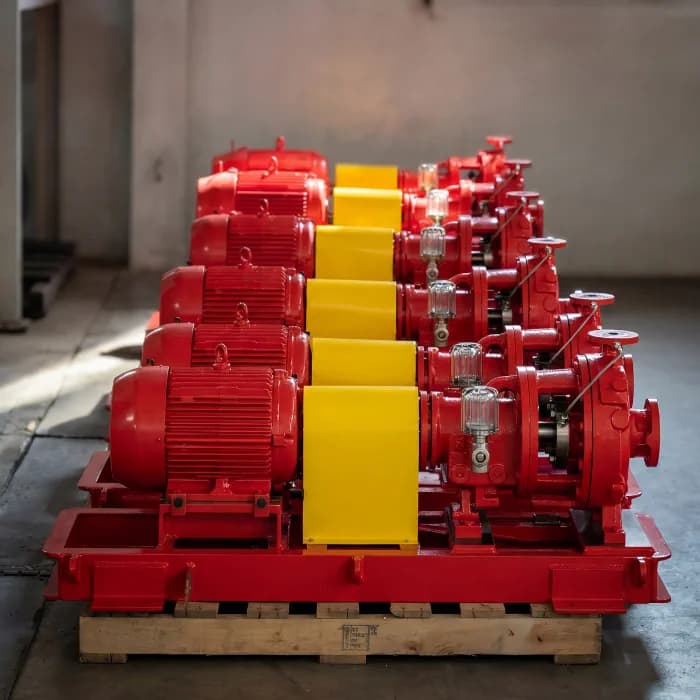
A jockey pump, or pressure maintenance pump, is the low-flow pump that keeps the fire protection network pressurized within preset limits while no water is flowing, replenishing allowable leakage and normal pressure drops. That is how NFPA 20 defines it, and the Brazilian standard NBR 13714 describes it as a centrifugal pump intended to keep the system pressurized within that range. It does not fight the fire: when a hydrant or sprinkler opens, pressure falls below the main pump start setting and the main fire pump starts.
That is why the jockey has its own pressure switch and works above the fire pump settings: it starts and stops on its own to make up small losses, and the main pump comes in only when the pressure drop exceeds what the jockey can replenish, as when a hydrant or sprinkler opens. The Brazilian rules cap the jockey at 20 L/min and set its maximum pressure at the main pump shutoff.
At FB Bombas, the jockey comes with every configuration of the FBFS fire pump package: electric, diesel and electric + diesel. Each package ships with its controller, pressure switches and pressure tank, and the pressure switch settings come from the network design.
Network pressurized while there is no flow
Make-up flow, up to 20 L/min under the Brazilian rules
Own pressure switch, above the main pump settings
Maximum pressure at the main pump shutoff
How Does a Jockey Pump Work?
Automatic pressure maintenance cycle
Pressure Drop
The network loses pressure through allowable leakage and normal drops. The jockey pressure switch follows this pressure through its own sensing line, connected between the discharge check valve and isolation valve.
Jockey Start
At the start setting, the jockey starts. The NFPA 20 annex proposes this setting at least 10 psi (0.69 bar) below the stop; the Brazilian rules recommend about 100 kPa (10 m of water column) between sequential starts.
Stop or Main Pump
The jockey stops at the stop setting, which the Brazilian rules cap at the main pump shutoff. If pressure keeps falling, as when a hydrant opens, the main pump starts at the next setting and stops only at its own controller.
The worked example of the settings, with shutoff, suction pressure and the sequence in psi and bar, is on the application page: Jockey pump in the fire system: pressure switch settings.
Jockey vs. Main Pump
Fundamental differences between the two devices
| Criteria | Jockey | Main Pump |
|---|---|---|
| Function | Keep the network pressurized with no flow | Fire fighting |
| Flow rate | Allowable leakage; up to 20 L/min under the Brazilian rules | Design fire demand |
| Pressure | Maximum equal to the main pump shutoff (Brazilian rules) | Fire duty point; shutoff up to 140% of rated head under NFPA 20 |
| Start and stop | Starts and stops through a pressure switch | Starts through a pressure switch; stops only at the controller (Brazilian rules) |
| Power | Alternate power not required by NFPA 20 | Electric or diesel, per the design |
Standards & Regulations
NFPA 20, NBR 16704, NBR 13714 and pressure switch settings
Defines the jockey as a pump that maintains pressure between preset limits with no flow and covers flow, relief valve, steel piping, sensing line and controller. The annex gives the setting sequence.
Confirm application of the Brazilian standard and local-authority installation requirements with the responsible professional.
Brazilian hydrant and hose standard: centrifugal pressure maintenance pump, 20 L/min maximum flow, maximum pressure equal to the main pump shutoff and a recommended differential of about 100 kPa between starts. São Paulo's IT 22 repeats these rules without specifying the pump type.
Pressure Switch Settings
Jockey stop at main pump churn plus minimum static suction, start at least 10 psi (0.69 bar) lower and main pump 5 psi (0.34 bar) below the jockey, per the NFPA 20 annex. Confirm on test gauges.
Frequently Asked Questions
What is a jockey pump?
A jockey pump, or pressure maintenance pump, is the low-flow pump that keeps the fire protection network pressurized within preset limits while no water is flowing, replenishing allowable leakage and normal pressure drops. That is how NFPA 20 defines it, and the Brazilian standard NBR 13714 describes it as a centrifugal pump intended to keep the system pressurized within that range. It does not fight the fire: when a hydrant or sprinkler opens, pressure falls below the main pump start setting and the main fire pump starts.
How to size a jockey pump?
By flow and by pressure. For flow, NFPA 20 requires capacity to replenish allowable leakage and normal pressure drops, never less than the normal leakage rate of the network. The annex explains that large underground mains are allowed some leakage and need a larger jockey; on aboveground-only sprinkler and standpipe piping, the jockey should deliver less flow than a single sprinkler, so that an open sprinkler makes the main pump start. One guideline in use is to make up the allowable leakage in 10 minutes, or 1 gpm (3.8 L/min), whichever is larger. In Brazil, São Paulo's IT 22 and NBR 13714 cap the jockey at 20 L/min. For pressure, the discharge must maintain the desired system pressure, and the Brazilian rules set the jockey's maximum operating pressure at the main pump shutoff. A fixed percentage of main-pump flow does not replace this calculation.
What is the difference between a jockey pump and a main fire pump?
The main pump delivers the design fire-fighting flow and pressure; the jockey only keeps the network pressurized while there is no flow. NFPA 20 does not allow the primary or standby fire pump to be used as a jockey pump, except where the standard itself permits. Controls also differ: under the Brazilian rules (São Paulo's IT 22 and NBR 13714), the jockey starts and stops on its own through a pressure switch, while the main pump only starts automatically and, once running, stops only at its own controller in the pump room. Under NFPA 20, the jockey controller must be listed, though listing for fire pump service is not required.
What standards govern the jockey pump?
NFPA 20 covers the jockey pump in the general chapter on fire pumps: definition, flow, pressure, relief valve, steel piping, sensing line and controller; the annex gives the setting sequence. NFPA 25 covers inspection, testing and maintenance. In Brazil, NBR 13714, for hydrant and hose systems, and IT 22 of the São Paulo Fire Department set a maximum flow of 20 L/min, a maximum pressure equal to the main pump shutoff and automation by pressure switches, and recommend about 100 kPa between starts. In other states, the local fire department rule applies, and the specification states the required edition.
Is a jockey pump required?
It depends on the rule that applies to the installation. São Paulo's IT 22 requires a jockey on hydrant or hose systems with more than six outlets and waives it when the fire water tank is elevated; NBR 13714 requires it when the network must be kept pressurized within a preset range. For pressure-actuated fire pumps, NFPA 20 requires a means to maintain system pressure: a jockey pump, a positive displacement water mist pumping unit or another approved means that is not the main fire pump. Without it, allowable leakage would drop the pressure to the main pump start setting. Removing the jockey is a decision for the responsible designer, with the local rule in hand.
Can the jockey pump be a centrifugal pump?
Yes, and it is the type the standards describe. NBR 13714 defines the pressure maintenance pump as a centrifugal pump, and the NFPA 20 annex considers a centrifugal type preferable. NFPA 20 also allows a turbine vane (peripheral) pump, but requires a relief valve on the discharge whenever the jockey is peripheral or when the centrifugal pump shutoff exceeds the working pressure rating of the components. Suction and discharge are steel pipe, with a check valve and isolation valve on the discharge, and the suction can come from the tank filling line, which allows the network to stay pressurized even with the tank empty for repairs. Model, material and motor come from the selection and the data sheet.
What does continuous jockey pump operation mean?
That the jockey cannot make up what the network is losing, or that pressure does not reach the stop setting. NFPA 20 sizes the jockey for allowable leakage and normal pressure drops; if it does not stop, the loss has exceeded that or the stop setting is above what the jockey reaches at zero flow. The symptom alone does not identify the cause: the maintenance team looks for the loss in the network, checks valves, pressure switches and the sensing line, and compares the settings with the design. The informative annex of NFPA 25 lists the jockey controller data that support this analysis: total starts and run time since the last reset, start and stop pressures and duration of the last run.
How much does a fire jockey pump cost?
It depends on the duty point and the scope. To get a quote, state the make-up flow (with the 20 L/min cap of the Brazilian rules, where they apply), the intended stop pressure and the main pump shutoff, the minimum and maximum suction pressures, the available voltage and whether the jockey ships loose or on the skid with the main pump. The FB Bombas proposal identifies the pump, motor, controller and accessories included and the installation responsibilities; in the electric and diesel FBFS configurations, the jockey is part of the fire pump package.
What is a jockey pump for?
It keeps the fire protection network pressurized without starting the main pump. The network loses some pressure through allowable leakage and normal pressure drops; the jockey starts when pressure falls to its start setting and stops when it reaches the stop setting. The network thus stays full and pressurized, and the main pump starts only when the drop is larger than the jockey can make up, as when a hydrant or sprinkler opens. The NFPA 20 annex recommends a jockey where a uniform or relatively high pressure is wanted on the fire protection system.
What is the jockey pump for in a fire system?
In the fire protection system, the jockey is the first of a sequence of pumps that start on pressure drop. It keeps the network between its stop setting, which the Brazilian rules cap at the main pump shutoff, and its start setting. If pressure keeps falling, the main pump starts at the next setting and the standby pump, where provided, at an even lower one; the Brazilian rules recommend about 100 kPa (10 m of water column, 1 bar) between these sequential starts. The jockey does not replace fire-fighting capacity: fire flow and pressure come from the main pump.
At what pressure does a jockey pump start and stop?
Under the Brazilian rules (São Paulo's IT 22 and NBR 13714), the jockey's maximum operating pressure equals the main pump pressure at zero flow (shutoff), and about 100 kPa (10 m of water column, 1 bar) is recommended between sequential pump starts. The NFPA 20 annex proposes: jockey stop equal to the main pump churn (shutoff) pressure plus the minimum static suction pressure; jockey start at least 10 psi (0.69 bar) below the stop; main pump start 5 psi (0.34 bar) below the jockey start, plus 10 psi (0.69 bar) for each additional pump. Final pressures must not exceed the pressure rating of the components, and settings are confirmed on test gauges. The worked example, in psi and bar, is on the jockey pump application page.
How does a jockey pump work?
Through pressure switches. The jockey pressure switch starts it when network pressure falls to the start setting and stops it at the stop setting; the main pump switch only starts it, at a lower setting. Under the Brazilian rules, the pressure switches sit on the automation manifold, wired to the controllers and motor starters of each pump, and the main pump, once running, stops only manually at its own controller in the pump room; opening any hydrant is enough for automatic starting. NFPA 20 requires an individual pressure sensing line for each controller, including the jockey's, connected between the discharge check valve and the discharge isolation valve of each pump.
Companies that Trust FB Bombas
Brazilian manufacturer since 1944 — fire protection systems for industry









Need a jockey pump?
Send the main pump curve and shutoff, the suction pressures, the intended stop pressure and the rule that applies to the installation (local fire code, NBR 13714 or NFPA 20). Our engineering team sizes the jockey pump and the complete system.
Where this line is specified
Sector guides with the criteria for selecting the pump in each application.
Compare before you specify
Side-by-side guides with the criteria behind each choice.
- COMPARISON
Electric or diesel fire pump?
Driver selection is part of the fire protection design. Assess energy sources, installation and requirements of the competent authority before specifying the assembly.
See comparison - COMPARISON
Brazilian-made or imported pump: cost and delivery
Compare proposals for an operation in Brazil using the same duty point, scope of supply and evaluation period. Origin, support and spare parts enter the decision through quoted data.
See comparison