

Types and when to use a
Understand the volumetric principle, compare pump types, and review viscosity, pressure and suction conditions before selecting equipment.

At a glance
- A positive displacement pump traps a volume of liquid and moves it with each shaft rotation; theoretical flow is proportional to speed, and delivered flow is lower because of internal slip.
- Compare positive displacement and centrifugal pumps at the same duty point: curve, power, suction conditions and liquid behavior.
- Among positive displacement pumps, rotary types use gears, lobes, vanes, screws or a flexible tube, and reciprocating pumps use a piston, plunger or diaphragm.
- At high viscosity, a centrifugal pump loses efficiency (about 80% on water and 50% at 1,000 SSU in the Hydraulic Institute example), while a positive displacement pump reduces slip.
- At FB Bombas, the FBE (external gear) runs from 1/8″ to 6″ (plus 10″ in the 2026 catalog), up to 22 kgf/cm² and from 30 to 100,000 SSU; the FBEI (internal gear) has independent maximums of 136 m³/h, 14 bar differential and 140,000 cP.
Updated
Answers to guide your selection
Difference between positive displacement and centrifugal?
A centrifugal pump is rotodynamic: the impeller imparts energy to the liquid, and flow settles where the pump curve crosses the system curve. A positive displacement pump moves a volume per rotation, and flow stays close to displacement times speed, minus slip, even as pressure varies; that is why it needs overpressure protection. With viscous liquids, a centrifugal pump loses head, flow and efficiency (in the Hydraulic Institute example, from about 80% on water to about 50% at 1,000 SSU), while in a positive displacement pump viscosity reduces slip. There is no fixed cP cutoff: compare both at the same duty point.
Is a gear pump positive displacement?
Yes. The gear pump, external or internal, is one of the rotary positive displacement pumps. The FBE runs from 1/8″ to 6″ in the models of manual MTEC-01/01 (p. 1), plus the 10″ in the 2026 FBE catalog (p. 6), with discharge pressure up to 22 kgf/cm² and viscosity from 30 to 100,000 SSU, limited by size (2026 FBE catalog, p. 3); under Table 2 of the manual, speed drops from 1,750 rpm with direct drive to as low as 150 rpm with a pulley or gear reducer, according to viscosity. The FBEI works on the gear-within-a-gear principle (2026 FBEI catalog, p. 2).
When to use a positive displacement pump?
When the liquid is viscous, when flow must follow speed even as pressure varies, or for metering. According to the Hydraulic Institute, a centrifugal pump loses head, flow and efficiency as viscosity increases, and its use may be limited when efficiency becomes unacceptable; in that case, a positive displacement pump may offer a better solution. There is no fixed cP cutoff: compare both at the same flow, pressure, viscosity and temperature. For the positive displacement pump, also check power and net positive inlet pressure required (NPIPR), which rise with viscosity, and overpressure protection.
What Is a Positive Displacement Pump?
Technical definition and volumetric principle
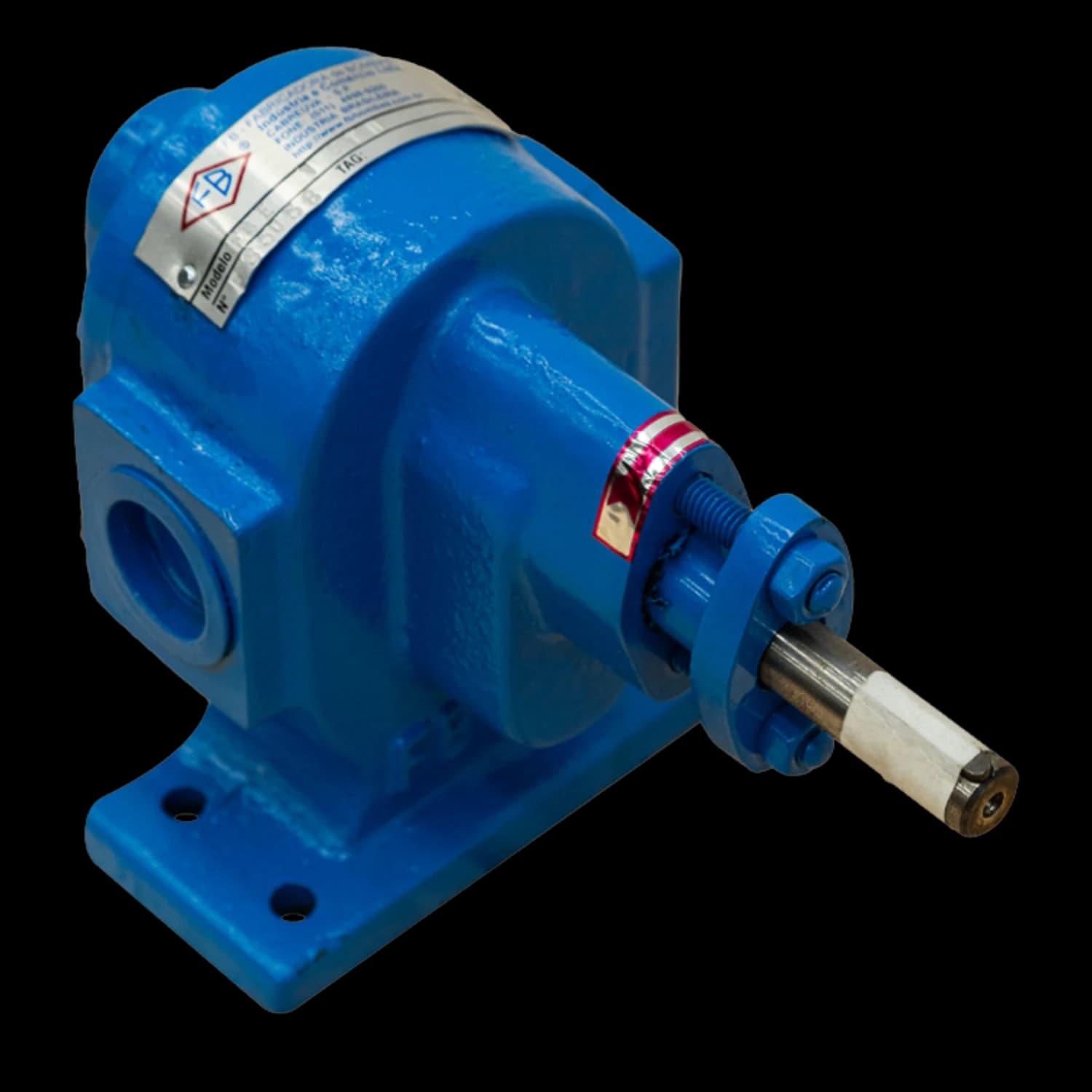
A positive displacement pump traps a volume of liquid and moves it from suction to discharge with each shaft rotation. It is one of the two pump classes defined by the Hydraulic Institute; the other, the rotodynamic class, imparts energy to the liquid through an impeller, as in a centrifugal pump. Theoretical flow is proportional to speed, and delivered flow is lower because of slip, the internal leakage through clearances, which varies with pressure and decreases as viscosity rises. Gear, screw, lobe, vane, piston, plunger and diaphragm pumps are examples.
At FB Bombas, both positive displacement series are rotary gear pumps manufactured in Cabreúva, São Paulo. The FBE external gear pump runs from 1/8″ to 6″ in the models of manual MTEC-01/01 (p. 1), plus the 10″ in the 2026 FBE catalog (p. 6), with discharge pressure up to 22 kgf/cm², viscosity from 30 to 100,000 SSU and a maximum speed of 1,750 rpm (2026 FBE catalog, p. 3). The FBEI internal gear pump, driven by a gear reducer in the standard series, is published with independent maximums of 136 m³/h, 14 bar differential, 140,000 cP and 340 °C (2026 FBEI catalog, p. 4). For selection, provide flow, differential pressure, viscosity and temperature at start-up and in operation.
Volume displaced with each shaft rotation
Theoretical flow proportional to speed
Less slip at higher viscosity
Internal relief valve as an accessory
How Does It Work?
Capture, transfer and volumetric discharge cycle
Capture
The mechanism opens spaces that receive liquid at suction. Filling depends on the supply and liquid conditions.
Transfer
Liquid travels through the mechanism in successive volumes. Internal clearances allow volumetric leakage, which is reflected in actual performance.
Discharge
Discharge delivers liquid to the system. Confirm flow and power at working pressure and include overpressure protection.
Positive Displacement Pump Types
Classification by transfer mechanism
External Gear
FBETwo gears, the driving and the driven gear, turn inside the casing; the liquid is carried, confined, in the cavities between the teeth and the casing, and the meshing prevents return to suction (2026 FBE catalog, p. 2). Heating chamber from 1.1/2″ to 6″.
See FBE seriesInternal Gear
FBEIInternal gear pumps may or may not have a crescent. In the FBEI, the pumping parts are the rotor with shaft and the internal gear (manual MAN001-10, p. 7), and the teeth form a seal between suction and discharge (2026 FBEI catalog, p. 2).
See FBEI seriesScrew
Rotary. Designs include the single-screw progressing cavity pump, the timed two-screw pump and the three-screw pump; the liquid advances along the axis, and allowable viscosity varies with the design.
Diaphragm
Reciprocating. Diaphragm movement changes the chamber volume; this family includes air-operated diaphragm (AOD) pumps and controlled-volume metering pumps. Diaphragm and wetted-part compatibility is part of selection.
Piston / Plunger
Reciprocating. The piston or plunger displaces liquid in the cylinder, in direct-acting or power pumps; according to the Hydraulic Institute, reciprocating power pumps typically handle up to 5,000 SSU.
Peristaltic
Rotary, flexible-tube type: progressive compression of the tube moves the liquid. Tube material, pressure, temperature and service life need specification.
Positive Displacement vs. Centrifugal
When to choose each pumping technology
| Criteria | Positive Displ. (FBE/FBEI) | Centrifugal (FBCN) |
|---|---|---|
| Principle | Fixed volume per cycle | Kinetic energy → pressure |
| Viscosity | Less slip, higher volumetric efficiency | Loses head, flow and efficiency (ANSI/HI 9.6.7) |
| Self-priming | Depends on design and installation | Depends on design and installation |
| Delivered flow | Displacement × speed, minus slip | Pump curve × system curve |
| Pulsation | Assess model and operation | Assess model and operation |
| Applications to assess | Oils, resins, asphalt, dosing | Water, solvents, high flow |
Industrial Applications
Sectors that use positive displacement daily
Asphalt / CAP / Bitumen
Temperature and start-up control
Industrial Oils
Lubricants, hydraulic, thermal
Adhesives and Waxes
Process viscosity and heating
Resins & Polymers
Viscosity and flow control
Paints & Varnishes
Compatibility and fluid sensitivity
Fuels
Diesel, kerosene, biodiesel
Viscous Chemicals
Heavy solvents, adhesives, waxes
Frequently Asked Questions
What is a positive displacement pump?
A positive displacement pump traps a volume of liquid and moves it from suction to discharge with each shaft rotation. It is one of the two pump classes defined by the Hydraulic Institute; the other, the rotodynamic class, imparts energy to the liquid through an impeller, as in a centrifugal pump. Theoretical flow is proportional to speed, and delivered flow is lower because of slip, the internal leakage through clearances, which varies with pressure and decreases as viscosity rises. Gear, screw, lobe, vane, piston, plunger and diaphragm pumps are examples.
What are the types of positive displacement pumps?
The Hydraulic Institute divides positive displacement pumps into two families. Rotary pumps move the liquid with rotating, meshing elements: external gear, internal gear (with or without a crescent), lobes, vanes, screws (the single-screw progressing cavity pump, two-screw and three-screw), flexible tube (peristaltic) and circumferential or axial piston. Reciprocating pumps use a piston, plunger or diaphragm and include air-operated diaphragm pumps and controlled-volume metering pumps. At FB Bombas, both series are rotary: the FBE external gear pump and the FBEI internal gear pump.
How does a positive displacement pump work?
The moving element opens a cavity at suction, the liquid fills it, and the closed cavity is carried to discharge. In an external gear pump such as the FBE, gear meshing creates a depression in the suction chamber, the liquid fills the cavities between the teeth and the casing and is carried, confined, to discharge, and the seal formed by the meshing prevents return to suction (2026 FBE catalog, p. 2). Because the pump keeps displacing with the discharge blocked, the design needs overpressure protection: the internal relief valve is an FBE and FBEI accessory in the 2026 catalogs, and FBEI manual MAN001-10 (p. 4) requires, on a pump without it, a system such as a line valve, pressure switch or torque limiter.
What is the difference between positive displacement and centrifugal pumps?
A centrifugal pump is rotodynamic: the impeller imparts energy to the liquid, and flow settles where the pump curve crosses the system curve. A positive displacement pump moves a volume per rotation, and flow stays close to displacement times speed, minus slip, even as pressure varies; that is why it needs overpressure protection. With viscous liquids, a centrifugal pump loses head, flow and efficiency (in the Hydraulic Institute example, from about 80% on water to about 50% at 1,000 SSU), while in a positive displacement pump viscosity reduces slip. There is no fixed cP cutoff: compare both at the same duty point.
What is a volumetric pump used for?
Volumetric pump is another name for a positive displacement pump; in common usage it also appears as displacement pump or positive pump. It is used to transfer viscous liquids such as oils, greases, asphalt, resins and molasses, which the 2026 FBE catalog lists among the series applications (p. 3), and for metering when the design and control allow. Metering accuracy does not come from the principle alone: it depends on speed, pressure, viscosity and slip, and must be specified.
What is a rotary positive displacement pump?
It is a positive displacement pump in which rotating elements carry the liquid from suction to discharge; it is also called a rotary volumetric pump. The Hydraulic Institute list, covered by ANSI/HI 3.1-3.5, includes external and internal gear, lobe, vane, screw, flexible tube (peristaltic) and circumferential or axial piston pumps. Theoretical capacity is proportional to speed, and flow and volumetric efficiency typically increase with viscosity. The FB Bombas FBE (external gear) and FBEI (internal gear) series are rotary pumps.
Is a gear pump a positive displacement pump?
Yes. The gear pump, external or internal, is one of the rotary positive displacement pumps. The FBE runs from 1/8″ to 6″ in the models of manual MTEC-01/01 (p. 1), plus the 10″ in the 2026 FBE catalog (p. 6), with discharge pressure up to 22 kgf/cm² and viscosity from 30 to 100,000 SSU, limited by size (2026 FBE catalog, p. 3); under Table 2 of the manual, speed drops from 1,750 rpm with direct drive to as low as 150 rpm with a pulley or gear reducer, according to viscosity. The FBEI works on the gear-within-a-gear principle (2026 FBEI catalog, p. 2).
When to use positive displacement instead of centrifugal?
When the liquid is viscous, when flow must follow speed even as pressure varies, or for metering. According to the Hydraulic Institute, a centrifugal pump loses head, flow and efficiency as viscosity increases, and its use may be limited when efficiency becomes unacceptable; in that case, a positive displacement pump may offer a better solution. There is no fixed cP cutoff: compare both at the same flow, pressure, viscosity and temperature. For the positive displacement pump, also check power and net positive inlet pressure required (NPIPR), which rise with viscosity, and overpressure protection.
Can a positive displacement pump handle food products?
Among FB’s positive displacement pumps, the series with food applications in the 2026 catalog is the FBE: milk, syrups, molasses, butters, jams, gelatin, glucose, BPF oil, vegetable oil, citrus, soft drinks, aromatic essential oils, ferments and yeast (2026 FBE catalog, p. 3). The catalog does not declare a sanitary standard. The casing (cast iron, ductile iron, carbon steel or CF8M stainless steel), bushings and sealing (packing, mechanical seal or lip seal) are defined by the product in the quotation; provide the product, the viscosity and the pumping temperature.
Companies that Trust FB Bombas
Brazilian manufacturer since 1944 — positive displacement pumps









Need a positive displacement pump?
Send us your process data and operating conditions. Our engineering team will select the ideal pump — external gear (FBE) or internal gear (FBEI) — for your application.
Where this line is specified
Sector guides with the criteria for selecting the pump in each application.
Compare before you specify
Side-by-side guides with the criteria behind each choice.
- COMPARISON
Which FB pump to use — decision by fluid and condition
Organize fluid, operating and installation data to compare FBCN, FBOT, FBE and FBEI. Each series is a starting point for the technical assessment of your application.
See comparison - COMPARISON
Brazilian-made or imported pump: cost and delivery
Compare proposals for an operation in Brazil using the same duty point, scope of supply and evaluation period. Origin, support and spare parts enter the decision through quoted data.
See comparison