

How it works: the
Complete technical guide on thermal oil pumps: operation up to 350 °C, industrial heating systems, material selection and how to specify for your process.

At a glance
- It is a pump for circulating heat-transfer oil in heating systems. At FB Bombas, the FBOT series uses centrifugal construction for organic thermal oils. Selection considers the fluid, start-up and operating temperatures, flow, head and suction conditions.
- The FBOT catalog lists up to 350 °C as a general series limit. This value alone does not approve an application: check the oil, configuration-specific pressure and temperature limits, sealing, materials and duty point. The technical proposal should identify the selected configuration.
- The FBOT catalog lists organic thermal-oil circulation in pharmaceutical, chemical, food, textile and plastics industries, as well as asphalt plants. The liquid must not contain abrasive particles or substances that attack the components. Provide its composition and circuit conditions for application assessment.
- The difference lies in the configuration selected for the duty. FBOT combines back pull-out construction, graphite packing and an oil-immersed mechanical seal, as described in its technical documents. The centrifugal principle alone is insufficient for comparison: check each pump's materials, sealing, pressure and temperature limits, and installation requirements.
- The catalog gives general limits of up to 2,200 m³/h and 135 m head. These maxima are not simultaneous and do not represent every model's performance. The individual curve, speed, impeller diameter, power and NPSH must be confirmed for the specified oil and duty point.
Updated
Answers to guide your selection
Why does a thermal oil pump need a special seal?
Manual MTEC-16/00 describes graphite packing in the first stage and an oil-immersed mechanical seal in the bearing housing. Its technical table lists 5.5 mm packing and Ø32 or Ø42 mm seals depending on the configuration. Use the equipment manual and parts list for maintenance; the series temperature limit does not define a universal inspection interval.
What is the FBOT Series temperature range?
The FBOT catalog lists up to 350 °C as a general series limit. This value alone does not approve an application: check the oil, configuration-specific pressure and temperature limits, sealing, materials and duty point. The technical proposal should identify the selected configuration.
Where are thermal oil pumps used?
The FBOT catalog lists organic thermal-oil circulation in pharmaceutical, chemical, food, textile and plastics industries, as well as asphalt plants. The liquid must not contain abrasive particles or substances that attack the components. Provide its composition and circuit conditions for application assessment.
Which pump should I use for hot oil at 300 °C?
FBOT is a series to assess for this duty, since its catalog lists up to 350 °C. For operation at 300 °C, specify the oil, flow, head, suction conditions and cold start. Selection must confirm the curve, configuration-specific pressure and temperature limits, sealing and materials; temperature alone does not define a design margin.
What Is a Thermal Oil Pump?
Centrifugal pump designed for high temperature in heating circuits
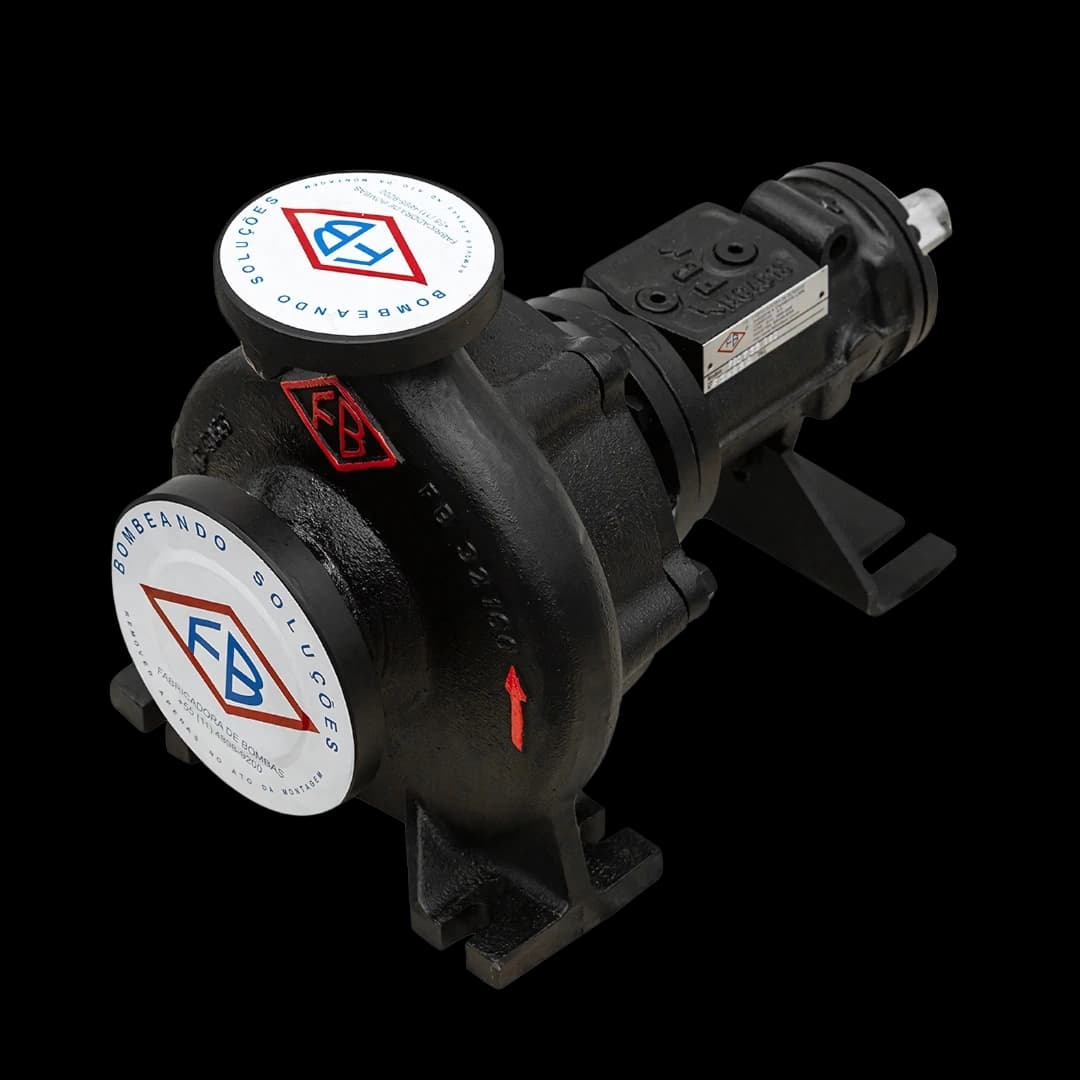
It is a pump for circulating heat-transfer oil in heating systems. At FB Bombas, the FBOT series uses centrifugal construction for organic thermal oils. Selection considers the fluid, start-up and operating temperatures, flow, head and suction conditions.
The difference lies in the configuration selected for the duty. FBOT combines back pull-out construction, graphite packing and an oil-immersed mechanical seal, as described in its technical documents. The centrifugal principle alone is insufficient for comparison: check each pump's materials, sealing, pressure and temperature limits, and installation requirements.
Organic thermal oils without abrasive particles
General series limits: 350 °C, 2,200 m³/h and 135 m, not simultaneous
Graphite packing and an oil-immersed mechanical seal
Back pull-out construction
How It Works in a Thermal Oil Circuit?
From the heater to the heat consumers — and the thermal barrier on the shaft
Closed Heating Loop
The circulation pump draws oil from the heater (gas, biomass or electric boiler) and delivers it to the heat consumers — exchangers, jacketed reactors, presses, dryers — from where it returns to the heater. Duty is continuous: plant availability depends on this pump.
Centrifugal Pumping at High Temperature
The impeller transfers energy to the oil and the casing directs the flow. Selection combines flow and head with viscosity, density and vapor pressure at start-up and operating temperatures. Use oil properties supplied by the fluid manufacturer.
Sealing and Bearings
The FBOT manual describes graphite packing and an oil-immersed mechanical seal. The housing uses two bearings, with lubrication arrangements identified in the manual. Lubrication and maintenance instructions must match the installed configuration.
Why 350 °C Changes the Selection
Viscosity, vapor pressure, expansion and density behave differently when hot
Viscosity Drops with Temperature
Provide oil viscosity at start-up and operating temperatures. Check the curve and power under both conditions; do not substitute water properties for the oil properties.
Vapor Pressure Rises
Available NPSH must be calculated at operating temperature, with the hot fluid's vapor pressure — never with cold-water data. Loop pressurization and the expansion tank are part of the calculation.
Thermal Expansion
The installation must accommodate expansion between start-up and operating conditions. Check alignment, supports and nozzle loads according to the design and manuals; back pull-out construction does not replace these checks.
Density and Power
Use density at pumping temperature to relate pressure and head and assess power. Selection also considers viscosity, efficiency, speed and duty point.
FBOT Thermal Oil Pump Advantages
Construction, sealing and selection for thermal circulation
Application temperature
The catalog presents FBOT for organic thermal oils, with a general 350 °C limit. The configuration is selected for the specified fluid, pressure, temperature and duty point.
Dual Safety Sealing
FBOT documents describe graphite packing and an oil-immersed mechanical seal. Confirm sealing dimensions and components against the equipment identification and documentation.
Two-Bearing Frame
The manual describes one oil-immersed bearing and one shielded, grease-lubricated bearing. Lubrication and inspections must follow the instructions for the installed configuration.
Back Pull-Out
Allows the bearing assembly to be removed without disconnecting the casing from the piping. Allow maintenance space and follow the equipment isolation, disassembly and reassembly procedures.
Materials Matched to the Fluid
Cast iron, carbon steel or stainless steel — the choice follows the thermal fluid, working temperature and contamination risk, not one material for everything.
Complete Pump Set
The manual lists an electric motor, flexible coupling, guard and U-shaped steel baseplate. Confirm included components, interfaces and installation requirements in the proposal.
Thermal Oil Pump Applications
Where indirect heating by thermal fluid is the process
Pharmaceutical industry
Chemical industry
Food industry
Textile industry
Plastics industry
Asphalt plants
In these applications, selection concerns the thermal oil circuit. Listing an industry does not establish suitability for directly pumping food, asphalt or another process product.
FBOT · Application and construction (Portuguese PDF, p. 2, 13.5 MB)Thermal Oil Pump vs. Standard Centrifugal
What changes in the pump when the fluid is at 350 °C
| Criteria | FBOT thermal oil pump | Standard centrifugal (water/process) |
|---|---|---|
| Design temperature | Up to 350 °C in continuous duty | Limited by elastomers and by the seal in contact with the fluid |
| Shaft sealing | Dual: graphite packing (1st stage) + oil-immersed mechanical seal in the bearing frame | Single mechanical seal in direct contact with the pumped fluid |
| Bearing frame | Two bearings: one oil-immersed, one shielded and grease-lubricated | Grease-lubricated bearings |
| Fluid | Organic thermal oils (mineral or synthetic), free of abrasive particles | Water and clean low-viscosity liquids |
| Materials | Cast iron, carbon steel or stainless steel per fluid and temperature | Cast iron or stainless steel per fluid |
| Governing selection criterion | Hot NPSH and temperature — oil vapor pressure rises with T | Q×H duty point and efficiency at BEP |
How to Specify a Thermal Oil Pump
The data engineering needs to select the right FBOT
Operating & Maximum Temperature
Provide normal, maximum and start-up temperatures. Confirm model, material and sealing limits for actual circuit conditions.
Thermal Fluid
Type (mineral or synthetic) and trade name, cold and hot viscosity, vapor pressure at operating temperature. No abrasive particles.
Flow & Head
Q×H duty point of the loop, with friction losses calculated for the hot fluid. The series covers DN 25 to DN 300, up to 2,200 m³/h and 135 m.
Hot Available NPSH
Expansion tank pressure, static head and suction losses at operating temperature. Prevents cavitation and flashing at the impeller.
Installation & Pump Set
Flanges, clearance for back pull-out, pump set with U-shaped baseplate and guarded coupling. Standby pump when the process cannot stop.
Operating Regime
Continuous 24/7 or batch, start/stop frequency, load variation and the redundancy the process requires.
Frequently Asked Questions
What is a thermal oil pump?
It is a pump for circulating heat-transfer oil in heating systems. At FB Bombas, the FBOT series uses centrifugal construction for organic thermal oils. Selection considers the fluid, start-up and operating temperatures, flow, head and suction conditions.
What is the maximum operating temperature of the FBOT pump?
The FBOT catalog lists up to 350 °C as a general series limit. This value alone does not approve an application: check the oil, configuration-specific pressure and temperature limits, sealing, materials and duty point. The technical proposal should identify the selected configuration.
What applications are thermal oil pumps used for?
The FBOT catalog lists organic thermal-oil circulation in pharmaceutical, chemical, food, textile and plastics industries, as well as asphalt plants. The liquid must not contain abrasive particles or substances that attack the components. Provide its composition and circuit conditions for application assessment.
What is the difference between a thermal oil pump and a standard centrifugal pump?
The difference lies in the configuration selected for the duty. FBOT combines back pull-out construction, graphite packing and an oil-immersed mechanical seal, as described in its technical documents. The centrifugal principle alone is insufficient for comparison: check each pump's materials, sealing, pressure and temperature limits, and installation requirements.
Can the FBOT be used in a closed-loop circuit?
FBOT can be assessed for thermal-oil circulation in a closed loop. Provide the heater, heat-user and expansion-tank arrangement, together with pressures, levels and temperatures. A closed loop does not eliminate friction losses or the need to check NPSH and suction pressure.
What is the flow rate range of the FBOT series?
The catalog gives general limits of up to 2,200 m³/h and 135 m head. These maxima are not simultaneous and do not represent every model's performance. The individual curve, speed, impeller diameter, power and NPSH must be confirmed for the specified oil and duty point.
Can I replace my current thermal oil pump with an FBOT?
Replacement depends on a technical comparison. Send the installed pump's nameplate, dimensional drawing, curve and operating conditions. Engineering checks connections, baseplate, drive, flow and head, suction, materials and sealing. The proposal should identify the FBOT configuration and required modifications; a similar model name or appearance does not prove equivalence.
How does the FBOT dual sealing system for thermal oil work?
Manual MTEC-16/00 describes graphite packing in the first stage and an oil-immersed mechanical seal in the bearing housing. Its technical table lists 5.5 mm packing and Ø32 or Ø42 mm seals depending on the configuration. Use the equipment manual and parts list for maintenance; the series temperature limit does not define a universal inspection interval.
What should I check on an FBOT model with the .1 suffix?
Use the complete nameplate code when checking the data sheet or requesting parts or a replacement. The suffix identifies a cataloged variant, but does not establish suitability for a nitrogen-pressurized circuit. Confirm the drawing, components, suction pressure and other configuration limits with FB engineering.
Can the FBOT be coupled to a steam turbine in addition to an electric motor?
Manual MTEC-16/00 lists an electric motor among the drive accessories. For a steam turbine or another drive, send the requirements to engineering for a specific assessment. Back pull-out construction does not establish compatibility: speed, power, torque, coupling and start-up conditions must be confirmed.
Which pump should I use for hot oil at 300 °C?
FBOT is a series to assess for this duty, since its catalog lists up to 350 °C. For operation at 300 °C, specify the oil, flow, head, suction conditions and cold start. Selection must confirm the curve, configuration-specific pressure and temperature limits, sealing and materials; temperature alone does not define a design margin.
Companies that Trust FB Bombas
Supplying pumps for industrial heating since 1944









Need a thermal oil pump?
Send us your heating system data. Our engineering team will size the ideal FBOT for your operating temperature and flow rate.
Where this line is specified
Sector guides with the criteria for selecting the pump in each application.
Compare before you specify
Side-by-side guides with the criteria behind each choice.
- COMPARISON
FBCN vs FBOT — standardized centrifugal or thermal oil?
FBCN handles process liquids; FBOT was developed for organic thermal oil circulation. Fluid, sealing and duty point guide selection alongside temperature.
See comparison - COMPARISON
Which FB pump to use — decision by fluid and condition
Organize fluid, operating and installation data to compare FBCN, FBOT, FBE and FBEI. Each series is a starting point for the technical assessment of your application.
See comparison