


FB Bombas Engineering Team7 min read
FBOT circulates organic thermal oils with back pull-out construction, graphite packing and a mechanical seal, without external cooling. Selection combines oil properties, startup and operating temperatures, flow, pressure and suction conditions.
Read the complete answer
For thermal-oil circulation, select the pump using fluid properties, startup and duty temperatures, flow, pressure and suction conditions. FBOT is the FB Bombas range for organic thermal oils; its catalogue publishes up to 350 °C, back pull-out construction and graphite packing plus mechanical sealing, without external cooling for the described duty. Confirm each configuration’s limits.
FB Bombas pump for this application
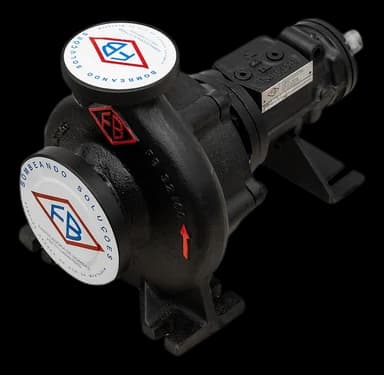
Circulating thermal oil?
The FBOT is the FB Bombas centrifugal pump for thermal oil, used for circulation in industrial heating.
Source: manual FBOT MTEC-16/00
At a glance
- FBOT thermal oil pump operates continuously up to 350 °C in closed-loop industrial heating circuits.
- The catalogue describes graphite packing and mechanical sealing without external cooling in the stated duty.
- Use product data for viscosity, density and vapour pressure over the temperature range.
- Confirm material and pressure against the configuration’s curve; do not choose casing by temperature cutoff alone.
- The proposal should record configuration, limits and documentation of the assembly selected for the circuit.
Mechanical seal, bearing-housing thermal barrier, materials and mistakes that compromise service life.
1. What is an industrial thermal oil system
A thermal-oil system circulates heat-transfer fluid between the heater and process users. Design temperature and pressure depend on the product, operating phase and circuit. Use the fluid datasheet for vapour pressure, viscosity, density and temperature limits; do not assume 6–10 bar for every system.
The FBOT catalogue lists pharmaceutical, chemical, food, textile and plastics industries, plus asphalt plants. Selection concerns thermal-oil circulation: naming a sector does not approve pumping its other products directly. The liquid must not contain abrasive particles or chemically attack components.
2. The three unique technical challenges of thermal oil pumping
Compared to a conventional process centrifugal pump for water or moderate chemicals, a thermal oil pump faces three distinct and cumulative physical problems. Ignoring any of them causes premature failure and unplanned downtime — the kind of problem a thermal oil boiler should never have, because it feeds the entire production process.
The first issue is shaft sealing. Face and secondary-seal materials, local temperature and auxiliary fluids must match the specified arrangement. There is no single 200 °C limit for all mechanical seals or universal external-water requirement: check assembly design and manual.
The second challenge is differential thermal expansion. A pump operating at 350 °C has its components expanded relative to cold assembly — the impeller grows, the shaft grows, the casing grows. If the design does not compensate for this expansion, internal clearances go out of spec or the pump itself misaligns with the motor and coupling.
This causes vibration, accelerated bearing wear and seal rupture.
The third issue is bearing support and lubrication. Process temperature is not automatically bearing temperature. Check the specified lubricant, level, intervals and local limits in the configuration’s manual; do not substitute synthetic oil merely because the pump handles hot duty.
Warning
Adapting an existing pump requires renewed checks of thermal limits, pressure, materials, sealing and alignment. Range name or appearance does not prove suitability or determine a failure interval.
3. How the FBOT solves the three challenges
The FBOT catalogue describes a range for high-temperature organic thermal oils without external cooling in the described duty. The published range limit is 350 °C. Duty approval combines that envelope with the curve, material, pressure and fluid properties.
Graphite packing and a mechanical seal appear in both the current catalogue and MTEC-16/00. They describe the seal-bath fluid differently; confirm the arrangement in the supplied equipment’s drawing and manual, including any filling procedure.
Clearances and alignment must follow the configuration’s drawing and procedure for assembly and heating. Do not treat an apparently tight clearance as proof of correct adjustment. Commissioning must verify the intended condition after thermal stabilisation.
Bearing lubrication, filling and maintenance must follow assembly documentation. Back pull-out construction allows removal of the bearing assembly without disconnecting the casing from piping. Confirm withdrawal space and maintenance access in the layout.
4. Selection by thermal fluid
The universe of organic thermal fluids is more diverse than many realize. The most common brands in the Brazilian industrial market include families of mineral and synthetic hydrocarbons with different maximum operating temperature ranges, viscosities, densities and chemical compatibilities. FBOT pump selection must consider which specific fluid will be used, because each family has characteristics that affect pumping.
- Mineral oils: obtain the exact product datasheet with viscosity, vapour pressure and design-temperature limits.
- Synthetic aromatic fluids: confirm product, operating phase, vapour pressure and supplier-approved maximum temperature.
- Other organic synthetics: check properties by temperature; chemical family does not replace the datasheet.
- Other fluid bases, such as silicone: confirm compatibility and supply scope before applying the FBOT envelope.
5. Five common sizing pitfalls
Check these points before selecting or replacing the circuit pump:
- Using only duty viscosity: also check minimum startup temperature and power required in that condition.
- Omitting vapour pressure: use product data at the highest evaluated temperature in suction calculations.
- Choosing pipe size by a fixed rule: calculate suction losses using flow, viscosity, internal diameter and fittings.
- Ignoring circuit level and pressure: assess the lowest available absolute inlet-pressure condition.
- Replacing sealing components without checking configuration: validate materials, assembly and auxiliaries against manual and drawing.
6. Casing material: cast iron or carbon steel?
Casing selection requires matching material, temperature and pressure to the configuration’s applicable curve. The reviewed sources do not support declaring cast iron always suitable up to 260 °C/10 bar or carbon steel mandatory above them. Confirm the complete specification before selecting or replacing a pump.
Chemical compatibility depends on the actual liquid and its condition. Report contamination, degradation products and particles when known. The FBOT catalogue requires liquid without abrasives or substances attacking components; the oil’s trade name does not replace that check.
7. Specification checklist: what to send FB Bombas engineering
When you contact FB Bombas engineering to size an FBOT pump, the information below allows a precise technical response after technical project review. The more data, the better the sizing — but even with partial information, our team can make preliminary recommendations.
- Commercial brand and family of thermal fluid (e.g. Therminol 66, Mobiltherm 603, Dowtherm A). If unknown, specify type: mineral or synthetic, aromatic or alkylbenzene.
- Maximum process operating temperature and minimum start temperature (cold start regime).
- Desired flow (m³/h) and circuit head (can be estimated by summing consumer losses).
- Installation layout: relative elevation between pump and expansion tank, suction and discharge piping diameter, number of parallel consumers.
- Operating regime: continuous 24/7, shifts, or intermittent with frequent stops (important for material selection).
- Circuit working pressure and maximum allowable discharge flange pressure.
8. Conclusion
To assess FBOT, collect the fluid datasheet, startup and operating conditions, system curve and installation data. Confirm configuration, thermal and pressure limits, sealing and documentation in the proposal. For replacement, include the existing pump’s nameplate, model and operating records.
From the selection chart to the FBOT model curve
Start with the FBOT selection charts at 1,750 and 3,500 rpm, at 60 Hz, to locate the range of interest. Then check the model data and the curve for the duty point. Specify the required flow and head together: the range maxima are not achieved simultaneously by one model or duty point.
FBOT circulates organic thermal oil without abrasive particles or constituents that chemically attack the pump. In food processing and asphalt plants, this application is the oil circuit that carries heat. Selecting a pump to transfer food or asphalt is a separate step: identify the fluid actually entering the suction before comparing pump families.