

What it is and how to size a
What a booster pump is, how to size it by flow and total head, industrial water transfer with the FBCN, and how it differs from the fire system pumper connection.

At a glance
- A bomba de recalque (transfer pump) lifts water from a lower to an upper reservoir through the discharge (recalque) line that starts at the pump outlet; in a building, from the cistern to the rooftop tank.
- The fire system's dispositivo de recalque is not a pump: under NBR 13714, it is the connection through which the fire department pumps water into the system from its truck.
- Flow is the volume to transfer divided by the pumping time; total head adds the static head between the levels and the friction losses, which grow with flow (Hydraulic Institute).
- Standby capacity and alternation must meet the supply continuity required by the design, with coordinated controls and maintenance.
- At FB, building and industrial water transfer is served by the FBCN Series, with series limits of 2,200 m³/h and 135 m that do not apply at the same time; the size comes from the duty point and the NPSH.
- The transfer (recalque) pump fills the rooftop tank and is controlled by level. The booster (pressure set) raises the pressure in the supply network and is controlled by pressure or by a variable frequency drive. The jockey pump maintains fire-network pressure between preset limits while no water is flowing and is sized to replenish allowable leakage and normal pressure drops (NFPA 20). Function, controls and network are not interchangeable: select by service, not by pump name.
Updated
Answers to guide your selection
What does "recalque" mean on a pump?
In Brazilian Portuguese, recalque is the pump discharge side: water leaves through the discharge (recalque) flange or nozzle and follows the discharge line to its destination. The opposite side is the suction, where water enters. The term appears in technical documents: in the FBCN Series designation, such as FBCN 150-400, the first number is the nominal diameter of the discharge flange, in mm, and the second is that of the impeller (manual MTEC-03/00, p. 1). In fire protection, NBR 13714 uses recalque for the fire department sending water into the system through the fire department connection (3.6).
Which pump for building water transfer duty?
The classic configuration is a horizontal-shaft centrifugal pump for water; at FB, the FBCN Series, designed for clean or turbid liquids (manual MTEC-03/00, p. 1). The 2,200 m³/h and 135 m limits belong to the series, not to each size, and do not apply at the same time. The size comes from the (Q, H) point and the NPSH available, respecting the minimum flow of each size in Table 1 of the manual: 0.1 or 0.15 Qot (the optimum flow), depending on the bearing frame.
Is the fire department connection the same as a transfer pump?
No. Under NBR 13714, the dispositivo de recalque (fire department connection) is the device used by the fire department to pump water into the hydrant system (3.6): an extension of the main pipe, DN50 to DN100, with couplings compatible with those of the local fire department, at the sidewalk, on the facade or on the boundary wall (4.2.1 to 4.2.4). It has no motor or impeller; the fire truck does the pumping. The building transfer pump moves water between reservoirs, and the fire system pump is the main fire pump, with the jockey pump.
What Is a Booster Pump?
Definition, the double meaning of the term and where each applies
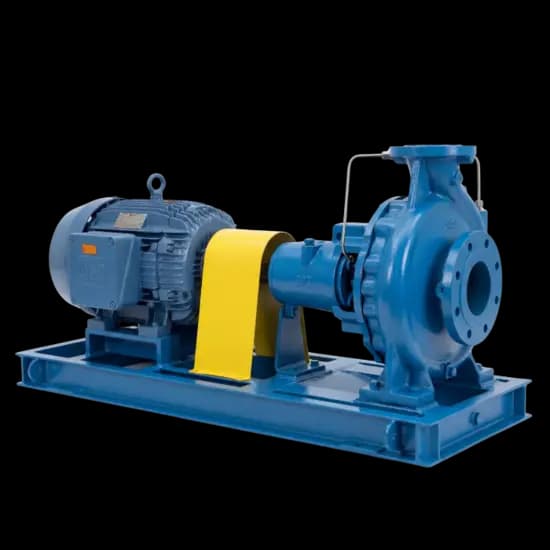
A booster (transfer) pump moves water from a lower level to a higher level — in the typical building installation, from the cistern (lower tank) to the rooftop tank. In Brazilian practice the discharge piping after the pump is called the "recalque" line, as opposed to the suction line before it. In most buildings it is a horizontal centrifugal pump, operating in automatic cycles commanded by level switches.
Mind the double meaning: in the fire-fighting system there is the Brazilian "registro de recalque" — the sidewalk fire department connection through which the fire truck injects water into the hydrant network. Despite the name, it is not a pump. Whoever is looking for the fire system pump actually needs the main fire pump and the jockey pump, governed by NBR 16704 and NFPA 20.
Transfers water from the cistern to the rooftop tank
Horizontal centrifugal — FBCN series for clean water
Automatic start by level switches (float)
Alternating standby, when the design requires it
Industrial Transfer: Intake, Lift Stations and Tank Transfer
When water transfer is an industrial duty, and what FB supplies for it
Lifting water to the tank of a house or small building calls for an off-the-shelf domestic pump from a retailer. FB Bombas manufactures industrial pumps: the transfer duty it serves is water in industry and sanitation, such as river or well intake, lift stations and tank-to-tank transfer.
For this duty, FB supplies the FBCN standardized centrifugal pump, driven by an electric motor or a diesel engine (manual MTEC-03/00, accessories). Pre-selection by flow and head starts from the FBCN series Q×H matrix and the published curves: 1,750 rpm (PDF, Portuguese) and 3,500 rpm (PDF, Portuguese). Engineering confirms the model on the curve, with the available NPSH at the suction.
How to Size It
The four data points that define the correct booster pump
Design flow
Flow is the volume to transfer divided by the pumping time set by the design, in consistent units: 30 m³ in 3 h gives 10 m³/h. Also report demand variations, which the pumping time must absorb.
Total head
Add the static head (the height difference between the water surface in the cistern and the arrival point in the tank, plus the pressure difference between them) to the friction losses in the piping, fittings and valves. Per the Hydraulic Institute, losses typically vary with the square of velocity, which is why the system curve rises with flow.
Available NPSH
Suction must deliver enough pressure so the pump does not cavitate — deep cisterns or long suction lines require NPSH verification before purchase.
Alternating standby
The need for standby capacity depends on required supply continuity and design requirements. Where duty and standby pumps are provided, sizing, alternation, controls and maintenance must be coordinated. Confirm the configuration with the responsible professional before purchasing the package.
Booster vs. Pressure System vs. Jockey
Three building pumps with similar names and different functions
| Criteria | Booster | Pressure set | Jockey |
|---|---|---|---|
| Function | Fill the rooftop tank | Keep pressure in the consumption network | Keep pressure in the FIRE network |
| Control | Level switches (float) | Pressure switch or VFD | Pressure switches with NFPA 20 setpoints |
| Duty | Long cycles, few times a day | Frequent, follows consumption | Short cycles, compensates micro-leaks |
| Reference standard | Building hydraulic design | Building hydraulic design | NBR 16704 / NFPA 20 |
Frequently Asked Questions
What is a bomba de recalque (transfer pump)?
A bomba de recalque is the pump that lifts water from a lower reservoir to an upper reservoir or a higher point of use, through the discharge (recalque) line that starts at the pump outlet. In a building, it moves water from the cistern to the rooftop tank. To do so, it overcomes the height difference between the water surfaces and the piping losses; in industry, the same duty appears in water transfer between tanks.
How to size a building transfer (recalque) pump?
Start from two numbers. Flow is the volume to transfer divided by the pumping time set by the design. Per the Hydraulic Institute, total head adds the static head (the height difference between the free surfaces of the cistern and the tank, plus the pressure difference between them) and the friction losses in the piping and components, which grow with flow. With the (Q, H) point, check the model curve for power and for the NPSH required against the NPSH available; the design defines controls and redundancy.
Suction and discharge (recalque): what is the difference, and what is discharge height?
Suction is the section from the source reservoir to the pump inlet; discharge (recalque) is the section from the pump outlet to the destination. Splitting at the pump shaft the height difference between the levels, which, with open reservoirs, is the Hydraulic Institute's static head, gives the static suction height (from the water level to the shaft) and the static discharge height (from the shaft to the discharge point); the losses of each section add to them in the total head. With the shaft below the water level, suction is positive; above it, suction is negative, as São Paulo's IT 22 classifies fire pumps (C.1.12), and the NPSH available decreases.
What is a booster pump?
A booster pump is installed in series in a line to raise the pressure of the water that already reaches it, not to fill a reservoir; per the Hydraulic Institute, pumps in series add head at the same flow. Its purpose is to pressurize a building supply network or an industrial line, and it is controlled by network pressure, not by level; the Hydraulic Institute gives the example of a booster fitted with a variable frequency drive for fluctuating flow. The transfer (recalque) pump, controlled by level, fills the rooftop tank. The same centrifugal family can serve both duties, with a duty point and controls specified for each. Because a booster receives water under pressure, check the suction limit: 10 bar on the FBCN Series (manual MTEC-03/00, Table 1).
Does a transfer pump need a standby unit?
The need for standby capacity depends on required supply continuity and design requirements. Where duty and standby pumps are provided, sizing, alternation, controls and maintenance must be coordinated. Confirm the configuration with the responsible professional before purchasing the package.
Why does my transfer pump start and stop all the time?
Very frequent starts require installation assessment. Check reservoir levels, sensors, controls, valves, demand and pump suitability for the duty. In a pressurized network, include pressure-control devices. The symptom alone does not identify the cause; record conditions and consult maintenance.
Does FB Bombas serve industrial transfer beyond buildings?
Yes. The FBCN Series was designed for clean or turbid liquids in applications such as the chemical, petrochemical, paper, pulp, steel, mining, food, textile, pharmaceutical and sanitation industries (manual MTEC-03/00, p. 1). The series limits, 2,200 m³/h and 135 m, do not apply at the same time; size, materials and sealing (packing or mechanical seal) are defined in the inquiry. For viscous liquids, the choice moves to the FBE and FBEI gear pump series; for thermal oil, to the FBOT.
What is the difference between a transfer pump, a pressurizer and a jockey pump?
The transfer (recalque) pump fills the rooftop tank and is controlled by level. The booster (pressure set) raises the pressure in the supply network and is controlled by pressure or by a variable frequency drive. The jockey pump maintains fire-network pressure between preset limits while no water is flowing and is sized to replenish allowable leakage and normal pressure drops (NFPA 20). Function, controls and network are not interchangeable: select by service, not by pump name.
Need a booster pump?
Send the liquid and temperature, flow, total head (or the levels and the piping layout), suction condition and duty, building or industrial. FB engineering selects the FBCN size and the package, with alternating standby when the design requires it.
Related Content
Centrifugal Pump: Technical Guide
The principle behind the booster pump
NFPA 20 Jockey Pump
The fire system pressure-maintenance pump
Building & HVAC: Applications
Building pressurization, transfer and condensing duty
FBCN Series — Standardized Centrifugal
54 clean-water models up to 2,200 m³/h
Pump Not Priming: Causes and Solutions
Step-by-step priming and suction troubleshooting
Pump Losing Pressure: Diagnosis
The causes of pressure loss in transfer duty
NBR 13714: Hydrants and Hose Stations
The fire department connection of the hydrant system
Head Loss Calculator
Friction losses in the discharge line