

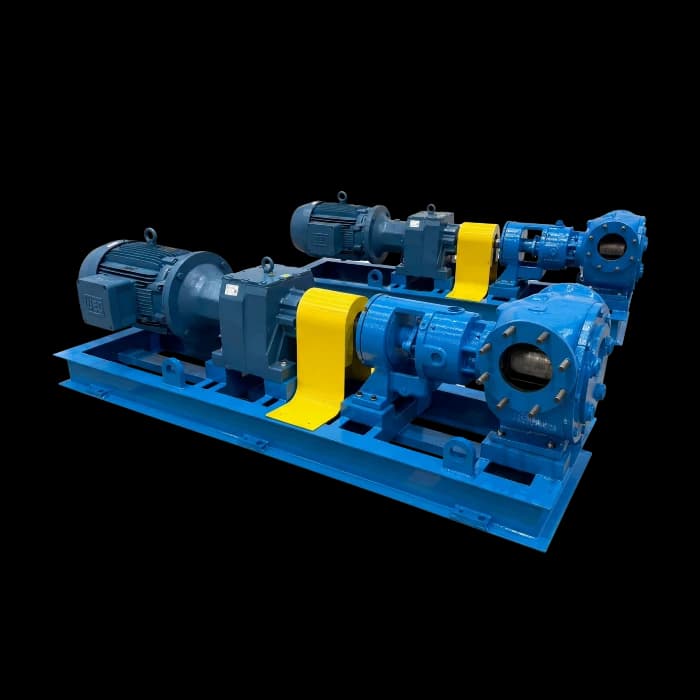
An overheating pump has a hydraulic or a mechanical cause. The hydraulic causes are (1) running with the discharge blocked or below minimum flow — the motor's energy turns into heat in the liquid trapped in the casing — and (2) internal recirculation through worn clearances. The mechanical causes are (3) wrong bearing lubrication, (4) pump-motor misalignment, (5) over-tightened packing and (6) a mechanical seal outside its sealing conditions. The limits come from each series' manual: the FBCN has a minimum flow of 0.1 or 0.15 Qopt, depending on size; on the FBEI, the bearing may reach 50 °C above ambient, as long as the total stays at or below 90 °C. If the temperature keeps rising after start-up, stop, check flow, lubrication and alignment, and only then run again.
At a glance
- Pump overheating has six causes: two hydraulic (blocked discharge and internal recirculation) and four mechanical (bearing lubrication, alignment, packing and seal).
- At zero flow, heat builds at a rate of power ÷ (mass × specific heat): 8 kW into 15 kg of water gives about 7.6 °C per minute, ignoring losses.
- The FBCN centrifugal pump has a minimum flow of 0.1 or 0.15 Qopt, depending on size; on a gear pump, the discharge is never closed with the pump running.
- On the FBEI, the bearing may reach 50 °C above ambient without exceeding 90 °C, and the reference alignment is under 0.05 mm radial and 0.6° angular.
- Packing must drip: tighten about 1/6 of a turn at a time and watch the first 5 to 8 hours; tightening until the leak stops heats the shaft.
1. Shutoff operation: the most dangerous heating
Shutoff operation means running the pump with discharge valve fully closed — zero flow. In an FBCN centrifugal pump, this may happen intentionally (during startup procedure, moments before opening discharge) or accidentally (block valve mistakenly closed, check valve stuck, automatic flow control at unfeasible point). The danger is that the motor keeps delivering energy to the impeller, but as there is no useful flow, all that energy is dissipated as heat in the liquid trapped inside the casing.
The heating rate comes from an energy balance: rate ≈ absorbed power at zero flow ÷ (mass of liquid in the casing × specific heat). An order-of-magnitude example, ignoring heat loss to the surroundings: if the curve shows 8 kW at zero flow and the casing holds 15 kg of water (4.19 kJ/kg·K), the rate is 8 ÷ (15 × 4.19) ≈ 0.13 K/s, about 7.6 °C per minute. The number changes from pump to pump; the method does not.
That is why the FBCN manual sets a minimum flow — 0.1 or 0.15 Qopt, depending on size, where Qopt is the best-efficiency flow — and, when the process can close the discharge, the design needs a return line that guarantees that flow.
Internal recirculation is a chronic partial shutoff: part of the liquid returns from discharge to suction inside the pump, through the clearances between impeller and wear rings, without leaving through the nozzle. The thermal effect is the same, on a smaller scale — the pump heats up while running apparently normally. The measured symptom is flow and pressure below the curve at the same speed, with equal or higher power.
Confirm it by comparing the measured point with the supply's test curve and, on disassembly, measure the clearances and compare them with the build dimensions to decide whether to replace the rings.
Do not use a closed discharge valve as an operating condition. On the FBCN centrifugal pump, respect the manual's minimum flow (0.1 or 0.15 Qopt) and, if the process can close the discharge, provide a return line to guarantee that flow. On a gear pump, never close the discharge with the pump running or use the relief valve to control pressure or flow.
2. Bearing with the wrong lubrication: too little, too much or contaminated
The bearing is the component most sensitive to temperature, and the first question is which bearing the pump has. On the FBCN centrifugal pump, there are two oil-lubricated rolling bearings, with a dipstick or an optional constant-level oiler. On the FBOT, one bearing runs submerged in oil and the other is shielded and grease-lubricated.
On the FBE external gear pump, the shafts turn in bushings — bronze, graphite or Teflon — and there is no rolling bearing, except in the optional external bearing. Oil, grease and lubrication by the pumped product are not interchangeable: a low level, the wrong lubricant or one contaminated by water or solids breaks the lubricating film, and friction turns into heat.
That is why the routine follows the lubricant of the installed bearing. On the FBCN, check the oil level at the dipstick or oiler before start-up and during operation; darkened oil, or oil with water or particles, calls for a change and for finding the source. In the FBOT's shielded bearing, the grease comes inside the bearing itself. Too much lubricant also causes heating: oil above the level or excess grease increases internal friction and hinders heat dissipation.
Quantities, oil type and intervals are those in the manual and on the supply's nameplate — do not carry one series' schedule over to another.
3. Pump-motor misalignment and ISO 10816 vibration
A flexible coupling tolerates small deviations in operation, but that does not justify poor alignment: the pump shaft and the motor shaft must be aligned within very tight tolerances. Misalignment creates cyclic loads on the bearings at every shaft revolution, and the result is heating of the coupling-side bearing, vibration and seal wear. The FBEI manual refers to the coupling manufacturer's tolerance and gives, as a reference, radial deviation below 0.05 mm and angular deviation below 0.6°.
Pumps leave the factory pre-aligned, but transport, loading and unloading usually misalign the set: realign on the final base, after tightening the anchor bolts and connecting the piping, using a dial indicator or laser.
Vibration helps confirm the diagnosis but does not replace measuring alignment. ISO 10816-7 evaluates the vibration of industrial rotodynamic pumps measured on non-rotating parts, in zones A to D whose limits depend on the pump's category and power — use the standard's table for your set, not values from another part of the series. Misalignment usually shows up as components at 1× and 2× running speed and high axial vibration, together with heating of the coupling-side bearing.
With that picture, stop, check for soft foot and base bolt tightness, and redo the alignment, allowing for thermal growth in hot service.
4. Over-tightened packing and mechanical seal without cooling
Packing must drip. The drip lubricates the contact between packing and shaft and carries away the friction heat; tightening the gland until the leak stops leaves the packing dry, and it heats up and wears both the packing and the shaft sleeve.
The FBEI manual describes the adjustment: at start-up, the gland nuts are only finger-tight; in operation, tighten about 1/6 of a turn and watch the packing for the first 5 to 8 hours, tightening another 1/6 of a turn only if leakage is excessive. After bedding in, a weekly check is enough. With a hazardous fluid, where dripping is not acceptable, the right seal is a mechanical seal, defined at selection.
A mechanical seal depends on the liquid film between its faces to lubricate and remove heat; without it, the faces run dry and fail. The FBCN manual shows how the seal chamber changes with the application: in the standard arrangement, for clean, non-aggressive fluids, lubrication is by the pumped fluid itself; for toxic fluids, fluids with solids, abrasives or a tendency to crystallize, clean liquid from an external source is added for sealing or flushing; in thermal oil, graphite packing.
Without a cooling chamber, FBCN packing covers −50 to 105 °C; with a chamber, the cooling water flow grows with the pumped temperature, according to the manual's table. The seal follows the seal manufacturer's recommendation.
5. Temperature limits and FB Bombas startup procedure
Always separate three temperatures: the fluid's, the bearing's and the seal's. On the FBEI, the bearing may reach 50 °C above ambient, as long as the total stays at or below 90 °C.
On the FBOT, the published maximum of 350 °C refers to the pumped thermal oil, not the bearing: the design protects the bearing with graphite packing in the first stage, in contact with the thermal oil, and a mechanical seal mounted inside the bearing housing, immersed in the lubricating oil. On the FBCN, the range without a cooling chamber (−50 to 105 °C with packing) is what calls for a chamber and cooling water in hotter service.
At start-up, the FBEI manual's routine works as a checklist: before switching on, check lubrication, direction of rotation and that valves are open; on a pump with a heating chamber, feed the chamber gradually to avoid thermal shock, and only start with the fluid at the right temperature and viscosity. Record the ambient temperature.
For the first two hours, check motor current, suction pressure, vibration, noise and bearing temperature every 15 minutes; if everything is normal, move to hourly checks until the first 5 to 8 hours are complete. The stabilized temperature becomes the baseline: if it creeps up over the months, schedule maintenance before failure.
6. When to stop and when to call FB engineering
Stop the pump if the bearing temperature exceeds the manual's limit or keeps rising without stabilizing, if the heating comes with visible vibration on the casing, if there is smoke or a burning smell, or if the motor's thermal protection trips repeatedly. Before working on the set, isolate electrical energy, pressure and fluid, and wait for it to cool: besides the risk of burns, measuring alignment and clearances on a hot pump gives results distorted by thermal expansion.
On a fire pump, stopping follows the site's procedure, because it leaves the system unavailable.
Contact FB Bombas engineering when the temperature rises again after lubrication and alignment have been corrected, when the service is critical and does not allow trial and error, when a sealing problem is suspected on a special fluid — thermal oil, acid or volatile hydrocarbon — or when vibration stays high after realignment.
To speed things up, send the nameplate model and serial number, fluid and pumping temperature, ambient temperature, flow, suction and discharge pressures, speed, motor current and the temperature history since start-up, to comercial@fbbombas.com.br or WhatsApp +55 11 97287-4837.