

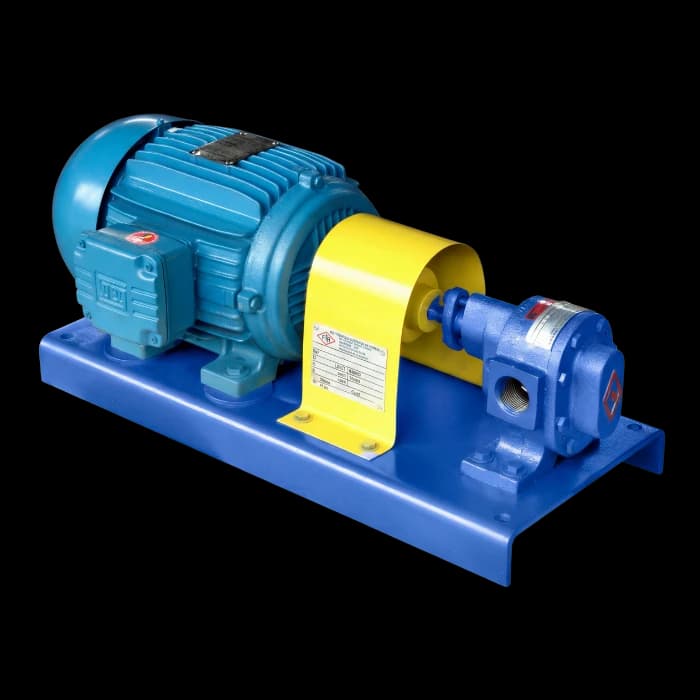
Here, extreme service describes duties needing special attention to viscosity, temperature, solidification or chemical compatibility; it is not a standard classification with one universal cutoff. FBE and FBOT serve distinct functions: gear-pump transfer and thermal-oil circulation. Compare configuration documents and confirm the complete duty without combining maxima from different ranges.
At a glance
- Extreme service describes process demands, not a universal standard viscosity or temperature cutoff.
- FBE requires selection by size, viscosity, pressure, material and temperature; maxima are not simultaneous.
- FBOT circulates organic thermal oil; the catalogue publishes up to 350 °C and graphite packing plus mechanical sealing.
- For FBE-CA, confirm the heating circuit and product preservation during shutdowns.
- Define testing and acceptance criteria in the proposal; a catalogue does not prove every pump was tested with the customer’s liquid.
1. What defines extreme service in industrial pumping
Duty severity depends on how closely its conditions approach the selected configuration’s limits. Assess viscosity, temperature, product changes and compatibility together. The reviewed documents do not establish 1,000 SSU or 150 °C as a universal definition of extreme service.
The practical consequence of these factors is that the pump efficiency curve leaves the "sweet spot" and degradation accelerates. Mechanical seals work outside their design range, bearings suffer thermal misalignment, and available NPSH (calculated under ideal conditions) may be insufficient when the fluid heats up and generates secondary vapor. In this territory, selecting the right pump stops being a catalog question and becomes applied engineering.
Use each range envelope separately. The current FBE catalogue publishes up to 22 kgf/cm² and up to 500 °C, subject to configuration; FBOT publishes up to 350 °C for thermal oil. These maxima are not one duty point and do not authorise substituting one range for another.
2. What to check before selecting a centrifugal pump
Viscosity changes centrifugal flow, head, efficiency and power relative to a water curve. The Hydraulic Institute advises correcting water-test performance with ANSI/HI 9.6.7 and notes that centrifugal pump use may be limited where viscosity results in unacceptable efficiency; there is therefore no single viscosity limit for every pump, nor any basis for claiming that power always rises quadratically.
At high temperature, check the assembly’s casing, impeller, seal, bearing, lubricant and alignment limits. Liquid temperature is not automatically bearing temperature. FBOT has documented thermal-oil construction, but this does not prove every other centrifugal pump fails above 150 °C.
3. Why FBE (external gear) wins on viscosity
Rotary positive displacement pumps operate by the opposite law from centrifugals: increasing viscosity actually improves volumetric efficiency. This happens because viscous fluid seals the internal clearances between teeth and casing better, reducing the "slippage" that steals flow. The FB Bombas FBE pump is designed for this physics: calibrated internal clearances, helical teeth that reduce pulsation, and materials selected according to temperature and fluid.
FBE-CA incorporates a heating chamber. Assess medium, pressure, temperature, heating sequence and shutdown preservation. Suitability depends on the product; do not assign a fixed CAP solidification time or guarantee continuous operation solely from chamber presence.
- FBE materials: Table 6 lists options including ASTM A48 CL30 and ASTM A216 WCB; selection depends on duty.
- FBE-CA: confirm chamber limits for supply; product and heating-medium temperatures are not the same value.
- Material and sealing: assess composition, pressure and startup and duty temperatures without a universal 250 °C cutoff.
4. Why FBOT wins in high-temperature thermal oil
The FBOT catalogue describes organic thermal-oil circulation, up to 350 °C for the range, without external cooling for the described duty. Selection needs product viscosity, density and vapour pressure at startup and duty temperatures. “Thermal oil” does not define one value for these properties.
The catalogue and MTEC-16/00 describe graphite packing and a mechanical seal. Because their seal-bath fluid descriptions differ, confirm that detail in supplied-equipment documentation. Back pull-out construction facilitates bearing-assembly removal without disconnecting casing from piping.
5. Selection table: application × FBE vs FBOT vs FBEI
The table organises the information to provide for each application. It does not assign typical properties without product data or replace technical range selection.
| Application | Properties to provide | Thermal conditions to provide | Range to assess |
|---|---|---|---|
| CAP asphalt / bitumen | Product viscosity and additives | Startup, duty and preservation | FBE-CA (with heating jacket) |
| Thermal oil (Therminol, Mobiltherm) | Fluid datasheet and vapour pressure | Minimum and maximum temperatures | FBOT |
| Molasses (sugar-ethanol) | Concentration, viscosity and solids | Actual product temperature | FBE/FBEI — confirm composition |
| Glycerin (biodiesel/pharma) | Purity, concentration and viscosity | Startup and duty | FBE or FBEI |
| Liquid polymers / resins | Rheology, composition and curing | Product and heating limits | FBE-CA |
| BPF fuel oil | Commercial grade and viscosity | Startup and transfer | FBE |
6. Materials and sealing in extreme service
Check materials of every wetted component, not only the casing. Selection must consider composition, temperature, pressure and possible particles. The list below identifies what to confirm without promising service life by material.
- Casing: material, pressure rating and compatibility at duty temperature.
- Shafts and gears: configuration materials and treatments per drawing and parts list.
- Mechanical seal: faces, secondary seals and auxiliaries per specified arrangement.
- Packing: material, adjustment and duty per manual; confirm process containment requirements.
7. Qualitative MTBF in extreme service — the real factors
MTBF requires operating and failure records for a defined population. Without them, an expectation for FBE or FBOT cannot be quantified. Organise history by model, duty and failure mode to guide maintenance and compare interventions.
- Record alignment, vibration, temperature, flow, pressure and fluid condition using configuration-appropriate criteria.
- Investigate starts outside specified conditions, thermal shocks, obstructions and operation outside the approved range.
- Compare operating hours, failure count and modes, and conditions before and after intervention.
Confirm scope, frequency and responsibility for the maintenance plan. The reviewed documentation does not establish a standard FB Bombas quarterly or semiannual visit contract or an MTBF promise.
8. Applications and data for a more precise assessment
Catalogues identify application sectors; validating a specific process requires its data. Use these examples to prepare an assessment without inferring customer supplies or results:
- Asphalt: provide product, viscosity by temperature, transfer and heating conditions.
- Thermal oil: send product data, circuit, startup temperature and duty point for FBOT assessment.
- Molasses: provide concentration, solids, viscosity and flow before assessing a gear pump.
- Fuel oil: provide product grade and viscosity; BPF refers to low pour point, not fish oil.
- Resins and polymers: provide composition, rheology, shear sensitivity and cleaning conditions.
9. When NOT to specify FBE or FBOT — constructive honesty
Request specific assessment when requirements exceed documented scope. Avoid selecting or rejecting a technology solely by fluid name:
- Water and high flows: compare the curve and operating range of a centrifugal pump suitable for the duty.
- Abrasives: the FBOT catalogue excludes them; for FBE, discuss solids and compatibility before selection.
- Metering: provide accuracy and repeatability requirements and request confirmation by configuration and duty.
- Deep vacuum or compressible gases: process pumps are incompatible — use dedicated vacuum pumps
Send the application to the technical team to check available scope and missing selection data. Contact comercial@fbbombas.com.br or WhatsApp +55 11 97287-4837.