

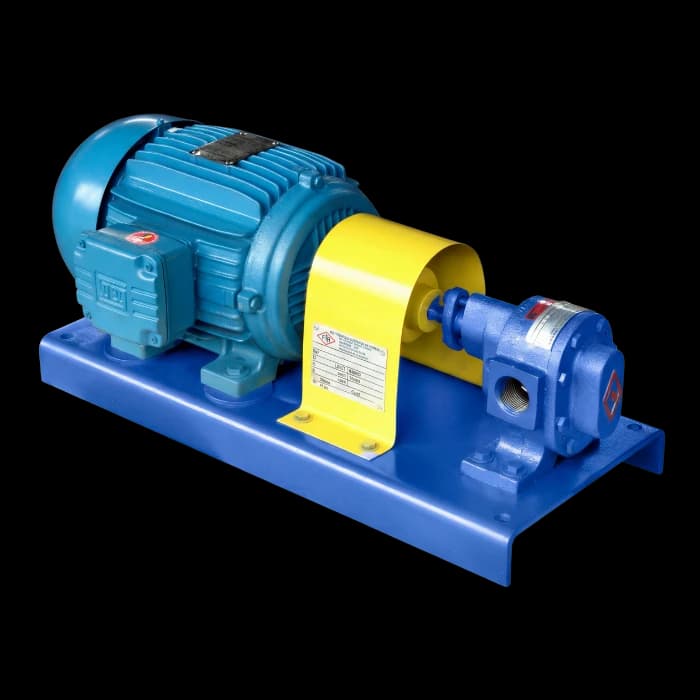
The FBE catalogue includes asphalt applications and a heating-chamber option. Selection for CAP or bitumen depends on composition, startup and operating viscosity, flow, pressure and temperature. Confirm the CA configuration and thermal limits with engineering. Emulsions and modified products need fluid-supplier data; the label “asphalt” alone does not determine speed, material or heating.
At a glance
- The FBE catalogue lists asphalt-sector applications and the CA heating-chamber option.
- Size heating for the product, chamber and shutdown and startup conditions.
- The manual’s 100,000 SSU limit requires specific sizes and speeds; it is not simultaneous with other maxima.
- 850 rpm corresponds to 2,500–7,500 SSU for listed models, without a universal CAP temperature.
- Send product viscosity data and installation conditions to confirm the FBE configuration.
1. The challenge of asphalt pumping
Before selecting the pump, obtain the viscosity-versus-temperature data for the exact product. CAP, emulsions and modified asphalt must not receive the same temperature or heating strategy simply because their names are related. Assess transfer, shutdown and restarting.
Positive displacement pumps can suit viscous liquids. A centrifugal pump assessment requires viscosity-corrected performance, following Hydraulic Institute guidance. There is no universal 500 SSU cutoff ruling out every centrifugal pump, nor one technology suitable for every asphalt product.
2. The FBE-CA variant: integrated heating jacket
CA identifies the FBE heating-chamber option. Heating design must maintain the conditions needed for flow without exceeding product, pump or chamber limits. Pumped-liquid temperature and heating-medium temperature are separate quantities.
- Steam: provide supply pressure and temperature; confirm the limits of the supplied FBE chamber.
- Thermal oil: provide fluid, temperature and heating-circuit pressure; do not transfer FBEI limits.
- Product temperature: confirm for the configuration against current catalogue, manual, materials and sealing specifications.
- Product identification: provide CAP grade, modified formulation or emulsion type and the corresponding datasheet.
Never attempt to start an FBE-CA pump with cold (solidified) asphalt without first heating the jacket. Dry or solid-product startup can damage gears, bushings and seals. Heat gradually before starting the motor.
3. Selection by viscosity: how to size for asphalt
Use viscosity measured or declared by the supplier at actual temperature. The table below reproduces three FBE manual bands without automatically assigning a CAP grade to a temperature. Each band remains subject to the sizes covered by Table 2.
| Asphalt viscosity (SSU) | Speed (rpm) | Drive |
|---|---|---|
| 2,500 to 7,500 | 850 | Direct |
| 7,500 to 10,000 | 700 to 500 | Pulley or gearbox |
| 10,000 to 50,000 | 500 to 300 | Pulley or gearbox |
Temperature alone does not determine speed. Table 2’s 850 rpm band covers 2,500–7,500 SSU in listed sizes; its 500–300 rpm band covers 10,000–50,000 SSU from 1½″ to 6″. Confirm other models or conditions with engineering.
4. Construction materials for asphalt
MTEC-01/01 Table 6 lists construction materials. It does not establish a universal switch from cast iron to carbon steel at 250 °C. Selection must check temperature, pressure, fluid composition and all wetted components.
- ASTM A48 CL30 cast iron: documented manual option; confirm duty and limits for the proposed assembly.
- ASTM A216 WCB carbon steel: documented option; suitability depends on complete service conditions.
- Sealing: the manual lists packing, mechanical seals and other arrangements. Confirm materials, auxiliaries and thermal limits for the product.
5. Typical applications in the asphalt sector
Examples of process stages to discuss with engineering, confirming the product and conditions of each duty:
- Asphalt plants: CAP transfer from storage tanks to the mixing plant
- Fuel distributors: loading and unloading of tank trucks
- Port terminals: transfer from ships to coastal tanks
- Asphalt emulsion production: precise CAP dosing in the emulsification process
- Polymer-modified asphalt (PMA/SBS): transfer of product with higher thermal demands
- Industrial waterproofing: asphalt membrane, primer and asphalt sealants
To assess FBE, send product type, datasheet, viscosity, minimum and maximum temperatures, flow, pressure and heating conditions. Contact: WhatsApp +55 11 97287-4837 or comercial@fbbombas.com.br.