

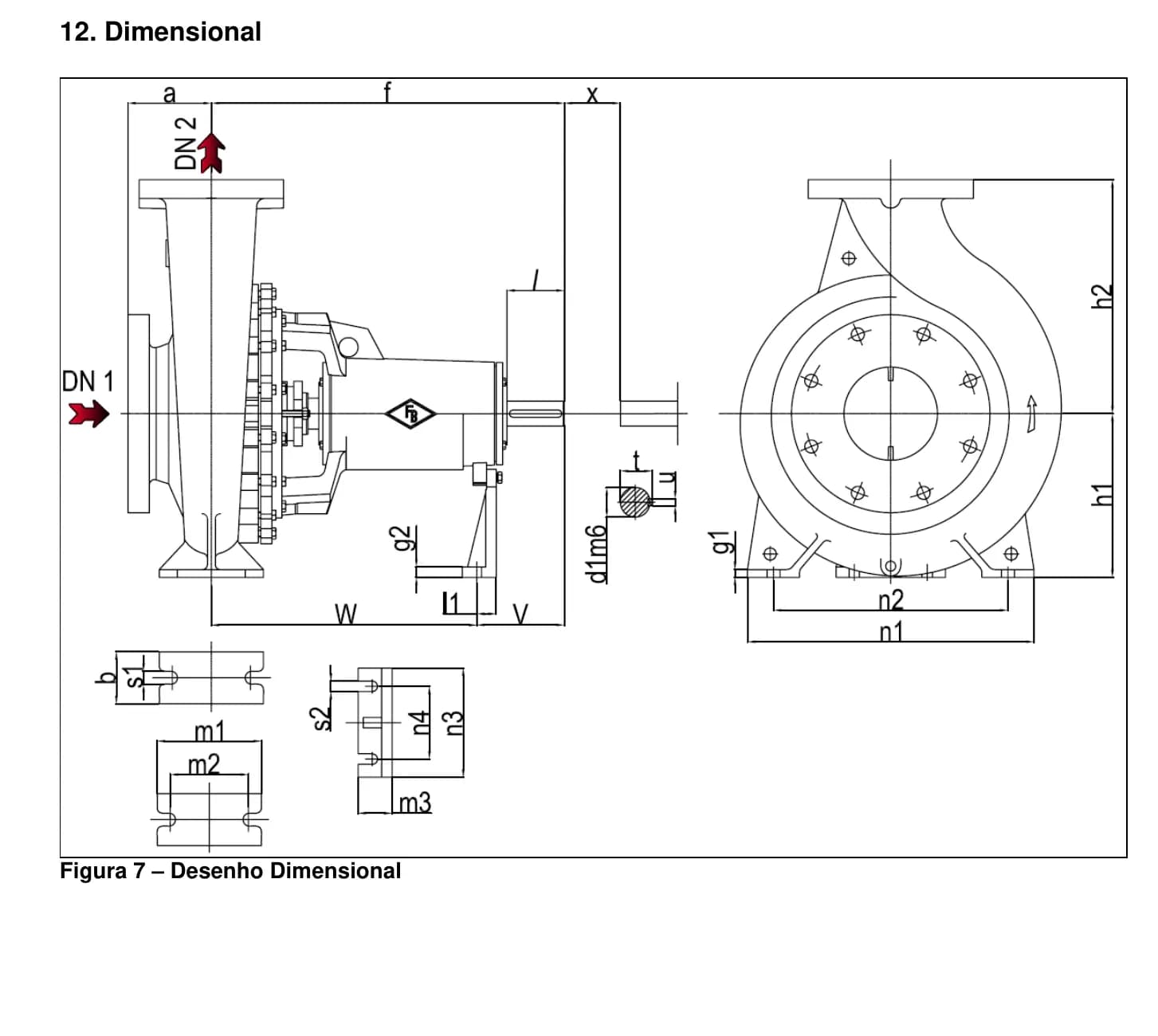
ASME B73.1 is the design and specification standard for the horizontal chemical-process centrifugal pump: end suction, single stage and centerline discharge, metallic or solid polymer. It intends pumps of the same dimension designation to be interchangeable in mounting, nozzles, input shaft, baseplate and foundation bolt holes. B73.2 covers the vertical in-line pump. For the FBCN, MTEC-03/00 states mechanical construction to B73.1; compare drawings, hydraulics, materials and sealing before a replacement.
At a glance
- ASME B73.1 is the design and specification standard for the horizontal chemical-process centrifugal pump: end suction, single stage, centerline discharge, metallic or solid polymer.
- Pumps of the same dimension designation are intended to be interchangeable in mounting, nozzles, input shaft, baseplate and bolt holes; curve, materials and sealing are still checked.
- B73.2 covers the metallic vertical in-line pump; maintenance and operation are not included in the standard.
- MTEC-03/00 states the FBCN mechanically conforms to B73.1, with back-pull-out and non-simultaneous maxima of 2,200 m³/h, 135 m, 260 °C and 3,500 rpm.
- A mechanical declaration does not prove interchangeability with every B73.1 pump: compare drawings, curve, materials, sealing and tests in the proposal.
What ASME B73.1 covers — and why it exists
On the standard’s official page, ASME describes B73.1 as a design and specification standard for metallic and solid-polymer centrifugal pumps of horizontal, end-suction, single-stage, centerline-discharge design for chemical process. It combines dimensional interchangeability requirements with design features that facilitate installation and maintenance and enhance the reliability and safety of B73.1 pumps.
Multistage, split-case and vertical pumps fall outside that envelope by definition; for the vertical in-line chemical-process pump, ASME has B73.2. When purchasing, identify the standard, edition and extent of declared conformity: a mechanical-construction reference does not extend to dimensions, materials, tests or certification without the corresponding documents.
Compare the existing pump drawing with the proposal. Without this check, an ASME B73.1 statement does not justify assuming replacement without adaptation.
Dimensional interchangeability: the heart of the standard
ASME’s stated intent is that pumps of the same standard dimension designation, from any source of supply, be interchangeable in mounting dimensions, size and location of suction and discharge nozzles, input shafts, baseplates and foundation bolt holes. In practice, this allows a change of supplier that reuses piping, baseplate and foundation, provided the designation and drawings confirm it.
This interchangeability is about the interface: curve, efficiency and NPSHr of each configuration are still checked on the manufacturer’s curve, and equal dimensions do not mean equivalent materials or sealing. In a real application, compare nozzles, shaft, baseplate and fixings on the drawings, plus removal clearance.
In a replacement enquiry, send a photograph of the pump identification, the existing drawing and the process data. Request a comparison of the interfaces and state which adaptations are acceptable. For the FBCN, the manual’s mechanical declaration should be read within that scope limit.
What else the standard asks for: back pull-out and seal chamber
Beyond dimensions, ASME cites design features aimed at installation, maintenance, reliability and safety; the detail is in the standard itself. For the FBCN, MTEC-03/00 (p.1) describes back-pull-out construction, which lets the bearing assembly be removed from the volute without disconnecting or misaligning the piping. It eases access but sets no universal repair time and does not replace isolation, disassembly and alignment per procedure.
For sealing, the manual provides packing or a mechanical seal and chooses the chamber arrangement by application; with an external-source liquid, a cooling chamber cannot be used. A seal plan requires compatibility with liquid, pressure and temperature; the ASME reference alone neither selects a plan nor guarantees process reliability.
| Arrangement | Application in the manual | Temperature in the manual |
|---|---|---|
| ST (packing) | Standard design, lubricated by the pumped liquid; clean, non-aggressive liquids | up to 160 °C |
| S1 (packing) | Sealing by clean external liquid; toxic, aggressive or malodorous liquids, or suction from a tank under vacuum or below atmospheric pressure | up to 105 °C |
| S2 (packing) | Lubrication and sealing by external liquid; suspended solids or small fibres | up to 105 °C |
| S3 (packing) | Flushing with clean external liquid; abrasive particles or a tendency to crystallise | up to 105 °C |
| S (mechanical seal) | Seal according to application needs and the request | per application |
B73.1 vs B73.2: horizontal or vertical in-line
On the official B73.2 page, ASME describes it as a design and specification standard for metallic centrifugal pumps of vertical-shaft, single-stage design with suction and discharge nozzles in-line. The intended interchangeability covers mounting dimensions and the size and location of the nozzles, and the page itself notes that maintenance and operation requirements are not included in the standard.
For installation, assess the in-line pump with the piping design, support and access: in-line does not automatically waive a foundation or permit any load on the piping. Allow room for component removal, lifting where required and drive access. Selection depends on duty and available configuration; layout is not the only criterion.
| Criterion | ASME B73.1 (horizontal) | ASME B73.2 (vertical in-line) |
|---|---|---|
| Installation | Own baseplate + alignment | Support according to design |
| Footprint | By drawing and access needs | By drawing and access needs |
| Maintenance | Back pull-out at floor level | Vertical lift of the assembly |
| Typical use | Pump house, general process duty | Pipe rack, congested plants |
B73.1 or API 610: which standard your service calls for
ASME B73.1 and API 610 have their own scopes. API identifies 610 for centrifugal pumps in the petroleum, petrochemical and natural gas industries. The adopted standard must match the process and contract requirements; do not use the industry sector alone as proof that a configuration complies.
Define pressure, temperature, materials, sealing, nozzle loads and required tests. Ask the supplier for the compliance matrix and any deviations. Cost and reliability must be compared for the actual duty, without claiming that a standard always adds cost without benefit or solves every utility service.
FBCN: mechanical construction described to ASME B73.1 in its manual. API 610 projects: assess custom configuration and scope with evidence defined in the proposal.
How to specify a B73.1 pump
Organise specifications by process, interfaces, materials, sealing, drive and acceptance. Include flow and head by regime, available suction, temperatures, composition and solids. Confirm operating region and power across intended duty using proposed configuration curves.
For the FBCN, the operating data in MTEC-03/00 (p.1), which are not simultaneous, run from DN25 to 300 mm, with flow up to 2,200 m³/h, head up to 135 m, temperature up to 260 °C and speed up to 3,500 rpm. The casing is cast iron, A216 WCB carbon steel or A743 CF8M stainless, with maximum discharge pressure versus temperature in Figures 1 and 2 (p.6).
Impeller material limits speed through peripheral velocity (item 6, p.8): up to 40 m/s in cast iron, 60 m/s in ductile iron and carbon steel and 80 m/s in stainless steel. A stainless impeller with a passage width up to 12 mm loses 3 points of curve efficiency, and from 12 to 15 mm, 2 points (Table 4).
The proposal should identify included drawings, curves and reports with acceptance criteria. Material certificates, witnessed tests and other documents depend on the agreed specification. Petrobras supplier registration is not product certification or a substitute for evidence.
When consulted on 25/09/2026, the ASME catalogue listed B73.1 in its 2026 edition and B73.2 in its 2023 edition. State the adopted edition in the specification.