

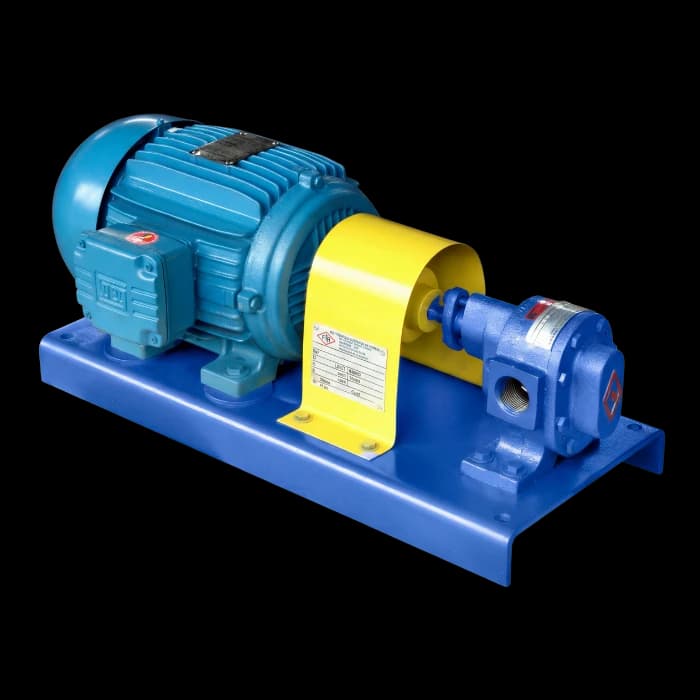
It depends on the role. In a foam system designed to NFPA 11, the pump that injects foam concentrate also follows NFPA 20, which covers concentrate pumps among positive displacement pumps: it must be listed for the service and suited to the viscosity, with discharge pressure above the highest water pressure at the injection point, pressure relief, compatible seals and automatic starting. For unloading, filling or transferring concentrate between tanks, an industrial gear pump can be assessed against the concentrate datasheet.
What foam concentrate is and what to check when changing it
NFPA 11 defines foam concentrate as a concentrated liquid foaming agent as received from the manufacturer. Mixed with water at its specified proportion, it forms foam solution; AFFF, for example, is usually diluted to a 1%, 3% or 6% solution. The same standard classifies the concentrate type by chemical composition, use percentage, minimum usable temperature and the fuels on which it is effective.
AFFF is based on fluorinated surfactants. Alcohol-resistant (AR) concentrate is used on water-soluble liquids and other fuels destructive to regular foams, as well as on hydrocarbons. SFFF (synthetic fluorine-free foam) is based on hydrocarbon surface-active agents and is not formulated to contain PFAS. AFFF and AR-AFFF remain fluorinated foams: alcohol resistance does not mean fluorine-free.
When moving to SFFF, NFPA Global Solutions points to changes the system may need: a larger storage tank, because the application density may be higher; a different discharge device, because many SFFFs are applied at a higher expansion; and a specific proportioner for high-viscosity SFFFs. There is no single viscosity for all SFFFs, and the use of fluorinated foam depends on local rules: confirm with the authority having jurisdiction.
Nor is the change made by topping up the tank. NFPA 11 prohibits mixing different types of concentrate in storage, and different brands of the same type may be mixed only with manufacturer data, accepted by the authority having jurisdiction, proving that they are compatible. Replacement concentrate must also be listed for use with the system components.
Changing concentrate requires checking system compatibility: materials, pump, proportioner, discharge devices and conversion procedure. Use the relevant manufacturers’ documentation.
Centrifugal, piston or gear: what viscosity changes
In a centrifugal pump, a viscous liquid increases friction: input power rises, while head, flow and efficiency fall compared with the water test. In the Hydraulic Institute (HI) example, a centrifugal pump drops from nearly 80% efficiency on water to about 50% on 1,000 SSU. For this reason, the HI notes, centrifugal pumps may be limited above certain viscosities, and positive displacement pumps may offer a better solution.
As NFPA 20 defines it, a positive displacement pump captures a specific volume per revolution; in a gear pump, the gear teeth and casing displace the liquid. According to the HI, theoretical capacity is proportional to speed, and the difference from delivered capacity is internal slip; higher viscosity reduces that slip and raises volumetric efficiency, but it also increases input power and the net positive inlet pressure required (NPIPR).
The HI itself warns that these generalities are not absolute: specific designs change capability, and the pump manufacturer should be consulted. A test claim from another manufacturer or system does not prove FBE performance. Request configuration data for the intended duty: pressure, flow, speed, temperature and concentrate behaviour. Selection follows that comparison, not a universal ranking of centrifugal, piston and gear pumps.
NFPA 11 treats alcohol-resistant concentrates as non-Newtonian: it requires friction loss in their piping to be computed from the manufacturer’s data and keeps the Darcy-Weisbach formula for Newtonian concentrates. In a non-Newtonian liquid, measured viscosity depends on the shear applied in the test, so compare data obtained at the duty temperature and conditions. NFPA Global Solutions treats viscosity as a property to monitor as the concentrate ages.
| Pump type | Effect of viscosity | What to request from the supplier |
|---|---|---|
| Centrifugal | Power rises; head, flow and efficiency fall | Curve corrected for the concentrate, required NPSH and starting torque |
| Piston (reciprocating) | Slip falls; power and NPIPR rise | Flow, pulsation and inlet capability with the fluid |
| Gear (rotary) | Slip falls; power and NPIPR rise | Actual flow, power, suction and compatibility |
What NFPA 11 and NFPA 20 require from the foam concentrate pump
NFPA 11 is the standard for low-, medium- and high-expansion foam systems: it covers concentrate types, application rates, proportioning methods and system tests. It does not say where foam is required; that comes from local rules. For pumping, the principle is compatibility: pump design, materials and sealing must suit the actual concentrate.
Under NFPA 11, system components must be listed for their intended use and, where no listing exists, approved; the concentrate must be listed for use with the proportioning equipment and discharge devices. Water or concentrate pumps required by the system are designed and installed in accordance with NFPA 20, which covers foam concentrate pumps in its positive displacement chapter. For the concentrate pump, the two standards require, among other items:
- Listing for the service (NFPA 11) and for the intended application, with the model’s performance curves verified by the listing (NFPA 20)
- Pump design and materials approved for the concentrate type (NFPA 11); suitability for the liquid’s viscosity and materials selected for the corrosion potential of the environment, fluid and operating conditions (NFPA 20)
- Rated capacity at or above the maximum system demand, including the highest permitted proportioning rate
- Discharge pressure at the design capacity above the highest water pressure available under any condition at the concentrate injection point
- A listed safety relief valve on the discharge, able to relieve 100% of rated capacity at no more than 125% of its set pressure (NFPA 20), returning to the concentrate tank, the tank return line or the pump suction with a means to prevent overheating, without exceeding the working pressure of the concentrate piping (NFPA 11)
- Seals compatible with the concentrate; in NFPA 20, mechanical or lip seals, with no packing
- Available NPSH above the manufacturer’s required NPSH plus 1.52 m (5 ft) of liquid
- Ability to run dry for 10 minutes without damage
- Means for flushing, a drain cock or valve, and automatic starting on system actuation
A listing applies to the identified equipment and scope, not to the gear pump type or an entire brand. The FBE 2026 catalogue shows no listing: if the pump will inject concentrate into a system that follows NFPA 11, confirm the required listing before finalising supply. Requirements may change between editions: check the edition adopted by the project and the authority having jurisdiction.
How to specify the foam concentrate pump in practice
Start with the concentrate datasheet. NFPA 11 requires the listing to publish acceptable ranges for density, pH, refractive index and viscosity, later used in NFPA 25 tests, and requires the concentrate to be stored within the listed temperature limits. With that data, define flow, head, the minimum operating temperature and the viscosity at that temperature, as well as wetted materials.
If the datasheet gives dynamic viscosity (cP), divide it by the density to obtain kinematic viscosity and convert that to SSU with a conversion table before comparing it with the FBE limit for each size, in the table in this section: from 2,500 SSU for sizes 1/8″ to 1/4″ up to 100,000 SSU for 3″ to 6″ (manual MTEC-01/01, Table 2).
Speed ranges from 1,750 rpm down to 150 rpm with a pulley or reducer, and the FBE 2026 catalogue recommends lower speed for higher viscosity.
In the concentrate line, NFPA 11 does not allow carbon steel or galvanised pipe and accepts brass, bronze, 304 or 316 stainless steel, 90/10 copper-nickel or another material covered by the concentrate manufacturer’s certification of compatibility and approved by the authority having jurisdiction.
The FBE 2026 catalogue offers casings in cast iron, ductile iron, WCB steel or CF8M stainless steel, shafts and gears in SAE 1045 steel or 316L stainless steel, and sealing by packing, mechanical seal or lip seal. For foam concentrate, each material’s compatibility must be confirmed with the concentrate manufacturer; in a pump that follows NFPA 20, packing is ruled out.
On the suction side, NFPA 11 requires the atmospheric tank outlet to be located to give the pump a positive head, and the suction inlet to be at least 25 mm above the tank bottom; concentrate below it does not count as usable.
The suction strainer must be removable and cleanable and installed at least 10 pipe diameters from the pump suction inlet, with its pressure drop calculated to ensure sufficient NPSH (NFPA 20). Under NFPA 11, its open basket area is at least 10 times the inlet pipe area, its net open area at least four times the suction pipe area, and its mesh follows the pump manufacturer’s recommendation for the concentrate viscosity.
With the datasheet, assess the gear configuration for actual flow, pressure, speed, suction, relief and materials, and send the concentrate data to FB Bombas engineering to confirm whether the proposed FBE suits the duty. Define the required tests and documents in the proposal; the range maxima are not simultaneous and do not prove capability for every foam concentrate.
| FBE size | Maximum viscosity |
|---|---|
| 1/8″ to 1/4″ | 2,500 SSU |
| 3/8″ to 1″ | 7,500 SSU |
| 1.1/2″ to 2″ | 50,000 SSU |
| 3″ to 6″ | 100,000 SSU |
Where the foam concentrate pump fits in the complete fire system
There are two different roles. The system concentrate pump injects foam concentrate for proportioning. NFPA 11 methods include balanced pressure pump-type proportioners, in-line balanced pressure proportioning with a pump or bladder tank, direct injection with a variable output foam pump, and a concentrate pump coupled to a positive displacement water motor. For fixed proportioning means, the standard prefers balanced-pressure or positive-pressure injection.
The transfer pump unloads trucks, fills tanks and moves concentrate between reservoirs. NFPA 11 requires loading and transportation facilities for concentrate and a reserve supply for the worst-case fire scenario and for putting the system back into service: in separate tanks or compartments, in drums or cans on the premises, or obtainable from an approved outside source within 24 hours. Refilling the system tank from that reserve is transfer duty.
The foam system does not replace the water system. The water pump of a foam system also follows NFPA 20, and the concentrate quantity covers the largest single hazard or the group of hazards protected at the same time. Consumption is based on the percentage used in the design, such as 3% or 6%.
For a fixed-roof tank containing hydrocarbons with Type II fixed discharge outlets, NFPA 11 requires at least 4.1 L/min·m² (0.10 gpm/ft²) of solution: 30 minutes with a flash point between 38 °C and 60 °C; 55 minutes with a flash point below 38 °C, for liquids heated above their flash point or for crude petroleum. With monitors or handlines, the table rises to 6.5 L/min·m² (0.16 gpm/ft²), for 50 or 65 minutes respectively.
With monitors or handlines, the solution flow must also allow for wind and ambient losses, with a minimum factor of 1.5 on the application rate. For arithmetic only, 1,900 L/min of solution at 3% needs 57 L/min of concentrate; over 30 minutes, 1,710 L, before the reserve supply. These values do not size a real installation: rate, time, area and percentage come from the design and the applicable rules.
In an FB Bombas enquiry, separate the water pump set, designed in accordance with NFPA 20 and NBR 16704, from the foam concentrate transfer pump, which can be an FBE assessed against the concentrate datasheet. Also state whether the design includes a concentrate pump under NFPA 11: it must be listed, and the FBE 2026 catalogue shows no listing.
Confirm equipment, materials, required approvals, tests, documentation and included field work in the proposal, without assuming certification or a standard FAT for every assembly.