1. Applicable standards: NFPA 20 and ABNT family
Fire protection system design in Brazil follows two references: the international standard NFPA 20 (National Fire Protection Association) and Brazilian ABNT standards. Understanding the scope of each is the first step to correct specification.
- NFPA 20 — International standard for stationary fire pump installation. Defines requirements for main pump, standby, jockey, controllers and testing
- NBR 10897 — Fire protection by automatic sprinkler. Defines flow and pressure at nozzles
- NBR 13714 — Hydrant and hose reel systems for fire fighting
- NBR 16704 — Stationary pumps for fire protection. Brazilian standard specific to the pumps (the "Brazilian NFPA 20")
2. The three system pumps: main, standby and jockey
NFPA 20 requires redundancy. The complete system has three pumps with distinct functions:
| Pump | Drive | Function | When it operates |
|---|---|---|---|
| Main | Electric motor | Provides flow and pressure to the sprinkler and/or hydrant system | Auto-start on network pressure drop |
| Standby (diesel) | Diesel engine | Takes over during power failure or main pump failure | Auto or manual start. Diesel tank autonomy per standard |
| Jockey | Electric motor (smaller) | Maintains constant network pressure. Compensates leaks and variations | Operates continuously at low flow. Prevents unnecessary main pump starts |
3. Main pump — FBCN for fire systems
FB Bombas uses the FBCN series (normalized centrifugal) as the main pump in fire pump systems. The FBCN meets NFPA 20 and NBR 16704 requirements with the following characteristics:
- Flow: sized per system demand (sprinklers + hydrants + reserve)
- Pressure: per building height + friction losses + minimum pressure at the most remote nozzle
- Back-pull-out construction: maintenance without disconnecting piping (essential for system availability)
- Materials: cast iron (standard) or steel for saltwater or additive applications
- Speed: up to 3,500 rpm per FBCN manual
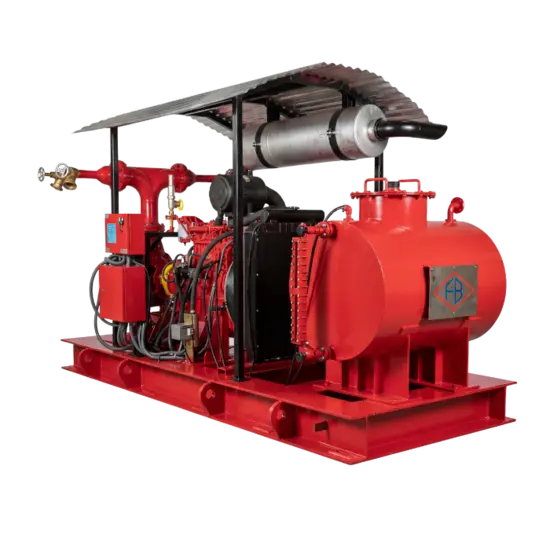
4. Pre-assembled skid: what it includes
FB Bombas supplies the complete system pre-assembled on a metal skid, ready for on-site installation. The typical scope includes:
- Main pump (electric motor) sized for the project
- Standby pump (diesel engine) with fuel tank and starting battery
- Jockey pump for continuous pressurization
- Automatic control panel (pressure switch start, alarms, monitoring)
- Gate, check, relief and test valves
- Suction and discharge manifolds with flanges
- Structural metal base with leveling feet
5. Where it applies: building types and industries
Fire pump systems are required by law or insurers across various building categories and industrial facilities:
- Shopping centers, hospitals and condominiums — sprinklers + hydrants per NBR 10897 and NBR 13714
- Logistics warehouses and storage facilities — areas with high fire load
- Refineries, power plants and fuel terminals — NFPA 20 requirement by risk class
- Sugar-ethanol mills — combustible bagasse + flammable ethanol
- Pulp and paper mills — fibrous materials and boilers


