

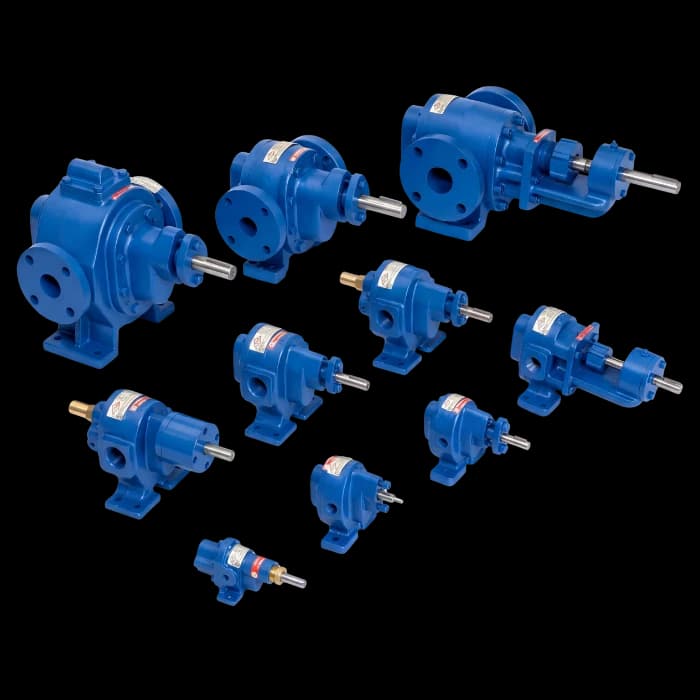
A self-priming pump removes air from the suction line by itself and starts pumping, even when installed above the liquid level. Positive displacement pumps, such as gear pumps, are usually self-priming; most centrifugal pumps are not. Self-priming does not authorise dry running or skip the manual’s preparation: the FBEI, self-priming per its 2026 catalogue, is switched on only with fluid inside, as its manual requires. Foot valves and accessories depend on the arrangement.
1. What "self-priming" means
A self-priming pump is one that, prepared as its manual requires, removes air from the suction line by itself and starts pumping, even when installed above the liquid level. The US Department of Energy (DOE) Sourcebook notes that positive displacement pumps are usually self-priming and can operate with entrained gases in the suction line. Most centrifugal pumps are not: when one loses its prime, it must be filled and vented before it can restart.
Priming prepares the pump to start with liquid under required conditions. Self-priming designs can remove suction air but remain subject to lift, time, fluid and preparation limits. Consult the configuration procedure rather than assuming wetting during a previous start is sufficient.
The FBEI manual (MAN001-10, p.13) defines priming as filling the pump and the suction piping with liquid while removing the air inside, and lists this step among the pre-operation actions. The 2026 FBEI catalogue (p.3) lists the series as self-priming. One does not cancel the other: the catalogue classification does not replace the priming or the preparation the manual requires before startup.
In the Brazilian market, the terms "autoescorvante" and "autoaspirante" (self-priming and self-suction) circulate as synonyms — different manufacturers prefer one or the other name for the same capability. In specification practice, what differentiates products is not the label, but the mechanism that generates suction and each model’s real limits of suction lift, viscosity and speed.
2. Self-priming is not the same as dry running
Operation without the specified liquid can impair lubrication, sealing and internal components. Time to damage depends on configuration and conditions and must not be treated as an operating allowance. FBEI MAN001-10 requires waiting for liquid to enter before switching on.
Starting with air in the piping must be confirmed for the configuration and line. It does not permit continued operation after the tank empties. Define detection and stopping for liquid starvation with the designer, including restart procedure.
FBEI startup has explicit steps (MAN001-10, p.5): open all valves and wait for the fluid to flow into the pump before switching it on; check that it is at the proper temperature and viscosity; and check the packing tightness or that the air has left the mechanical seal area. The rule is never to run without fluid inside. The driver’s direction of rotation is checked with the pump uncoupled, to avoid dry running (p.13).
Follow the manual startup procedure. For FBEI, confirm suitable liquid inside and open valves; self-priming does not permit dry running.
3. Why gear pumps generate suction
On the gear-pump inlet side, unmeshing increases available volume between teeth. Liquid fills these spaces, travels around the periphery and is displaced to discharge. Air or gas performance requires separate assessment; this mechanism does not turn a liquid pump into a compressor.
The 2026 FBE catalogue (p.2) describes this cycle for external gears. Constant meshing creates a depression in the suction chamber, and fluid comes from the tank to fill the cavities between the teeth and the casing. Trapped there, it is carried around the periphery to the discharge chamber, and the seal formed by the meshing prevents it from returning to suction. As the gears rotate, flow becomes continuous.
Internal clearances and fluid condition influence recirculation losses. Construction and sealing must match the priming procedure. A conventional centrifugal pump also needs the filling condition specified in its manual; dedicated centrifugal self-priming designs also exist.
The DOE lists operation with entrained gases in the suction line as a positive displacement advantage: it allows the pump to be placed above the fluid level and can simplify the layout. Centrifugal pumps often require special equipment to remove gases and prime the impeller. Self-priming centrifugal pumps exist, but according to the same document they tend to be less efficient than conventional ones and should be used only when necessary.
4. The real limits of self-priming
Check tank level, absolute pressure, line losses, vapour pressure and pump inlet requirements. Self-priming does not provide a universal 6–8 m lift: capability depends on fluid, temperature, speed, construction and line sealing. Assess startup under the most demanding installation conditions.
The physical ceiling comes from atmospheric pressure. The standard atmosphere is 101.325 kPa (BIPM), which supports about 10.3 m of cold-water column at sea level; a less dense liquid rises in a taller column, and at altitude the column is shorter. After line losses, vapour pressure and the pump inlet requirement are deducted, the practical limit is well below that.
The FBEI manual (MAN001-10, p.4) sets the suction installation rules: pump as close as possible to the suction point, piping with the fewest possible fittings, and a diameter at least equal to the pump suction nozzle. Whenever possible, a 40 to 80 mesh strainer, depending on the model, with the largest possible flow area, to avoid cavitation. Without a permanent strainer, fit a temporary cone (witch’s hat) strainer before any test or startup.
Tightness decides whether the vacuum becomes a liquid column. According to the DOE, excess air leakage can keep pumps from staying primed and prevent self-priming pumps from repriming on startup. Air drawn into the suction region, for example through improperly installed packing when stuffing box pressure is below atmospheric, can degrade pump performance by 3% or more.
| Factor | Effect on priming | Recommended practice |
|---|---|---|
| Air ingress in the suction line | Generated vacuum escapes through connections — the pump turns without forming a liquid column | Seal joints, packing and connections; tightness test before startup |
| Excessive suction lift | Required column exceeds what atmospheric pressure and available NPSH allow | Install the pump as close as possible to the reservoir; calculate installation NPSHa |
| Viscosity above design | Suction friction loss grows and fluid does not fill the chamber at operating speed | Follow the speed-by-viscosity table in the 2026 FBE catalogue (p.5), the same as Table 2 of manual MTEC-01/01; reduce speed with a pulley or gear reducer |
| Inadequate speed | Speed above the one recommended for the actual viscosity; the 2026 FBE catalogue (p.5) lowers speed as viscosity rises | Select speed by actual operating viscosity, not motor nominal |
| Long or restricted suction piping | Air volume to expel increases and priming time grows; friction loss counts against NPSH | Size the line and filter using flow, viscosity and allowable pressure loss. |
5. Self-priming water pump × gear pump for viscous fluids
The search for "self-priming pump" mixes two worlds that do not substitute each other. The first is clean, low-viscosity water — small farms, shallow wells, drainage, residential pressurisation: that market is served by dedicated self-priming centrifugal motor pumps, which use a recirculation chamber to separate air from water at startup. FB Bombas does not manufacture that type of product — buyers looking for a domestic water pump will find better options in residential retail lines.
For industrial transfer, include product and suction arrangement: tank, truck or other supply point, elevations and accessories. FBE and FBEI have separate selection data. Check the range table rather than treating a general viscosity capability as self-priming approval for any installation.
The 2026 FBE catalogue publishes 30 to 100,000 SSU as the series range (p.3); with the catalogue’s approximate conversion, SSU = cSt × 4.635 above 300 SSU (p.5), the maximum equals about 21,600 cSt, while water at 20 °C is close to 1 cSt (NIST). Among its applications, the catalogue lists diesel and solvents, not water. The FBEI manual forbids running the pump with water (MAN001-10, p.5).
6. The FBCN centrifugal is not self-priming — by design, not defect
The FBCN is a conventional centrifugal pump, with a spiral casing and a single-suction radial impeller (MTEC-03/00, p.7). Like most centrifugal pumps, it is not self-priming: before startup, the pump and suction line must be full of liquid, through flooded supply or design-defined priming provisions. A foot valve helps retain liquid, but its presence alone does not prove the installation is primed.
The DOE describes the same picture for centrifugal pumps in general. They are not designed to run without fluid: mechanical seals, packing and impeller wearing rings are susceptible to damage without lubrication. In tanks, if the level drops close to the suction inlet, a vortex can form and let air into the pump; in severe cases, the pump loses its prime, which can cause severe performance degradation and even damage.
If the duty requires suction lift, state it at the start of the assessment. Compare inlet requirements, startup preparation, liquid and performance curve; a gear or centrifugal label alone does not resolve the installation arrangement.
7. FBE or FBEI: which gear pump to select
Compare current catalogues: FBE uses external gears and FBEI internal gears. The FBEI catalogue includes the 6″ N and publishes up to 136 m³/h, 14 bar differential pressure, 140,000 cP and 340 °C as range data. These are neither simultaneous nor ratings for every model. Confirm configuration and suction requirements before selection.
For the FBE, the 2026 catalogue (p.3) publishes a temperature of 10 °C to 500 °C, discharge pressure up to 22 kgf/cm² and a maximum speed of 1,750 rpm, also as general, non-simultaneous range data. For the FBEI, the catalogue lists self-priming, constant flow, reversible rotation and an internal relief valve as features (p.3); with a gear reducer, low speed gives longer service life, low NPSH required, higher efficiency and lower noise (p.4).
Send fluid data, startup and duty temperatures, flow, pressures and suction drawing. Engineering may request additional data before confirming model, speed and drive. Contact comercial@fbbombas.com.br or WhatsApp +55 11 97287-4837.