


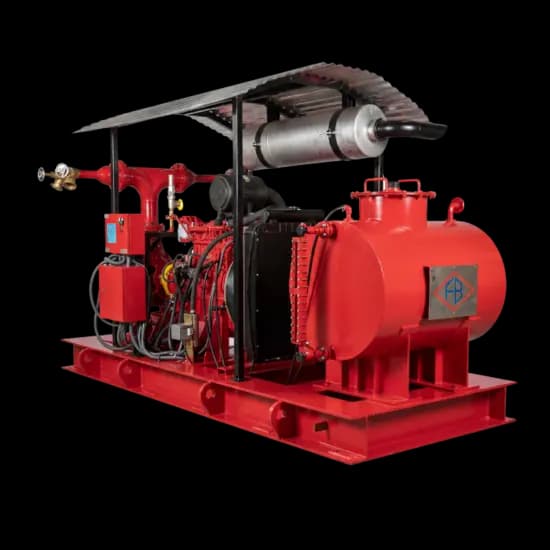
1. Overview: what sizing requires
Sizing a fire pump is not choosing a catalog model by flow. NFPA 20 (2022 edition) and NBR 16704 (2024) require the responsible engineer to specify three distinct pumps operating together — main, diesel standby and jockey — and that the main pump meets a specific characteristic curve envelope that many commercial pumps do NOT meet. Therefore, the first rule is: start sizing knowing what the standard requires of the curve, not what flow you need.
- Step 1 — Design flow: sprinklers (NBR 10897) + hydrants (NBR 13714) + reserve per risk class
- Step 2 — Required pressure: geometric height + friction losses (Hazen-Williams) + minimum pressure at most remote nozzle
- Step 3 — Available NPSH at suction (verify against selected pump NPSHr to prevent cavitation)
- Step 4 — Main pump: mandatory NFPA 20 characteristic curve (100/150 % flow at 65 % pressure envelope)
- Step 5 — Diesel standby pump: identical flow and pressure + fuel reserve per NBR 16704
- Step 6 — Jockey pump: sized to compensate leaks (1 % of main pump flow) with start pressure above the main pump
2. Step 1 — Calculate design flow
The fire pump design flow is the sum of simultaneous demands from the systems it feeds. For most buildings in Brazil, this means: sprinkler flow (calculated per NBR 10897) + hydrant flow (calculated per NBR 13714) + safety reserve per risk class of the facility. NFPA 20 requires the pump to be sized for the worst simultaneous demand scenario, not the average.
| Category | NFPA 13 Risk | Sprinkler flow | Hydrant flow | Typical total flow |
|---|---|---|---|---|
| Residential building | Light hazard | ~570 L/min | 500 L/min | ~1,000 to 1,300 L/min |
| Hospital | Light hazard | ~570 L/min | 900 L/min | ~1,500 to 1,800 L/min |
| Shopping mall | Ordinary hazard group 1 | ~1,350 L/min | 900 L/min | ~2,500 to 3,000 L/min |
| Logistics warehouse | Ordinary hazard group 2 | ~1,900 L/min | 1,500 L/min | ~3,500 to 4,500 L/min |
| Refinery / fuel terminal | Extra hazard | ~3,800 L/min | 1,500 L/min | ~5,500 to 9,000 L/min |
3. Step 2 — Calculate required pressure (total dynamic head)
The pressure the pump needs to deliver (total dynamic head — TDH) is the sum of three parts: (1) geometric height between the reservoir water level and the highest point of the system; (2) distributed and localized friction losses throughout the piping to the most remote nozzle; (3) minimum residual pressure at the nozzle, which for conventional sprinklers is typically 70 kPa (7 mwc) and for hydrants may reach 100 kPa (10 mwc) or more per State Fire Department requirement.
TDH = Hgeo + Hf + Pmin.
Distributed friction loss (Hf) in fire systems is traditionally calculated by the Hazen-Williams equation: Hf = 10.67 × (Q^1.852 / (C^1.852 × D^4.87)) × L, where Hf is loss in meters, Q is flow in m³/s, C is the Hazen-Williams coefficient (120 for new carbon steel pipe, 100 for steel with 10 years of use, 130 for CPVC), D is internal diameter in meters and L is equivalent length in meters (straight pipe + converted fittings).
NFPA 20 and NBR 16704 accept Hazen-Williams for water in turbulent regime — do not use for other fluids.
Hf = 10,67 × (Q^1,852 / (C^1,852 × D^4,87)) × L

Hf = perda de carga (m)
Q  = vazão (m³/s)
C  = coeficiente de rugosidade Hazen-Williams
D  = diâmetro interno (m)
L  = comprimento equivalente (m)
Hazen-Williams equation for friction loss in fire piping (water, turbulent regime):
4. Step 3 — Verify available NPSH at suction
NFPA 20 requires flooded suction for centrifugal fire pumps — that is, the reservoir water level must be ABOVE the pump centerline. This eliminates the need for priming and gives comfortable NPSH margin.
Available NPSH (NPSHa) is calculated by: NPSHa = Pa + Hz - Hf - Pv, where Pa is atmospheric pressure in mwc (10.33 at 0 m altitude, subtract ~1.2 mwc per 1,000 m altitude), Hz is the height between water level and pump centerline (positive if flooded, negative if drawn), Hf is the total suction friction loss and Pv is the water vapor pressure at operating temperature (0.24 mwc at 20 °C, 0.75 mwc at 40 °C).
The calculated NPSHa must be at least 1 m greater than the NPSHr of the selected pump — this 1 m margin is the minimum recommended by the Hydraulic Institute. In fire systems, where the pump operates intermittently and failure is not admissible, FB Bombas works with a 2 m margin whenever possible.
If the calculated NPSHa is marginal, three actions resolve it: (1) increase suction pipe diameter (reduces Hf); (2) reduce the number of elbows and globe valves in suction; (3) raise the reservoir water level (increases Hz).
5. Step 4 — The mandatory NFPA 20 characteristic curve
This is the step that differentiates an NFPA 20 fire pump from a commercial pump: NFPA 20 (section 4.8) and NBR 16704 require the pump to operate within a rigid characteristic curve envelope.
The pump must deliver: (a) 100 % rated pressure at 100 % rated flow (design point); (b) MAXIMUM pressure of 140 % rated at 0 % flow (shutoff — to prevent excessive system pressure when all sprinklers are closed); (c) MINIMUM pressure of 65 % rated at 150 % flow (overload — to ensure the system continues working if demand exceeds design, e.g., several sprinklers open simultaneously).
| Operating point | Flow (% rated) | Required pressure | Practical meaning |
|---|---|---|---|
| Shutoff (closed valve) | 0 % | Maximum 140 % of rated pressure | Limits excessive system pressure when pump operates against closed network |
| Design point | 100 % | 100 % of rated pressure (minimum) | Design flow and pressure — meets calculated demand |
| Overload | 150 % | Minimum 65 % of rated pressure | Ensures operation with multiple sprinklers open or exceptional demand |
6. Step 5 — Size the diesel standby pump
The diesel standby pump is required by NFPA 20 (chapter 11) and NBR 16704 whenever the main pump is electric and the system serves medium or high risk occupancies. Its function is to take over the system during power failure, main pump motor burnout, or breaker trip. Hydraulic sizing is IDENTICAL to the main — same flow, same pressure, same NFPA 20 characteristic curve. What changes is the drive (diesel engine instead of electric) and the need for fuel reserve.
Fuel reserve (NBR 16704, item 6.4): the tank must have capacity to operate the pump at rated flow for at least: 4 hours for light hazard; 6 hours for medium hazard; 8 hours for high hazard. For refineries and terminals (NFPA 20, annex A.11.4.1) the recommendation is 8 hours plus 5 % technical reserve of useful volume.
Example: 3,000 L/min diesel pump in logistics warehouse (medium hazard) requires tank of 3,000 × 60 × 6 = 1,080,000 L of equivalent water — converted to diesel by engine consumption curve (typically 0.22 L diesel per kW·h), a 75 kW engine operating 6 h consumes ~99 L of diesel. Minimum tank: 100 L. In practice, 200 L is installed for startup margin.
7. Step 6 — Size the jockey pump
The jockey pump is a small pump (typically vertical multistage centrifugal or monostage inline) whose sole function is to keep the network pressurized and compensate small leaks. When there is a minute leak (a dripping joint, a sprinkler with micro-leak) the network pressure drops slowly — and the jockey starts automatically to compensate. Without it, any minimum leak would trigger the main pump several times a day, causing premature wear of the electric motor, impeller and mechanical seal.
- Jockey flow: 1 % of main pump flow (NFPA 20 annex A.4.27 rule of thumb). If main = 3,000 L/min, jockey = 30 L/min
- Jockey start pressure: 7 to 14 mwc BELOW main pump shutoff (so jockey acts before the main triggers)
- Jockey stop pressure: at least 7 mwc above start pressure (minimum hysteresis — prevents short cycling)
- Minimum time between starts: 1 minute (NFPA 20 — if cycles are more frequent, there is a real leak that needs repair, not compensation)
8. Three numerical examples: shopping mall, hospital and warehouse
To make it concrete: three real sizing examples, with flow and pressure typical of what FB Bombas designs daily. These are simplified scenarios — real projects also include specific factors (sprinkler operational area, State Fire Department risk class, number of floors with simultaneous sprinklers), but serve to calibrate order of magnitude.
| Scenario | Shopping 4 floors | Hospital 8 floors | Logistics warehouse |
|---|---|---|---|
| Design flow | 2,700 L/min | 1,700 L/min | 4,000 L/min |
| Geometric height | 20 m | 30 m | 12 m |
| Estimated friction loss | 25 m | 20 m | 35 m |
| Minimum nozzle pressure | 10 m (sprinkler) | 10 m (sprinkler) | 10 m (sprinkler) |
| Total TDH | 55 m | 60 m | 57 m |
| Suggested FBCN model | FBCN 100-250 | FBCN 80-250 | FBCN 125-250 |
| Jockey pump | 27 L/min @ 60 m | 17 L/min @ 65 m | 40 L/min @ 62 m |
| Diesel reserve (6 h) | 150 L tank | 100 L tank | 200 L tank |
9. Final checklist before buying
Before closing the purchase of an NFPA 20 fire pump system, validate with the manufacturer this checklist. Red items are immediate Fire Department disqualification — do not accept the equipment without them:
- Factory-certified characteristic curve per NFPA 20 envelope (0/100/150 %) — DISQUALIFICATION if absent
- Individual pump bench test NBR 13414 / Hydraulic Institute 14.6 — DISQUALIFICATION if absent
- UL/FM-certified electrical control panel or Brazilian NBR 16704 equivalent — DISQUALIFICATION if absent
- Back-pull-out construction (maintenance without disconnecting piping) — recommended for system availability
- Minimum NPSH margin of 1 m (FB Bombas works with 2 m in critical systems)
- Factory pump-motor alignment + vibration report (NBR 10082) on delivery
- Portuguese technical manual + characteristic curve + recommended spare parts list
- Minimum 12-month manufacturing defect warranty + national technical assistance