


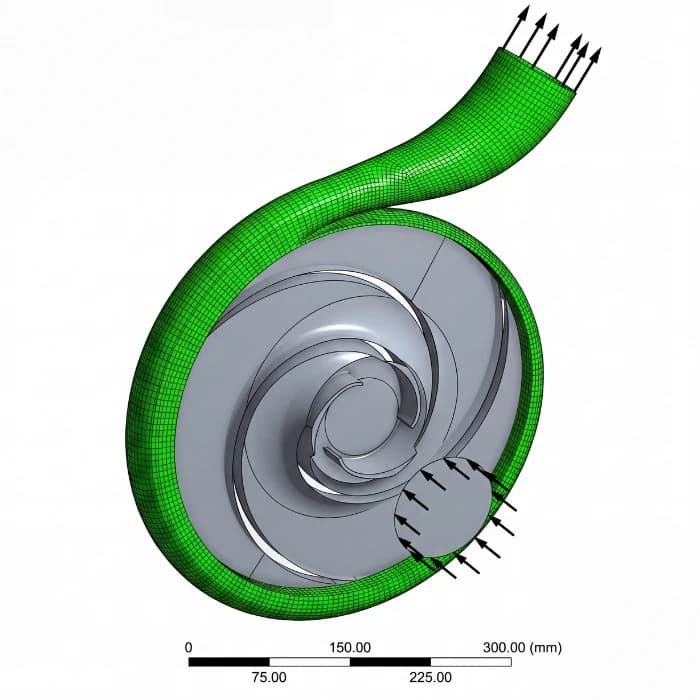
1. What is a centrifugal pump
A centrifugal pump is a hydraulic turbomachine that converts mechanical shaft work (delivered by an electric or diesel motor) into useful hydraulic energy to move liquid against installation resistance. Unlike positive displacement pumps — such as the FBE external gear series — the centrifugal pump does not displace a fixed volume per revolution; it imposes a centrifugal field on the fluid whose intensity depends on the impeller speed and outlet diameter.
For this reason, the centrifugal pump is the dominant technology in industrial applications with low to medium viscosity liquids, high flow rates and acceptable head variation depending on the operating point. At FB Bombas, the FBCN Series is designed per ASME B73.1 (dimensional standard for horizontal chemical-process centrifugal pumps) and API 610 12th ed.
(standard for refinery and petrochemical centrifugal pumps), offering back pull-out construction — a feature that allows disassembly of the impeller + cover assembly without disconnecting the piping.
2. Physical principle — kinetic energy to pressure energy
Operation occurs in two distinct physical stages within the casing. In the first stage (impeller), the liquid enters axially through the impeller eye and is forced by the blades to follow a radial trajectory rotating with the shaft. The blades transfer work to the fluid, increasing its absolute velocity — predominantly the tangential component. At the impeller outlet, the liquid carries high kinetic energy but still moderate static pressure.
In the second stage (volute), the fluid enters a spiral casing whose cross-section progressively increases from the volute tongue to the discharge nozzle. By the continuity equation (Q = A × v), the area increase implies velocity reduction. By the Bernoulli equation applied to an incompressible fluid, the reduction in kinetic energy converts to increase in static pressure.
The net result is the pump head: the amount of energy per unit weight that the pump delivers to the fluid, expressed in meters of pumped liquid column.
3. Main components — impeller, volute, shaft, bearings and seal
Each centrifugal pump component has a specific hydraulic or mechanical function, and the performance of the assembly depends on integration between them. FB Bombas designs these components per ASME B73.1 (FBCN/FBOT) and API 610 12th ed. (FBCN), with ISO 21940 G2.5 dynamic balancing and hydrostatic test bench per ANSI/HI 14.6.
- Impeller — the rotating part with curved blades; can be closed (with front and back shrouds, high efficiency), semi-open (no front shroud, better for suspended solids) or open (no shrouds, lower efficiency but tolerant of abrasive solids).
- Volute — the spiral casing that collects liquid at the impeller outlet and converts velocity into pressure. Can be single (typical in FBCN/FBOT) or double (in pumps with high radial load).
- Shaft — transmits torque from the motor to the impeller; must have sufficient rigidity so that deflection at the mechanical seal zone is below the seal allowable limit (typically 0.05 mm in API 610).
- Bearings — support the radial and axial loads of the impeller; in FBCN typically shielded rolling bearings, grease- or oil-lubricated, with bearing isolators to prevent contamination.
- Mechanical seal — seals the passage of liquid between the rotating shaft and stationary casing; in FBCN typically a cartridge seal per API 682, with API Plan 11/52/53 sealing plans depending on the application.
4. Euler equation for turbomachinery
The Euler equation for pumps relates the theoretical head delivered to the fluid (Hth, in meters) to the velocities at the impeller inlet and outlet. In its simplified form, ignoring inlet pre-rotation (typical case of well-designed process centrifugal pumps), the theoretical head is directly proportional to the product of the impeller tangential velocity (u₂) and the tangential component of the fluid absolute velocity at the outlet (cu₂).
Where Hth is the theoretical head in meters, u₂ is the tangential velocity at the impeller outlet (m/s), cu₂ is the tangential component of the absolute fluid velocity (m/s), g is gravitational acceleration (9.81 m/s²), D₂ is the impeller outlet diameter (m) and n is the speed in rpm.
The actual head delivered by the pump is lower than the theoretical due to three losses: (1) hydraulic losses from viscous friction and turbulence, (2) volumetric losses from internal recirculation between high and low pressure, and (3) mechanical losses in bearings and seal. The ratio of actual to theoretical head is the hydraulic efficiency of the pump.
Hth = (u₂ · cu₂) / g onde u₂ = π · D₂ · n / 60 (m/s)Simplified Euler equation for centrifugal pump (no inlet swirl)
5. Centrifugal vs positive displacement — when to use each
The centrifugal pump is advantageous when: (1) fluid viscosity is low to moderate (up to ~200 cP in FBCN with curve correction); (2) flow is high and relatively stable; (3) head is compatible with the operating point selected on the performance curve; (4) compact construction and lower purchase cost are desired; (5) continuous operation without significant flow pulsation is desired.
Positive displacement pumps (FBE external gear, FBEI internal gear) are advantageous when: (1) viscosity is high (above 200 cP); (2) flow proportional to speed independent of pressure is needed; (3) flow is low to moderate; (4) self-priming is required.
6. FBCN Series — real industrial application
The FBCN Series is FB Bombas' line of normalized centrifugal pumps, with 53 hydraulic models divided into 43 standard pumps (DN25 to DN150) and 10 large-capacity pumps (DN200 to DN300). Maximum flow of 2,400 m³/h, head up to 140 m and operating temperature up to 260°C. Models comply with ASME B73.1 (dimensional standard) and API 610 12th edition.
Back pull-out construction allows maintenance of the rotating assembly without disconnecting process piping — a significant operational advantage in refineries, chemical plants and mills.
Typical FBCN applications: industrial and process water, dilute chemical fluids, light hydrocarbons, circulation systems, boiler feed, cooling water. For high-temperature fluids (up to 350°C), the FBOT Series — also centrifugal, close-coupled with cooled sealing chamber — is dimensionally similar and follows the same ASME B73.1 standard.