1. The methodology: measure before intervening
The first action when diagnosing a pump that lost pressure is not to open the pump — it is to measure. Without the current operating point (Q × H) plotted on the catalog curve, any intervention is guesswork. Measurement requires three instruments: suction gauge (scale appropriate to expected pressure, typically -1 to +3 bar), discharge gauge (0 to 10/16/25 bar scale per application), and a flow meter.
In systems without permanent metering, flow can be estimated by volumetric method (timing fill of known-volume reservoir) or portable ultrasonic applied externally to the piping.
With Q and H measured, plot the point on the pump catalog curve. Three possible scenarios: (A) point exactly on original curve — pump is mechanically intact, and pressure drop felt by process comes from system change (more downstream friction loss, or different flow demand); (B) point shifted left of curve (same flow, lower head) — internal wear; (C) point shifted down (lower flow and lower head) — combination of wear with cavitation or altered viscosity.
Each scenario has distinct diagnostic direction.
2. Impeller wear and excessive ring clearances
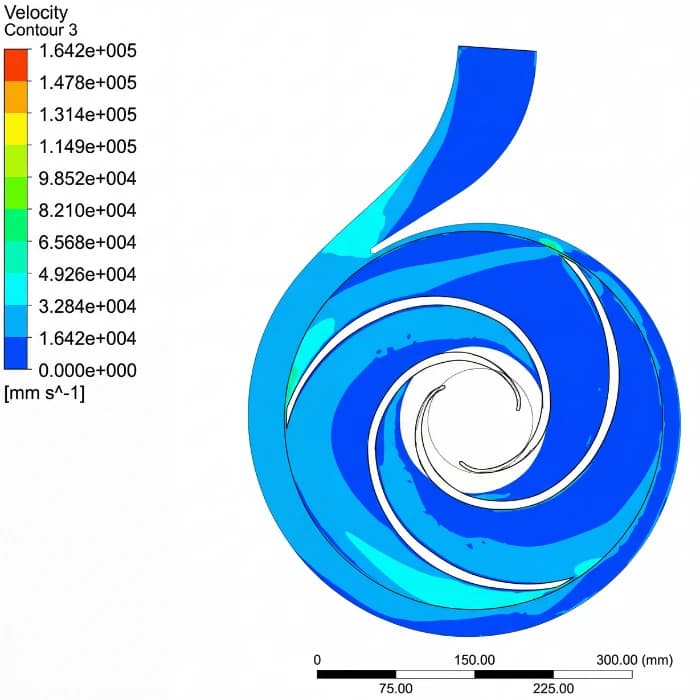
Progressive impeller wear is the most common cause of gradual pressure drop in FBCN centrifugal pumps after several years of operation. Erosion occurs mainly at outer vane edges (highest velocity zone) and at hubs near the impeller eye. In fluids with abrasive solids or aggressive pH, wear can reduce effective impeller diameter by 5% to 15%, and each 1% diameter reduction corresponds to ~2% head reduction (affinity law applied to impeller trimming).
Wear rings — sacrificial pieces installed between impeller and casing in every FBCN — are designed precisely to concentrate wear in quick and cheap replacement components, preserving impeller and casing. When radial clearance between impeller ring and casing ring grows from ~0.3 mm (new) to above 0.8 mm (worn), internal recirculation between discharge and suction grows exponentially. The effect is identical to an internal bypass: part of the liquid recirculates without exiting through discharge, reducing useful flow and head.
Solution: replace wear rings — planned maintenance operation that recovers ~95% of original performance without needing to replace impeller or casing.
3. Recurring partial cavitation
Cavitation is not only a catastrophic phenomenon — it frequently occurs in partial and chronic form, especially in installations where NPSHa is marginally above NPSHr (margin below 0.5 m). In this condition, vapor bubbles form intermittently at the impeller inlet, collapse, and generate both localized wear (pitting on suction face of vanes) and loss of hydraulic efficiency.
Partial cavitation symptoms: intermittent noise (not constant as in full cavitation), head drop of 5% to 15% versus curve, vibration slightly above ISO 10816 standard at low frequencies, and characteristic crater-shape wear on vanes after months of operation. Diagnosis: check installation change history (fluid temperature rose? suction geometric height changed? new strainer with more friction loss?). Solution: recalculate current NPSHa, compare with pump NPSHr and identify the offender — often it is the strainer or piping, not the pump.
4. External bypass, suction air and clogged strainer
An open bypass on the discharge line is a frequently overlooked cause — especially in systems with return to the suction tank (recirculation for flow control or heating). If the bypass valve is partially open without operation being informed, part of the pumped liquid returns to the tank without reaching the process. Diagnosis: measure flow on main line and bypass line with ultrasonic flow meter — if the sum equals pump flow on the curve, the bypass is the problem.
Air ingress at suction manifests as intermittent pressure drop accompanied by oscillation on the discharge gauge. The pump still generates pressure, but air diluted in the liquid reduces effective density and energy transfer from the impeller. Clogged downstream strainer (on discharge line) or partial clogging in heat exchangers, control valves or process nozzles increase system friction loss without the pump having a problem — the pump simply operates at lower flow and higher pressure on the curve.
Characteristic symptom: discharge pressure rose, but process flow dropped — the opposite of what appears as "pressure loss", and diagnosable only with full measurement.
5. Altered viscosity and motor speed drop
In centrifugal pumps, increased fluid viscosity drastically reduces delivered head. An FBCN sized for water (1 cP) operating with 50 cP fluid delivers ~80% of rated head; at 200 cP, ~50%; at 500 cP, ~25%. The Hydraulic Institute viscous correction curves rule is the standard method.
In FBE gear pumps, the effect is different: increased viscosity increases delivered head due to better internal sealing between teeth — but reduces flow if speed is not adjusted to allow complete chamber filling (reference: RPM × SSU table in manual MTEC-01/01).
Motor speed drop is an electrical cause manifesting as pressure loss proportional to speed squared (affinity law: H₂/H₁ = (n₂/n₁)²). Causes: voltage drop on the grid, motor with worn bearing slipping, increased slip in induction motor with 10+ years of operation, or simply motor specified below correct speed in similar replacement. Diagnosis: measure actual speed with optical tachometer on the shaft.
A difference of 60 rpm on a 4-pole motor (1,760 vs 1,700 rpm) corresponds to ~7% head drop — noticeable and frequently misattributed to internal wear.
6. FB Bombas decision tree
After measuring Q × H and plotting on the curve, follow this tree to reach root cause: if flow dropped and pressure dropped, compare with curve — if point is on curve but shifted bottom-right, pump is healthy and system changed; if point is below curve, it is internal wear (impeller + rings). If only pressure dropped while flow held, it is partial cavitation or increased viscosity — check NPSHa and fluid properties.
If drop is intermittent and oscillating, it is air ingress — pressurize suction and check with soapy solution. If drop appeared suddenly after electrical maintenance, it is incorrect rotation — measure RPM with tachometer. If drop appeared after change elsewhere in the system, it is open bypass or new line restriction — audit all valves.
FB Bombas keeps application engineering available for field diagnostic assistance: remote measurements via gauge photos, Q × H calculation worksheet compared with original model curve, and on-site technical visit when needed. Contact: comercial@fbbombas.com.br or WhatsApp +55 11 97287-4837.


