


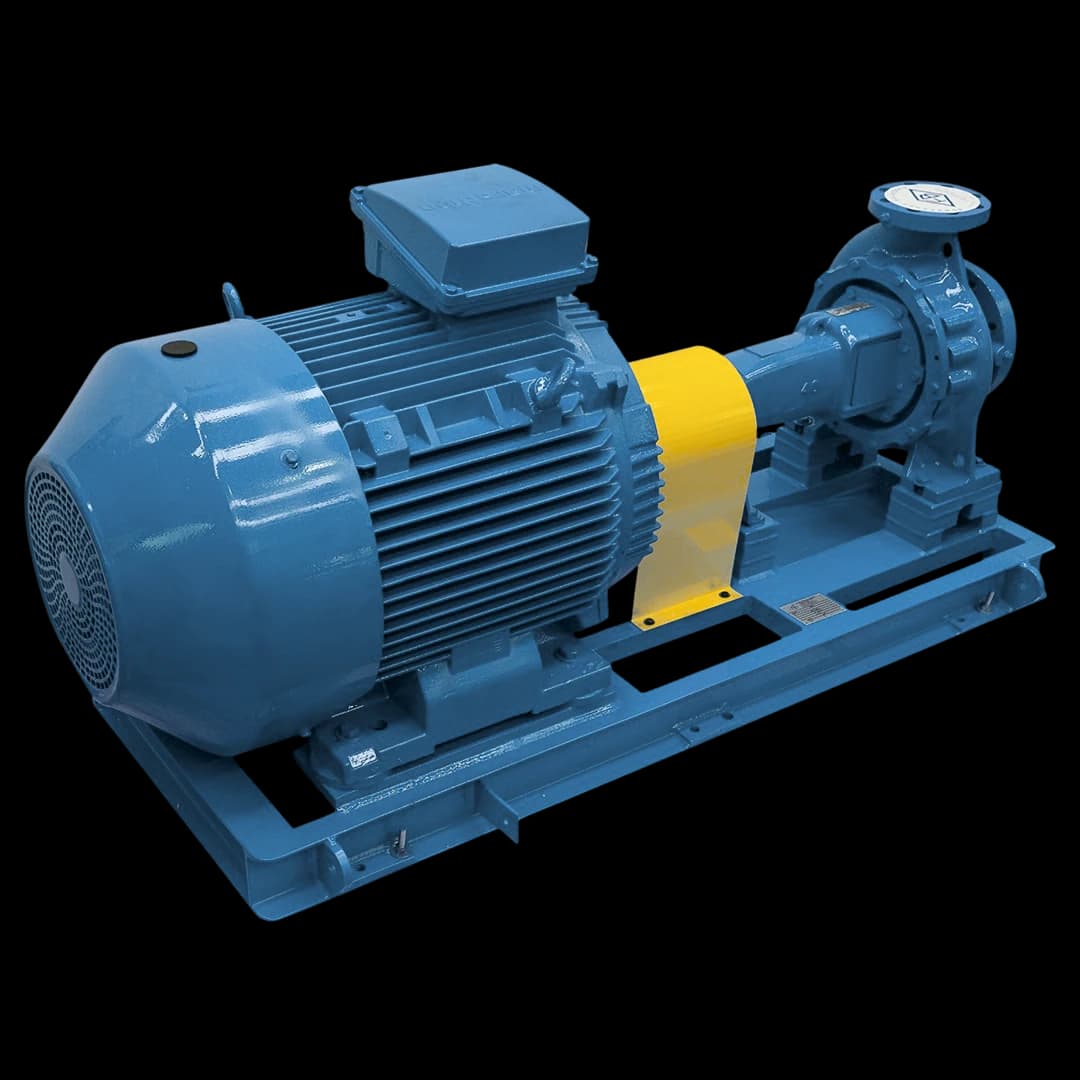
1. Pump not primed — the #1 cause
Conventional centrifugal pumps — including the entire FBCN line and FBOT — are not self-priming. This means the impeller only transfers energy to the liquid when the casing and the section up to the foot valve are completely filled with fluid. If there is an air pocket inside the casing, the impeller spins in air and cannot generate the suction needed to draw liquid from the suction reservoir.
The solution is the priming procedure: with the pump stopped, open the upper casing vent and inject liquid (clean water or the process fluid itself, according to service) until it flows continuously from the vent with no bubbles. In flooded suction (pump below reservoir level), simply open the suction block valve and the vent until all air is purged. In positive suction (pump above level), an auxiliary system is required: elevated gravity priming tank, vacuum pump, or ejector.
Characteristic symptom of unprimed startup: the motor starts, reaches rated speed, current reading stays below rated (because the impeller is moving only air), and the discharge gauge shows no pressure. The pump may operate in this condition for minutes before dangerously overheating — shut down immediately.
2. Air ingress at suction
The suction line operates under negative pressure (partial vacuum) whenever the pump is above the reservoir level. Any sealing discontinuity in suction — dry flange gasket, loose bolts, threaded connection without sealing tape or paste, poorly tightened block-valve packing, crack in reducer sleeve — works as a hole through which air enters. Air dilutes the pumped liquid, reduces flow, generates bubbling noise and, in severe cases, prevents aspiration entirely.
To diagnose air ingress, the simplest field test is to pressurize the suction: close the foot valve (or plug the pipe inlet) and pressurize the line with 1 to 2 bar of compressed air. Apply soapy water solution to all joints, connections and stuffing box — bubbles indicate leakage. The fix is to replace gaskets, retorque bolts with correct torque, redo threaded connections with Loctite 567 or PTFE tape, and replace cracked sleeves.
In critical systems, specifying all suction connections as flanged (not threaded) drastically reduces failure points.
3. Foot valve stuck or with compromised sealing
The foot valve is installed at the lower end of the suction piping, submerged in the reservoir. Its function is twofold: to filter coarse particles and — above all — to maintain the liquid column in the suction line when the pump stops, preventing prime loss. If the valve sticks open (object trapped between disc and seat), the column drains every time the pump shuts down, and the next startup fails.
If it sticks closed (corrosion, sediment), the pump starts but cannot draw the liquid.
Diagnosis: after priming and stopping the pump, wait 10 to 15 minutes with the pump off. If the next startup requires re-priming, the foot valve is opening and draining — replace it. If startup never completes even with fresh prime, the valve may be stuck closed — disassemble and inspect. FB recommendation: always install cast iron foot valve with removable strainer, and in fluids with solids specify bronze or 304 stainless steel according to local chemistry.
4. Insufficient NPSHa and geometric height above physical limit
The absolute maximum height any pump can suction at sea level is about 10.33 meters — a limit imposed by atmospheric pressure pushing the liquid into the piping. In practice, considering water vapor pressure, friction losses and the pump NPSHr, the real limit drops to 6 to 7 meters for cold water, and much less for hot or volatile fluids. At high altitudes (Brasília is at 1,170 m, where atmospheric pressure drops to ~88 kPa), the limit reduces proportionally.
The technical parameter that materializes this limit is NPSH (Net Positive Suction Head). If the NPSH available at the installation (NPSHa) is lower than the NPSH required by the pump (NPSHr in catalog), the pump cavitates or simply fails to establish flow. FB Bombas recommends a minimum margin of 0.5 m for FBCN in water and 1.0 m for hot or viscous fluids.
Solution when NPSHa is insufficient: lower the pump (flooded suction), increase suction piping diameter, reduce number of bends and valves, cool the fluid if possible, or switch to a model with lower NPSHr.
5. Clogged strainer and reversed rotation direction
The suction strainer clogs progressively as sediment, biofilm or leaves (in surface water intakes) accumulate. The effect is increased suction friction loss, which reduces NPSHa until the pump stops drawing. Typical symptom: pump operates normally for days or weeks, then presents gradual flow drop and finally fails to draw. Diagnosis: measure pressure drop across strainer with gauges before and after — if above 0.3 to 0.5 bar, clean or replace.
Reversed rotation direction is a common cause after electrical maintenance: when replacing the motor or rewiring the contactor, two of the three phases may swap, making the motor spin backward. In an FBCN centrifugal pump spinning in the wrong direction, the impeller still generates some pressure (about 30% to 40% of rated), but flow is much reduced and there is abnormal noise. Diagnosis: check the arrow on the pump volute and compare with actual rotation observed at the coupling side.
Solution: swap two phases at the motor terminal block. Always verify before coupling — starting a pump uncoupled from the motor is the standard commissioning procedure precisely to avoid damage.
6. Worn impeller and dry packing aspirating air
An impeller worn after years of operation — especially in fluids with solids or aggressive pH — loses effective diameter at vane edges and wear rings. The result is progressive pressure and flow drop until the pump no longer overcomes installation friction losses and appears to "not draw". Diagnosis: compare current operating curve (measure Q and H at known point) with catalog curve. If flow is below 70% of expected, the impeller is worn.
Solution: replace impeller (FB Bombas standard spare part for all series) and wear rings, and investigate root cause (abrasion, corrosion, prior cavitation).
Dry packing is a frequently overlooked cause of air ingress. In pumps with traditional packing (not mechanical seal), sealing depends on small liquid drip for lubrication. If packing has been tightened beyond recommended, or if the pump has been stopped for too long allowing dry-out, the stuffing box aspirates air through the very zone that should seal — the effect on suction is identical to a hole in the line.
Solution: loosen the gland nut to allow controlled drip of 30 to 60 drops per minute, or plan conversion to simple mechanical seal (FB recommendation for most modern applications).
7. Correct startup procedure — FB Bombas reference
To avoid all nine causes above at initial and subsequent startups, FB Bombas establishes the following standard procedure for FBCN and FBOT: (1) verify pump-motor alignment with dial indicator before coupling — misalignment causes vibration and bearing wear; (2) verify decoupled motor rotation direction — observe arrow on volute; (3) couple pump and motor, check coupling axial clearance; (4) prime the pump — open upper vent, fill casing and suction line, close vent when liquid flows with no bubbles; (5) fully open suction valve; (6) fully close discharge valve; (7) start motor; (8) gradually open discharge valve to specified operating point; (9) check discharge pressure, motor current, bearing temperature and absence of abnormal vibration.
If after the complete procedure the pump still fails to establish flow, FB Bombas application engineering can assist with remote startup diagnostics via telemetry (current, pressure, flow) or on-site technical visit. Contact: comercial@fbbombas.com.br or WhatsApp +55 11 97287-4837.