


1. Classification by impeller flow direction
The first and most fundamental classification is by the direction the liquid takes through the impeller. In radial-flow pumps, the liquid enters parallel to the shaft and is discharged perpendicular to the shaft (radially) — geometry that prioritizes head generation at moderate flow. In axial-flow pumps, the liquid enters and exits parallel to the shaft, behaving like a propeller in a duct — geometry that prioritizes high flow at low head.
Mixed-flow pumps have intermediate trajectory, offering a compromise between head and flow.
The choice among radial, mixed and axial is guided by specific speed (Ns), a dimensionless parameter that combines rotation, flow and head. Radial pumps typically operate with Ns between 500 and 4,000 (Brazilian system); mixed-flow between 4,000 and 9,000; and axial above 9,000. The FB Bombas FBCN and FBOT Series are radial-flow pumps, ideal for industrial process applications where head dominates over flow (up to 140 m head in FBCN).
2. Classification by number of stages
Single-stage pumps have only one impeller — the full head is generated by a single conversion of kinetic energy to pressure. They are constructively simpler, cheaper and easier to maintain. The practical head limit in single-stage is around 90 to 140 m with conventional impeller at 3,500 rpm; above that, mechanical stress on the impeller and NPSH constraints make multi-stage necessary.
Multi-stage pumps have two or more impellers in series within the same casing. The head from each stage adds up, allowing very high pressures (up to hundreds of meters) with smaller and mechanically less stressed impellers. Typical multi-stage applications: boiler feed, oilfield water injection and high-pressure systems. The FB Bombas FBCN line is single-stage (53 models covering up to 140 m head) — suitable for the vast majority of industrial B2B applications.
3. Shaft orientation — horizontal vs vertical
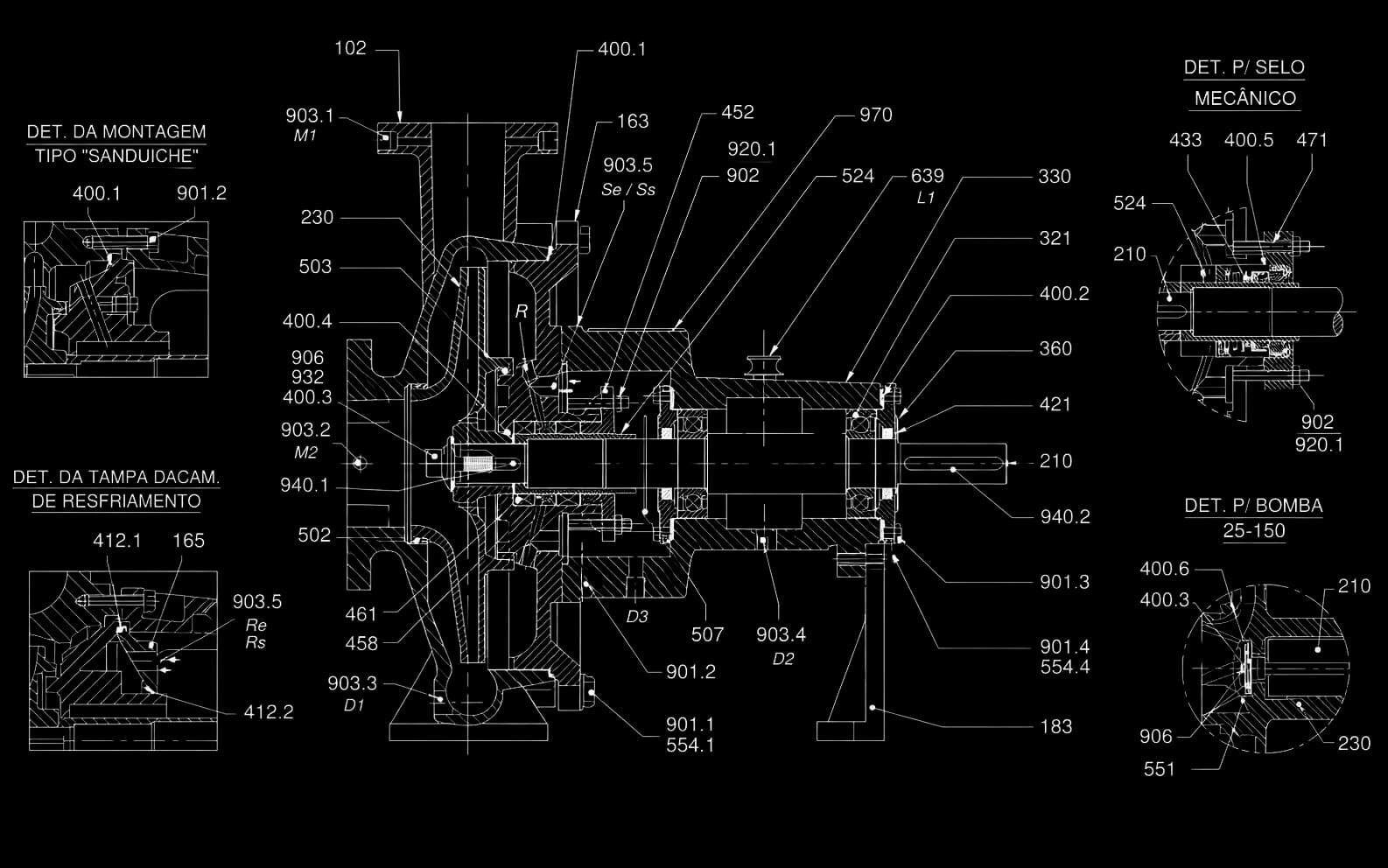
Horizontal centrifugal pumps have the shaft parallel to the ground. They are the most common configuration in industrial process because they facilitate motor alignment, bearing maintenance and casing drainage. The FB Bombas FBCN and FBOT Series are horizontal. FBCN has back pull-out construction — a feature that allows removal of the entire rotating assembly (impeller, shaft, bearings and bearing housing) from the rear without disconnecting process piping, significantly reducing maintenance time.
Vertical pumps have the shaft perpendicular to the ground. Their advantages are: (1) smaller footprint; (2) naturally flooded suction when installed in wells or tanks below the pump level; (3) natural casing drainage by gravity. Their disadvantages are more critical alignment, difficult maintenance of lower bearings and higher cost. They are common in raw water systems, industrial drainage and turbine pumps for deep wells.
4. Casing configuration — end-suction, split-case and in-line
In end-suction pumps (axial suction), the suction nozzle is aligned with the impeller axis (axial inlet) and the discharge nozzle exits radially from the volute. It is the most common configuration in industrial process — the entire FB Bombas FBCN Series is end-suction per ASME B73.1. FBOT is also end-suction, in close-coupled construction where the motor is flanged directly to the pump without intermediate coupling, eliminating shaft alignment and reducing footprint.
In split-case pumps, the casing is split into two halves by a plane containing the shaft. The impeller sits between the two halves. The advantage is access to the impeller without removing the nozzles — faster maintenance in large pumps. Common in high-flow pumps (cooling water, intake) and horizontal fire pumps. In in-line pumps, suction and discharge are aligned in series in the same pipe run — which simplifies installation and eliminates elbows. Typically used in booster and circulation pumps.
5. Impeller geometry — closed, semi-open and open
The closed impeller has blades enclosed by two shrouds (front and back). It is the highest hydraulic efficiency geometry because it minimizes internal recirculation. Suitable for clean liquids or those with fine particles. It is the standard geometry of the FB Bombas FBCN Series.
The semi-open impeller has only the back shroud, with blades exposed on the suction side. It is indicated for liquids with moderate suspended solids or pulps — the absence of the front shroud reduces clogging risk between blades and casing. Hydraulic efficiency is lower than closed impeller. The open impeller has only blades attached to the hub, without shrouds.
Used for fluids with large solids, fibers or applications where clogging is the main concern — at the cost of significantly lower hydraulic efficiency.
| Impeller type | Typical efficiency | Recommended application |
|---|---|---|
| Closed | 70 to 85% | Clean liquids, process water, light hydrocarbons (FBCN standard) |
| Semi-open | 60 to 75% | Pulps, liquids with moderate suspended solids |
| Open | 50 to 65% | Fibrous fluids, abrasive solids, applications where clogging is critical |
6. Classification of FB Bombas FBCN and FBOT Series
Applying the five criteria above to the FB Bombas centrifugal lines: the FBCN Series is radial (radial flow), single-stage, horizontal, end-suction with back pull-out construction and closed impeller — fully compliant with ASME B73.1 and API 610 12th ed. There are 53 models divided into 43 standard (DN25 to DN150) and 10 large-capacity (DN200 to DN300), covering flow up to 2,400 m³/h and head up to 140 m.
The FBOT Series is radial, single-stage, horizontal, end-suction close-coupled with cooled sealing chamber — designed specifically for thermal oil up to 350°C. Both series comply with ANSI/HI 14.6 for hydraulic acceptance testing and ISO 21940 G2.5 dynamic balancing.