


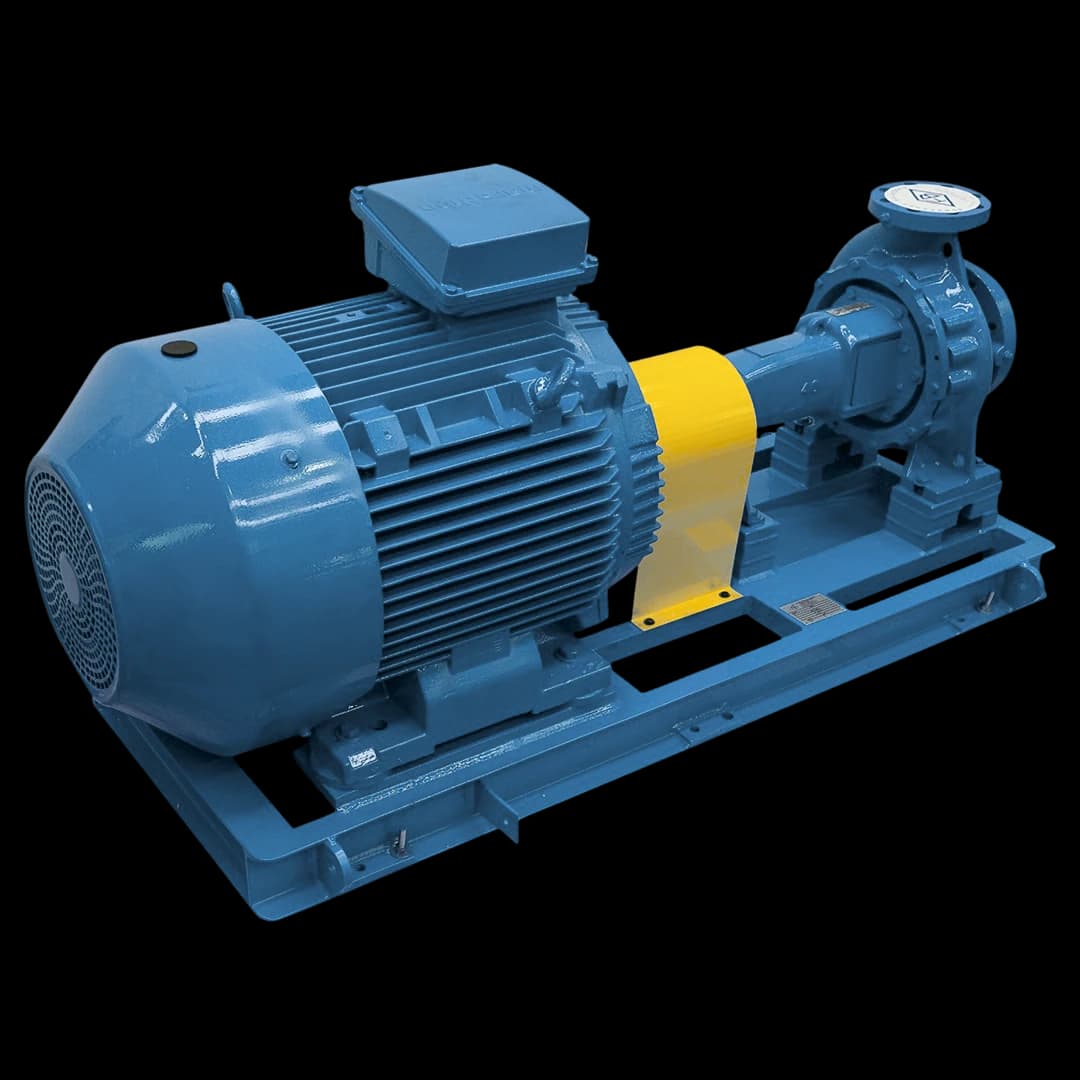
1. NPSH concept in centrifugal pumps
In a centrifugal pump, liquid enters axially through the impeller eye — region where static pressure is the lowest in the internal hydraulic circuit. If that pressure falls below the liquid vapor pressure at operating temperature, local vaporization occurs, forming vapor bubbles that — collapsing in higher-pressure zones — cause cavitation, a destructive phenomenon described in detail in a dedicated article. NPSH (Net Positive Suction Head) is the hydraulic parameter that quantifies the safety margin against this phenomenon.
The concept is dual: available NPSH (NPSHa) is the useful energy amount above vapor pressure that the installation provides to the pump; required NPSH (NPSHr) is the amount the pump needs to prevent cavitation onset. The safe operating condition is simple: NPSHa > NPSHr with adequate margin. While the concept is identical to NPSH in gear pumps, in centrifugal pumps the critical variables change: fluid viscosity weighs less; flow and impeller suction-specific speed dominate.
2. NPSHa calculation — installation formula
NPSHa is an installation property — it depends on the suction reservoir, piping, fluid temperature and geographic elevation. Its classical formula in meters of liquid column is presented below, and each term must be evaluated under actual operating conditions (not theoretical design).
NPSHa = (Pa − Pv) / (ρ · g) ± Hz − Hf [m]Available NPSH for a typical centrifugal installation
3. The four NPSHa terms in detail
The first term (Pa − Pv)/(ρ·g) represents the useful pressure on the liquid surface minus vapor pressure. In open tanks, Pa is local atmospheric pressure — corrected by altitude (about 10.33 m at sea level; 9.4 m at 1,000 m altitude; 8.2 m at 2,000 m). In pressurized tanks, Pa is the absolute pressure at the liquid top.
Pv depends strongly on temperature: water at 20°C has Pv = 0.24 m, but at 80°C rises to 4.8 m and at 100°C to 10.33 m — a detail that makes high-temperature suction particularly critical.
The second term Hz is the geometric height between the liquid level in the reservoir and the pump shaft. Positive sign when reservoir is above pump (flooded suction — favorable) and negative when below (suction lift — unfavorable). The third term Hf is the total suction line friction loss: depends on equivalent length, diameter, roughness and Reynolds number. For water in well-sized industrial piping, typical values are between 0.5 and 2.0 m.
In systems with filters, valves and elbows, Hf can exceed 5 m and be the root cause of cavitation from insufficient NPSH.
4. Safety margin — ANSI/HI 9.6.1
The NPSHr published in the catalog is the point where the pump shows a 3% head drop — called NPSH3. This is already a point with internal cavitation (small scale). For continuous operation without damage, it is necessary to work with margin above that value. ANSI/HI 9.6.1 (Hydraulic Institute) recommends minimum margin as the larger of two criteria: 0.6 m absolute OR 1.0× NPSHr — always the larger.
In critical applications (high temperature, fluids near saturation, volatile hydrocarbons), the margin can rise to 1.5× to 2.0× NPSHr.
5. Suction-specific speed (Nss) and internal recirculation
The suction-specific speed Nss is a dimensionless parameter characterizing the impeller hydraulic suitability regarding cavitation. Its formula combines speed, BEP flow and BEP NPSHr: Nss = N · Q^0.5 / NPSHr^0.75 (US system, with N in rpm, Q in GPM and NPSHr in ft).
Impellers with high Nss (above 11,000) tolerate low NPSH at BEP but tend to show hydraulic instability at part-load — phenomenon called suction recirculation, in which part of the liquid reverses flow at the impeller eye, causing recirculation cavitation even with NPSHa > NPSHr.
For this reason, the conservative centrifugal pump industry (refineries, chemical plants) limits Nss to values between 8,500 and 11,000. Low-Nss impellers are "well-behaved" at part-load — the application does not compromise service life when the operating point moves away from BEP. The FBCN Series is designed with conservative Nss criterion, aligned with API 610 12th ed. and ASME B73.1.
6. NPSH in FBCN DN200+ — critical selection variable
In large-capacity FBCN models (DN200, DN250 and DN300 — the 10 large-capacity Series models), operating flows are high (hundreds to thousands of m³/h), and NPSHr grows significantly at high flow. It is common in these models for BEP NPSHr to be between 4 m and 8 m — requiring careful installation: flooded suction with positive geometric height, short and generously sized piping (velocity ≤ 1.5 m/s), low-pressure-drop filters and attention to fluid temperature.
In situations where NPSHa is structurally low (atmospheric tank near boiling, high altitude, long piping), FB Bombas application engineering may recommend: (1) selecting an FBCN model with larger diameter and 1,750 rpm instead of 3,500 rpm — reduces NPSHr; (2) installing a low-speed booster pump at suction; (3) raising the reservoir to ensure positive Hz; (4) resizing the suction pipe diameter to reduce Hf. Each decision is validated on hydraulic bench per ANSI/HI 14.6 before shipment.