

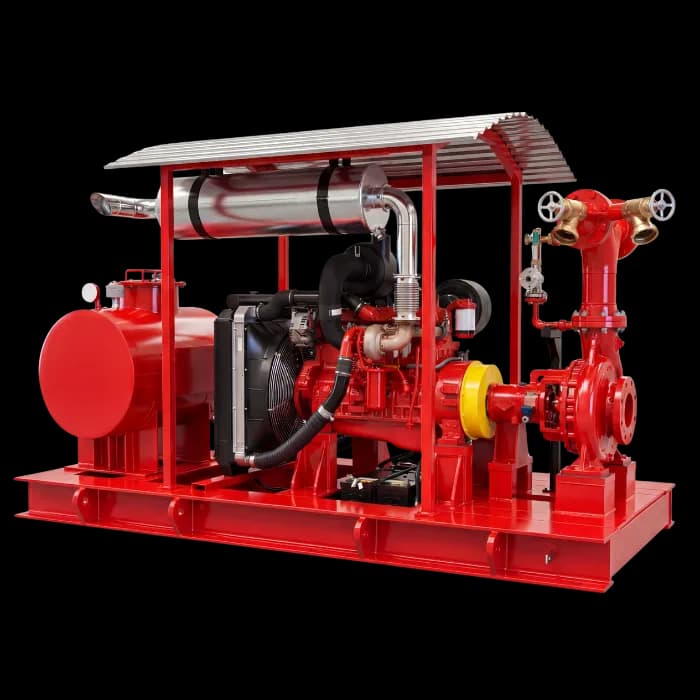
ABNT NBR 10897 is the Brazilian standard for automatic sprinkler fire protection systems. State rules apply it with their own criteria: Federal District NT 13 and São Paulo IT 23 classify hazard, as a rule, by fire load, use density/area curves, set 48 kPa as the minimum operating pressure at any sprinkler and tabulate minimum durations of 30 to 90 minutes. The calculated flow and pressure define the fire pump.
At a glance
- NBR 10897 is the sprinkler standard; Federal District NT 13 and São Paulo IT 23 apply it with their own parameters and accept NFPA 13 where the Brazilian standard is silent.
- As a rule, hazard comes from fire load: light up to 300 MJ/m² in both; ordinary I runs up to 900 MJ/m² in the Federal District and up to 800 MJ/m² in São Paulo.
- Density and area come from the same curves in both rules; 6.11 mm/min over 139.35 m² already adds up to about 851 L/min for the sprinklers alone.
- Minimum operating pressure of 48 kPa at any sprinkler and minimum durations of 30, 60 and 90 minutes; in the Federal District, without detection supervising the system, ordinary and extra hazard add 30 minutes.
- In São Paulo, the sprinkler pump works under positive pressure, with no priming tank, and the set meets NBR 16704; in the Federal District, NT 13 requires a jockey pump.
1. What NBR 10897 is and when it applies
ABNT NBR 10897, Fire protection systems by automatic sprinklers, is the Brazilian sprinkler standard. Under the CBMDF NT 13 definition, an automatic sprinkler is a spray device activated when heat reaches the rating of its heat-sensitive element, intended to extinguish or control the fire.
São Paulo IT 23 describes the system as fixed: automatic water discharge at the initial stage of the fire, with simultaneous activation of the building fire alarm. The hydrants and hose reels of NBR 13714 are a different measure, operated with a hose by trained personnel.
State regulation decides whether the system is required. In the Federal District, CBMDF NT 13 applies to buildings that the safety-measures standard classifies as requiring automatic sprinklers, and it does not apply to storage areas, which follow a specific standard. In São Paulo, IT 23 applies wherever sprinklers are required or installed for other reasons; storage occupancies follow IT 24.
Both rules start from NBR 10897. NT 13 requires the detailed design to follow the standard’s criteria and accepts the NFPA 13 parameter for items it does not cover; IT 23 adopts NBR 10897 subsidiarily and sets the operating area, tables and other technical parameters in its own text. That is why the design starts with the jurisdiction.
In São Paulo, the design submitted to the Fire Department is the preliminary one, with the isometric diagram of the operating area and the pipe route to the water supply; the detailed design need not be submitted for review, but must be kept available at the building. In the Federal District, the design submitted to CBMDF shows the tank, pump set, automation line, alarm check valve, test connection, fire department connection, piping and sprinklers.
2. Hazard classification: light, ordinary and extra
Hazard is classified for the sprinkler system, not for the whole building. CBMDF NT 13 considers the quantity and combustibility of contents, the expected heat release and the presence of flammable and combustible liquids, and warns that this classification is not a general definition of the occupancy. São Paulo IT 23 uses the same criteria and adds the total energy-release potential.
In the Federal District, NT 13 classifies by the sum of the fire load per square metre observed in the design area; in São Paulo, IT 23 starts from the IT 14 fire load. The ranges differ: light hazard goes up to 300 MJ/m² in both, but ordinary I ends at 900 MJ/m² in the Federal District and at 800 MJ/m² in São Paulo, and ordinary II at 1,800 and 1,200 MJ/m².
In São Paulo, extra hazard II is not a fire-load range: it covers occupancies with moderate or substantial quantities of combustible or flammable liquids, high-load occupancies classified as M-2 in IT 14, and car parks with vertical vehicle stacking or lifts of up to two levels. Extra hazard I, above 1,200 MJ/m², may not contain ignitable liquids.
Under IT 23, existing buildings, even if unlicensed or with a change of occupancy, area or height, may keep the hazard classification of the current occupancy by the NBR 10897 table or NFPA 13 Annex A.
| Hazard | Fire load, Federal District (NT 13) | Fire load, São Paulo (IT 23) | Minimum operating time |
|---|---|---|---|
| Light | up to 300 MJ/m² | up to 300 MJ/m² | 30 min |
| Ordinary I | over 300 up to 900 MJ/m² | over 300 up to 800 MJ/m² | 60 min |
| Ordinary II | over 900 up to 1,800 MJ/m² | over 800 up to 1,200 MJ/m² | 60 min |
| Extra I | over 1,800 up to 2,500 MJ/m² | over 1,200 MJ/m², no ignitable liquids | 90 min |
| Extra II | over 2,500 MJ/m² | combustible or flammable liquids; IT 14 M-2 | 90 min |
In the Federal District, the 60 and 90 minutes for ordinary and extra hazard assume automatic detection supervising the sprinkler system at the alarm test connection; without that supervision, NT 13 adds 30 minutes. With more than one hazard, NT 13 sizes the system for the one with the highest hydraulic demand; in mixed occupancies, IT 23 calculates the reserve from the flow of the most severe hazard and the time of the predominant one.
3. The density/area method: how the sprinkler defines the pump flow
The hydraulic calculation starts from two quantities: discharge density, in mm/min (1 mm/min equals 1 L/min per square metre), and operating area, the reference area tied to that density for each hazard class. CBMDF NT 13 and São Paulo IT 23 carry the same density/area curves, one straight line per hazard, and the calculation must satisfy one point of the chosen curve, not all of them.
In NT 13 Figure 01, light hazard runs from 4.07 mm/min over 139.35 m² to 2.85 mm/min over 278.70 m²; ordinary I and II run from 139.35 to 371.60 m², at 6.11 to 4.07 and 8.15 to 6.11 mm/min; and extra I and II run from 232.25 to 464.50 m², at 12.22 to 8.15 and 16.3 to 12.22 mm/min. The larger the area adopted, the lower the density.
IT 23 adds limits. For light and ordinary hazard, an operating area under 140 m² uses the density for 140 m²; for extra hazard, under 230 m² uses the density for 230 m². Ceilings sloped more than 16.7% and double-interlock preaction systems increase the area by 30% without changing the density, and high-temperature sprinklers in extra hazard allow a 25% reduction, down to 190 m².
Multiplying gives the order of magnitude: 6.11 mm/min over 139.35 m², a point on the ordinary I line, adds up to about 851 L/min for the sprinklers alone. In São Paulo, IT 23 requires hydrant demand to be added to sprinkler demand in the hydraulic calculation and the reserve, and that demand follows Table 2 of IT 22 even when the two systems are independent.
The design value comes from the sprinkler-by-sprinkler calculation, which starts at the hydraulically most remote sprinkler and accumulates flows and head losses up to the supply point. Each sprinkler in the operating area must discharge at least the minimum density times its coverage area.
The design area is a rectangle in the sector of highest hydraulic demand, with the side parallel to the branch lines at least 1.2 times the square root of the operating area, in both NT 13 and IT 23. In the IT 23 example, 140 m² at 11.1 m² per sprinkler gives 13 sprinklers, and 1.2 × √140 divided by the 3.7 m spacing between sprinklers gives 3.84, rounded up to 4 sprinklers per branch line.
Q [L/min] ≈ densidade [mm/min] × área de operação [m²]Sprinkler system reference flow (order of magnitude; the design value comes from the sprinkler-by-sprinkler hydraulic calculation)
4. Wet pipe, dry pipe, preaction and deluge: what changes for the pump
In a wet-pipe system, the network is filled with pressurized water, and a sprinkler opened by heat discharges at once. The National Fire Sprinkler Association (NFSA) describes it as the most common type, limited to buildings with above-freezing temperatures. In a dry-pipe system, suited to areas where the ambient temperature can fall below freezing, the network holds pressurized air or nitrogen, and water reaches the sprinkler only after that air is released, with a slight delay.
Preaction is designed to prevent accidental discharge: water enters the network only after a separate detection system identifies the fire and releases the valve. NFSA cites computer server rooms and surgery centers. In a deluge system, the pipes stay dry and the sprinklers are open: once fire is detected, the deluge valve releases water through all of them at once, in high-hazard areas such as chemical storage, aircraft hangars and power plants with flammable liquids or gases.
For the pump, the system type changes the demand and the calculation adjustments. In a deluge system, all open sprinklers in the circuit discharge together, and the pump serves the flow of that entire set. In São Paulo IT 23, double-interlock preaction increases the operating area by 30% without changing the density.
Between the pump and the network sits the alarm check valve (VGA), on the main supply riser. Under IT 23, a wet-pipe system signals flow through the alarm check valve or another flow detector; preaction and deluge carry two independently triggered alarms, one from the detection system and one from water flow.
NT 13 limits the area protected per main riser and floor: 4,800 m² for light and ordinary hazard and, for extra hazard, 3,700 m² when hydraulically calculated or 2,300 m² when sized by table. More risers extend the protected area, but the pump is still sized for the design area in the sector of highest hydraulic demand.
Define the system type before the pump. A deluge design calculated as a wet-pipe system underestimates the demand, because in a deluge system every sprinkler in the circuit discharges at the same time.
5. Water supply and pump: what the standard demands from the set
Under CBMDF NT 13, the reserve comes from the hydraulic demand and the operating time of the design-area hazard, as an exclusive volume for the sprinklers in an automatically operated tank. In São Paulo, the water source follows Annex B of IT 22.
When the reserve is not calculated, NT 13 sets the volume for spray sprinklers: 25,000 litres for light hazard, 91,000 and 136,500 litres for ordinary I and II, and 341,000 and 515,000 litres for extra I and II.
NT 13 describes the set: fire pumps specified by head, power and flow for the design-area demand; a pressure-maintenance (jockey) pump to keep the network within the supervision range and prevent false starts of the main pump; individual automatic start on pressure drop, with a manual start device; and fire-pump shutdown only by hand at the control panel, which signals automatic or manual mode with sound and light.
Electric pumps are fed by two distinct and independent power sources. With a diesel engine, the exhaust has a silencer and discharges outdoors, the tank provides at least 8 hours at full load and has a level indicator, and a reserve holds the same fuel volume as the tank. The pump room has a minimum fire resistance of 2 hours when it is not an isolated risk and, with a diesel pump, is protected by automatic sprinklers.
On the suction side, NT 13 calls for flooded pumps, with the shaft below water level X, and allows the shaft up to 2 m above it if that distance does not exceed 1/3 of the tank effective capacity, with a mandatory foot valve on the suction pipe. São Paulo IT 23 is stricter: sprinkler pumps must be under positive pressure, with no priming tank.
For the set, IT 23 refers to NBR 16704 and Annex C of IT 22 and requires pumps protected against mechanical damage, weather, chemical agents, fire and moisture. When the contract adopts NFPA 20, the standard limits the curve: the pump delivers at least 150% of rated flow at no less than 65% of total rated head, and shutoff head does not exceed 140% of rated head, for factory and field performance.
- Exclusive reserve in an automatically operated tank, calculated from demand and hazard duration (NT 13)
- Main and jockey pumps with individual automatic start on pressure drop; main-pump shutdown by hand only, at the panel (NT 13)
- Electric drive with two independent sources; diesel with at least 8 h at full load and a fuel reserve of equal volume (NT 13)
- Pump under positive pressure, with no priming tank, in São Paulo (IT 23)
- Pump set in accordance with NBR 16704 and Annex C of IT 22, in São Paulo (IT 23)
6. Common specification mistakes in sprinkler systems
Four mistakes deserve attention. First: classifying hazard from a generic occupancy list without checking the criterion of the state rule (in the Federal District, the fire load of the design area; in São Paulo, the IT 14 fire load, with the use-based classifications that IT 23 itself makes). Second: using another state’s ranges; ordinary I ends at 900 MJ/m² in the Federal District and at 800 MJ/m² in São Paulo.
Third: forgetting hydrant demand, which IT 23 requires to be added to sprinkler demand and which follows Table 2 of IT 22 even with independent systems. Fourth: calculating a deluge system as a closed-sprinkler system.
Order matters too: hazard classification and parameters under the jurisdiction’s rule, hydraulic calculation up to the supply point, and only then the pump set. NT 13 requires sizing by hydraulic calculation, presented on the forms of its Annex 2, and only accepts tables when extending or modifying systems originally sized by them.
IT 23 also requires hydraulic calculation. Tables are allowed only in a new system with an area under 465 m² and when extending or modifying a system originally sized by them; systems with sprinklers of nominal K-factor other than 80 and systems in extra hazard areas are always calculated.
The Annex 2 report closes with the results that define the set: reserve volume, final pressure at the most unfavorable sprinkler, flow in the application area, and flow, power and head of the fire and pressure-maintenance pumps. With that data, the reserve elevations and the driver type, FB Bombas application engineering selects the set: electric or diesel main pump, jockey pump and control panel.
Protection design, hazard classification and Fire Department approval remain with the facility’s responsible engineers. In São Paulo, IT 23 also recommends that the installer’s responsible engineer fill in the commissioning report of its Annex B, collect the owner’s signature and keep it with the project records.