

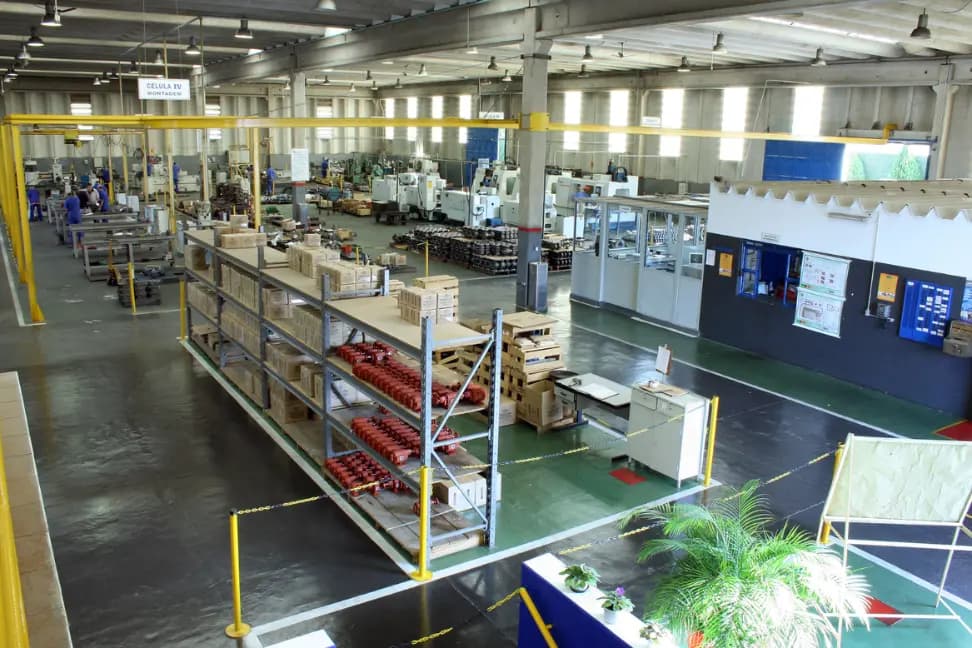
Pump manufacturing in Brazil forms part of the broader history of industrialisation and its sectors. FB Bombas traces its institutional history to 1944 in São Paulo; its current factory is in Cabreúva-SP. The creation of BNDES in 1952, Petrobras in 1953 and Proálcool in 1975 are documented milestones in this context. They do not establish a single origin for the sector, market shares or specific supply contracts without records.
At a glance
- Sector history covers different manufacturers and applications; a timeline does not prove market share.
- FB Bombas began its history in 1944 in São Paulo; its current factory is in Cabreúva-SP.
- Proálcool was established in 1975 by Decree 76,593.
- Assess lead time, parts and total cost in the proposal rather than inferring them from national origin.
- Current catalogues and manuals complement brand history with equipment-selection data.
1. How to read the sector’s history
Pumps serve different processes, including liquid transfer, circulation and pressurisation. A history of the sector therefore needs to distinguish applications and manufacturers rather than assume the entire industry began with one technology or in one year.
In this overview, institutional dates come from the organisations responsible for the records. Connections to pumping demand are application context, not sales estimates or evidence of FB Bombas contracts.
A founding date documents institutional history. Performance, quality and supply capability need their own evidence.
2. The 1940s and the beginnings of FB Bombas
CSN records its establishment in 1941 and the start of Presidente Vargas Steelworks operations in 1946. These mark industrial infrastructure development in the period. FB Bombas’s 1944 starting date belongs to that context but does not by itself establish commercial relationships with those projects.
Current FB Bombas catalogues trace the company’s history to 1944. Company information places its beginnings in São Paulo. The present Cabreúva facility should be described separately, without assigning the brand’s entire history to that address.
The current portfolio includes gear and centrifugal series and solutions for different processes. Available documentation supports describing those lines today; it does not establish when each series was launched in earlier decades.
3. Post-war infrastructure and energy
BNDES was established on 20 June 1952, initially as BNDE. Petrobras dates its creation to 3 October 1953. BNDES historical records also document the 1956–1961 Target Plan, associated with infrastructure and industrial development.
Energy, petroleum and manufacturing involve liquid circuits with different operating conditions. This context explains why pump specification requires process knowledge. It does not imply that one pump family suits every installation.
To connect a current product line to an application, consult its catalogue, curve and manual. Industrial history provides context; selection depends on flow, pressure, liquid, temperature and documented configuration.
| Year | Milestone | What the record establishes |
|---|---|---|
| 1944 | Founding of FB Bombas | Start of institutional history in São Paulo |
| 1946 | CSN at Volta Redonda | Start of Presidente Vargas Steelworks operations |
| 1952 | Creation of BNDE, now BNDES | Bank established under Law 1,628 of 20 June |
| 1953 | Creation of Petrobras | Company established on 3 October |
| 1956 | JK's Plano de Metas | 1956–1961 development programme |
| 1975 | Launch of Pró-Álcool | Programme established by Decree 76,593 |
4. Proálcool and sugar-energy processes
Decree 76,593 of 14 November 1975 established the National Alcohol Programme, known as Proálcool. It is a documented Brazilian energy-policy milestone, not a basis for estimating pump manufacturers’ market shares or market size.
Water, juice, molasses, ethanol and other mill liquids have different properties. Embrapa describes juice evaporation using steam; this must not be confused with a thermal-oil circuit. For pump selection, identify the actual circuit, composition, solids and temperatures.
A mill’s current requirements should appear in data sheets and proposals: curves, materials, seals and required documents. API or ASME compliance cannot be inferred solely from the sector served or manufacturer age.
Understand today’s application before selecting a series. The sugar-energy guide details the data that distinguish mill circuits.
5. Assessing a Brazilian manufacturer’s proposal
Brazilian origin is relevant supply information but does not alone establish lead time, performance or total cost. Compare proposals on the same technical basis, with explicit scope, materials, documentation and commercial terms.
For replacement parts, identify model, serial number, drawing and applicable revision. Support for a specific unit depends on correct identification and part confirmation, not a generic promise linked to company age.
At FB Bombas, use series and model pages to locate product documents and send the application to the team. Brand history complements this assessment; purchase decisions should be supported by configuration suitability for the process.
6. The pre-salt cycle and the return of Brazilian engineering
Petrobras dates the commercial pre-salt discovery to 2006. ANP documents local-content commitments in exploration and production contracts, with rules varying by contract and licensing round. They do not amount to universal technical certification of Brazilian-made pumps.
For oil and gas procurement, check local content, supplier registration, technical standards and test requirements separately. Each document supports a different aspect of supply; none replaces the others. A catalogue application also does not prove a historical operator contract.
7. Digital documentation and traceability
Online catalogues make families, general limits and applications accessible. Manuals identified by code and revision guide installation and maintenance of covered configurations. Digital access is valuable when users can distinguish these documents from the supplied unit’s curves and records.
For selection, collect process data and record each value’s source. A published curve, engineering estimate and individual test have different roles. The same care applies to illustrations and product photographs.
FB Bombas pages connect series, models, catalogues and technical contact. Choose a family for the application, consult configuration data and submit liquid, flow, pressure and temperature for assessment. This sequence connects initial research with a verifiable specification.
8. From history to equipment selection
These milestones show different contexts in Brazilian industry without turning the chronology into a manufacturer ranking. The buyer’s next step is to identify the application and check the corresponding series documents.
Send liquid, flow, pressure, temperature and installation conditions to FB Bombas. For existing equipment, include identification and available documents. This connects the brand’s history to a technical decision based on the actual process.
FB Bombas traces its history to 1944 in São Paulo. Its current factory is in Cabreúva-SP. Visit Our History for company information and product pages for current technical data.