


1. CRCC Petrobras Family 6 — the canonical technical registration
Petrobras Supplier Registration (CRCC) is the official system by which the state-owned company qualifies equipment and service suppliers for its plants throughout Brazil. Registration is organized by product families, each with specific technical criteria. Family 6 is for centrifugal pumps — includes audit of manufacturing facilities, machine park verification, engineering technical capability analysis, test bench validation, and supply history review.
For public tenders in general (not only Petrobras), CRCC Family 6 registration works as indirect reference of technical qualification: companies with this registration have been audited by one of the most rigorous technical buyers in the country, and the audit covers exactly the points that matter for pump quality.
Specifying "supplier with active CRCC Petrobras Family 6 on opening date" is verifiable, objective and non-discriminatory criterion — Petrobras publishes the list of registered, and any Brazilian supplier can obtain registration through audit.
FB Bombas maintains active CRCC Petrobras Family 6 registration for decades and supplies refineries, terminals and chemical plants of Petrobras throughout Brazil. This registration is one of the most relevant technical credentials a national pump manufacturer can present.
2. API 610 12th edition vs ASME B73.1 — when to use each
API 610 (American Petroleum Institute) is the worldwide reference standard for centrifugal pumps in oil, gas and refining service. The 12th edition (2021) is the version currently in force and covers detailed project, construction, materials, assembly and test requirements for pumps in critical process service in refineries and oil & gas plants.
API 610 pumps are of more robust construction than ASME B73.1: oversized bearings for B10h ≥ 25,000 hours life, machined monoblock base, flanged connections in high class, and mandatory tests including NPSH, hydraulic performance, mechanical and hydrostatic.
ASME B73.1 (American Society of Mechanical Engineers) is the standard for chemical-process standard pumps — horizontal format, end-suction, OH1/OH2 nozzles, with standardized dimensions that allow interchangeability between different manufacturers. It is the reference standard for process services in chemicals, petrochemicals (auxiliary systems), refining outside critical services, and pharmaceutical plants. Lighter construction than API 610 and significantly lower cost — adequate for 80% of industrial services that do not require API-level robustness.
Specification decision criterion: critical refining services (high pressure, hydrocarbons, high temperature) → API 610 12th ed.; standard process services in chemicals, auxiliary petrochemicals, food, pulp/paper, mining (water), sanitation → ASME B73.1; water, fire, utility applications → ASME B73.1 or ISO 2858 normalization (dimensional standard, not certification). FB Bombas FBCN is dimensionally compliant with ISO 2858 / ASME B73.1, serving the standard process universe.
3. ANSI/HI 14.6 test bench and ISO 21940 G2.5 balancing
Hydraulic test bench per ANSI/HI 14.6 (Hydraulic Institute, currently in its 2022 version) is the standard for certifying pump performance curves. The standard defines measurement instrument accuracy (flow, pressure, power, speed), stabilization time, number of points to record, and result acceptance criteria. Pumps tested on bench accredited per HI 14.6 deliver certified curve with ±3% flow accuracy, ±3% head, ±3% absorbed power, and ±0.5 m NPSHr — much smaller values than those tolerated in manufacturers without test bench.
Specifying "pump tested on bench per ANSI/HI 14.6, with test report signed by responsible engineer" is legitimate technical criterion, verifiable (the report is delivered with the equipment), and that filters suppliers without adequate technical capability. FB Bombas operates its own bench per ANSI/HI 14.6 at its Cabreúva-SP plant and issues test report for each supplied pump.
Dynamic impeller balancing per ISO 21940 (2017 standard that replaced the old ISO 1940) defines balancing quality grades expressed in mm/s. For industrial centrifugal pump impellers, grade G2.5 is the FB Bombas standard — meaning residual unbalance velocity is ≤ 2.5 mm/s, a value that keeps the impeller within ISO 10816 zone A vibration limits in well-aligned set. Specifying "impeller dynamically balanced per ISO 21940 grade G2.5, with individual report" is essential and verifiable technical criterion.
4. Mandatory documentation delivered with the pump
The tender terms of reference must explicitly list the technical documents to deliver with each pump — without this list, conformity verification is subject to conflicting interpretations between buyer and supplier.
Minimum required documentation is: (1) data sheet filled with actual operating parameters (Q, H, NPSHr, power, speed); (2) certified performance curve of the specific delivered pump (with serial number); (3) Mill Test Reports (MTR) of each main material — casing, impeller, shaft — with chemical composition and mechanical properties per applicable ASTM or DIN; (4) hydrostatic test certificate with pressure and time per project standard (1.5× maximum discharge pressure for 30 minutes for API 610); (5) dynamic impeller balancing report per ISO 21940 G2.5; (6) certified dimensional drawing of coupled pump (general arrangement); (7) recommended spare parts list for 2 years of operation.
For critical services (refining, NFPA-20, potable water), add: FAT (Factory Acceptance Test) certificate with independent inspector or buyer presence, NDT (non-destructive testing) certificate for main components — typically penetrant testing (PT) on casing and radiography (RT) on structural welds, and Operation and Maintenance Manual in Portuguese specific to the delivered model (not generic document).
5. Anti-pattern #1 — ISO 9001 requirement
Including "ISO 9001 mandatory" in tender documents for centrifugal pumps is the most common and most damaging anti-pattern.
Technical reasons: (1) ISO 9001 is a quality management system standard — attests to administrative and organizational processes, does NOT attest to intrinsic technical quality of delivered pump; (2) ISO 9001 certification has considerable annual cost (USD 6,000 to 16,000 per year for medium companies) and adds nothing to hydraulic, mechanical or metallurgical properties of the pump; (3) national manufacturers with proven technical excellence — Petrobras supply histories with active CRCC Family 6, API 610 and ASME B73.1 compliance, ANSI/HI 14.6 bench — may not have ISO 9001 simply by resource allocation choice.
Legal and administrative reasons: Law 14.133/2021 (new Tender Law) and the previous 8.666/1993 establish that technical qualification requirements must be proportional to the object, verifiable and necessary for contract execution. TCU (Federal Court of Audit) jurisprudence has consolidated, in several rulings, that ISO 9001 cannot be required as eliminatory criterion when the object admits direct technical verification — typical case of centrifugal pump, whose performance is measured on bench and whose quality is attested by specific technical documentation.
The correct substitution is to require direct technical criteria (CRCC Family 6, API/ASME, ANSI/HI 14.6, ISO 21940) and per-pump documentation, not a process certification.
6. Other anti-patterns to avoid in the tender
Restricting brand, model or origin is forbidden by Brazilian tender legislation — the tender may cite brands as reference ("or similar"), but cannot require a specific brand, except in justifiable cases of documented standardization with prior legal review. Specifying "national manufacturing" is discriminatory if it restricts international competition without technical justification; the legitimate criterion is to require standards compliance (which accepts national and international manufacturers) and technical/commercial service adequate to project deadline.
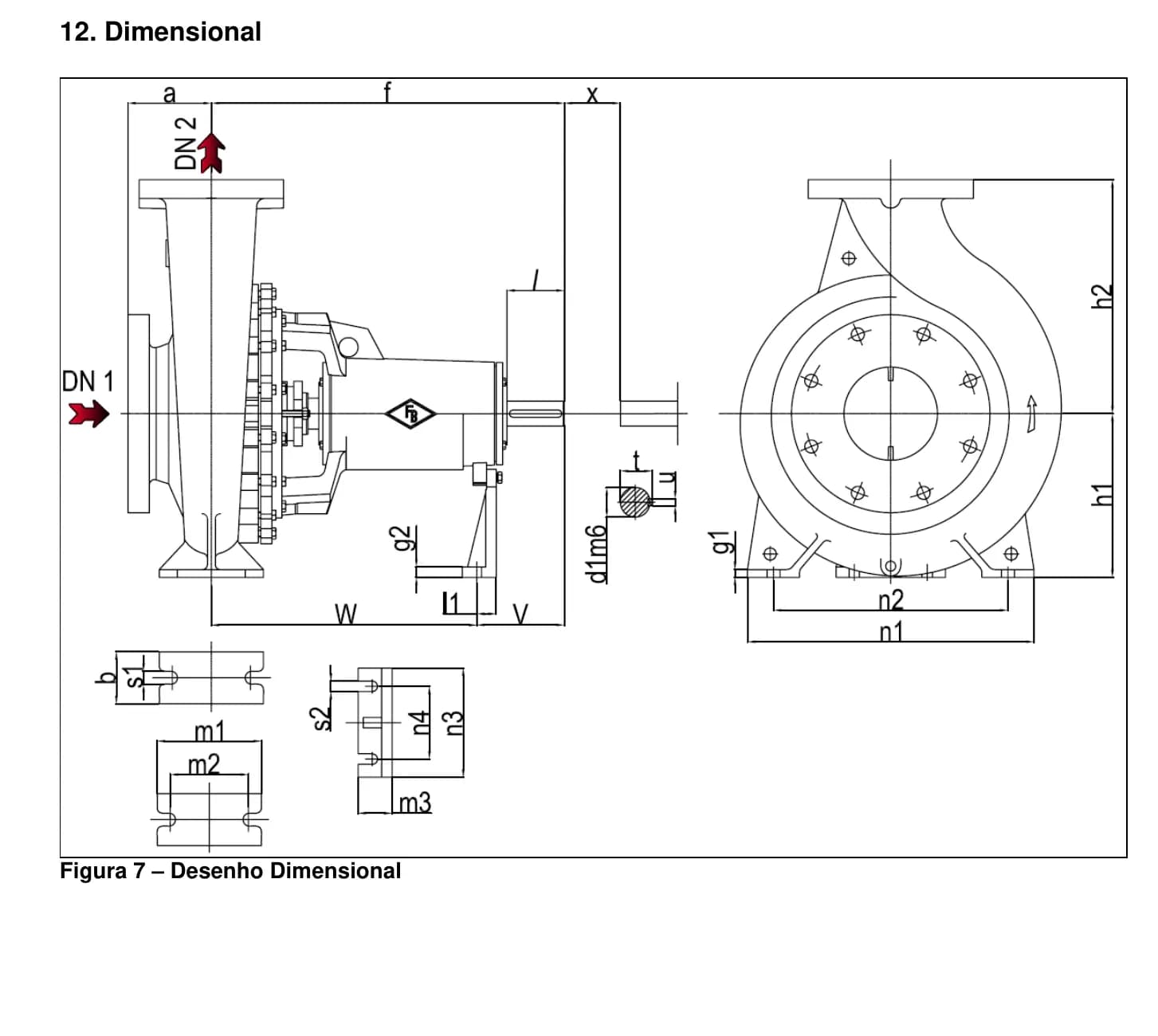
Requiring "ISO 2858 certification" is technically and formally incorrect — ISO 2858 is a dimensional standard for end-suction centrifugal pumps, defining standardized nozzle dimensions, shaft-to-base distance and height. There is no "ISO 2858 certification" as independent document — manufacturers simply deliver pumps dimensionally compliant with the standard, and this is verified by certified dimensional drawing. Correct wording is "pump dimensionally compliant with ISO 2858" or "ASME B73.1", not "ISO 2858 certified".
Other frequent anti-patterns: requiring destructive tests without criterion (a destroyed pump cannot be delivered, and sample destructive test only makes sense in high-volume serial production); requiring exaggerated "minimum company age" (above 10 to 15 years is generally discriminatory); asking for very specific "identical supply proof" that only one supplier fulfills; requiring environmental certifications (ISO 14001) or occupational health (ISO 45001) when the object does not involve environmental or safety risk specific to these standards.
In all these cases, the correct criterion is to require the desired technical result, not the management system.
7. Technical wording template for the tender
Technically correct wording for the technical qualification section of centrifugal pumps in public tender, adaptable per service: "The supplier shall prove: (a) active Petrobras CRCC Family 6 registration on bid opening date; (b) capability to supply centrifugal pumps compliant with [API 610 12th ed.
/ ASME B73.1 per service]; (c) hydraulic test bench in compliance with ANSI/HI 14.6, with test report issuance per pump; (d) dynamic impeller balancing procedure per ISO 21940 grade G2.5; (e) similar supply history (in quantity, capacity range and service type) in the last 5 years, with at least 3 technical performance attestations issued by clients — 'similar' concept defined by flow capacity, head and materials, not by specific brand."
FB Bombas maintains application engineering dedicated to technical support for terms-of-reference drafting for public bodies and state-owned companies. Support includes tender wording review, suggestion of verifiable technical criteria, and supply of updated standard references. Contact: comercial@fbbombas.com.br or WhatsApp +55 11 97287-4837.