1. What defines extreme service in industrial pumping
Extreme service is not marketing jargon — it is a technical condition characterized by at least one of these four factors operating near the limit: (1) kinematic viscosity above 1,000 SSU (~220 cSt); (2) operating temperature above 150°C; (3) fluid that changes phase at room temperature (solidifies, crystallizes, polymerizes); (4) combination of thermal cycling and chemical aggressiveness, as occurs in degraded thermal oil or chemical products with suspended particles.
The practical consequence of these factors is that the pump efficiency curve leaves the "sweet spot" and degradation accelerates. Mechanical seals work outside their design range, bearings suffer thermal misalignment, and available NPSH (calculated under ideal conditions) may be insufficient when the fluid heats up and generates secondary vapor. In this territory, selecting the right pump stops being a catalog question and becomes applied engineering.
2. Why conventional centrifugals fail in extreme service
The standard centrifugal pump (ISO 2858, ANSI B73.1, API 610 BB1/OH1) is designed for fluids with viscosity close to water — up to roughly 100-500 SSU. Above that, hydraulic efficiency collapses: the impeller must spin faster to generate the same flow, power consumption grows quadratically, and internal turbulence generates heat that further heats the fluid.
This vicious circle is why pumps like KSB Etanorm, Sulzer A-Line and similar — excellent for water and thin chemicals — are not specified for asphalt or viscous molasses.
At high temperature, the problem is different but equally severe. Standard centrifugals use rolling bearings near the impeller, bathed in conventional lubricating oil. Above 150°C, the lubricant degrades thermally, bearings lose hardness, and the shaft suffers expansion that misaligns the rotating assembly. That is why thermal oil pumps require special architecture — external bearings, thermal isolation, seal chamber cooling — exactly what the FBOT line delivers following API 610 hydraulic principles with extreme service adaptations.
3. Why FBE (external gear) wins on viscosity
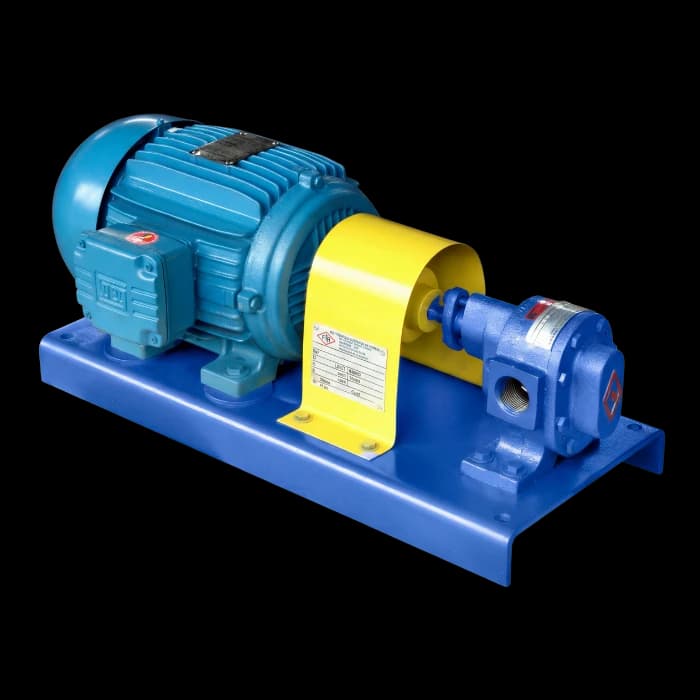
Rotary positive displacement pumps — the category governed by API 676 — operate by the opposite law from centrifugals: increasing viscosity actually improves volumetric efficiency. This happens because viscous fluid seals the internal clearances between teeth and casing better, reducing the "slippage" that steals flow. The FB Bombas FBE pump is designed for this physics: calibrated internal clearances, helical teeth that reduce pulsation, and materials selected according to temperature and fluid.
The FBE-CA variant (with integrated heating jacket) takes this capability to the limit: the casing is wrapped by a jacket that circulates steam or thermal oil around the pump body, keeping the fluid liquid even during extended shutdowns. Without this jacket, CAP asphalt at 180°C solidifies inside the pump within hours and removal requires complete disassembly — an operationally infeasible cost for paving plants.
That is the small engineering detail that separates "a pump that works" from "a pump that works in 24/7 production".
- FBE standard: cast iron ASTM A48 CL30, packing or mechanical seal, operation up to 250°C
- FBE-CA (with heating jacket): same hydraulic physics plus jacket for steam at 10 bar/185°C or thermal oil up to 350°C
- FBE in carbon steel ASTM A216 WCB: continuous operation above 250°C, polymer-modified asphalt and aggressive chemicals
4. Why FBOT wins in high-temperature thermal oil
Thermal oil is a curious extreme service case. Viscosity is relatively low at operating temperature (1-10 cSt at 250-300°C, similar to water) — so external gear is not the right technology. The challenge here is not viscosity, it is sustained temperature.
The FBOT is a monobloc or external-bearing centrifugal pump, derived from API 610 hydraulic principles but with three fundamental adaptations to survive temperature: bearings mounted on an external pedestal cooled by air or water, spacer between casing and bearings for thermal isolation, and seal chamber designed to drain vapor and expanded oil.
The operational secret of the FBOT is controlled thermal continuity. In a standard centrifugal, the gradient between hot casing and cold bearings generates stress that misaligns the shaft and kills the mechanical seal. In the FBOT, the metallic spacer functions as a passive thermal dissipator, keeping the bearings in a 60-80°C range even when the casing operates at 300°C.
This preserves bearing lubricant viscosity, maintains rolling element hardness, and extends service life by an order of magnitude compared to a standard centrifugal mis-specified for this application.
5. Selection table: application × FBE vs FBOT vs FBEI
The choice among the three FB Bombas extreme service technologies — FBE (external gear), FBEI (internal gear), FBOT (isolated centrifugal) — depends on three main variables: viscosity, temperature and presence of solids. The table below crosses these variables with the most common portfolio applications.
| Application | Typical viscosity | Temperature | Recommended technology |
|---|---|---|---|
| CAP asphalt / bitumen | 2,500–50,000 SSU | 150–250°C | FBE-CA (with heating jacket) |
| Thermal oil (Therminol, Mobiltherm) | 1–10 cSt @ operation | 200–350°C | FBOT |
| Molasses (sugar-ethanol) | 15,000–80,000 SSU | 50–90°C | FBE or FBEI (depends on solids) |
| Glycerin (biodiesel/pharma) | 900–3,000 SSU | 40–80°C | FBE or FBEI |
| Liquid polymers / resins | 5,000–30,000 SSU | 80–180°C | FBE-CA |
| BPF (raw fish/animal oil) | 500–5,000 SSU | 50–100°C | FBE |
| Chocolate / processed cocoa | 3,000–10,000 SSU | 40–60°C | FBEI (low pulsation, food-grade) |
6. Materials and sealing in extreme service
Material choice is where extreme service projects live or die. It is not enough to specify "stainless steel" — the specific steel grade, shaft heat treatment, mating gear hardness and seal face metallurgy determine whether the pump lasts 6 months or 6 years. FB Bombas offers tiered materials according to application severity.
- Casings: cast iron ASTM A48 CL30 (standard up to 250°C), carbon steel ASTM A216 WCB (continuous service above 250°C), stainless steel 316 (aggressive chemicals) (abrasive slurries)
- Shafts: nitrided SAE 1045 steel (standard), stainless 17-4 PH (chemical and food) (high temperature + corrosive)
- Mechanical seals: type 21 carbide/ceramic face (standard), externally water-cooled (above 200°C), pressurized double arrangement API plan 53/54 (hazardous fluids or zero-emission requirements)
- Packing: graphited PTFE or Klingerit for moderate temperature and non-toxic fluids; discontinued in zero-emission projects
7. Qualitative MTBF in extreme service — the real factors
We will not publish a table of "typical MTBF in hours" because that would be false. Service life of a pump in extreme service depends on so many operational variables — fluid quality, thermal cycle regularity, operator training, preventive maintenance discipline — that any absolute number would be misleading.
What we can honestly do is list the factors that demonstrably extend or shorten MTBF in these applications, based on what we see in the field and in ANSI/HI 9.6.5 (Condition Monitoring Guideline).
- EXTENDS: laser alignment at commissioning, vibration monitored per ISO 10816-3, relief valve sized for operating point, fluid filtration per manufacturer specification
- REDUCES: abrupt heating/cooling cycles (asphalt), starting with cold fluid in a pump without heating jacket, continuous operation above BEP (Best Efficiency Point), absence of reverse rotation protection
- WARNING: a client demanding "maximum guaranteed MTBF" without accepting a predictive maintenance plan is asking for the impossible — extreme service does not tolerate operational neglect
8. Five applications where FB Bombas has real track record
We are not in the business of promising applications we do not master. These are the five fronts where FB Bombas has documented industrial presence — active clients, technical manuals validated in the field, and internal team with specific experience in these physics.
- Asphalt plants and CAP distributors: FBE-CA is the national reference, with typical application in Brazilian asphalt plants and CAP distributors
- Industrial thermal oil systems: FBOT in chemical, textile, food and wood-processing plants — any plant with a thermal fluid boiler
- Sugar-ethanol industry: FBE for molasses and vinasse, FBOT for evaporators and juice heating — clients including Cargill, Aurora and regional mills
- Fuels, lubricants and BPF: FBE in mineral oil, BPF, glycerin, biodiesel transfer — clients including Vibra Energia, Ipiranga, Dislub Equatorial and Petrobras
- Polymers, resins and viscous chemicals: FBE-CA at BASF, MAHLE, 3M and fine chemistry clients for resin processing, adhesives and formulated products
9. When NOT to specify FBE or FBOT — constructive honesty
A serious supplier's reputation is built on the times we say "this application is not for us". To avoid frustrating projects for everyone, below we list cases where FBE/FBOT are NOT the best choice — and indicate the correct alternative.
- Massive water flows (above 500 m³/h) at low pressure: better a centrifugal FBCN or similar, not gear
- Highly abrasive mineral slurries (above 30% solids by volume): consider specific slurry pumps with rubber or hard-metal lining — FBE is not designed for extreme abrasion
- Ultra-precise dosing in pharma/biotech (±0.5% tolerance): piston dosing pumps or peristaltic are better than gear for this precision
- Deep vacuum or compressible gases: process pumps are incompatible — use dedicated vacuum pumps


