

Technical documents
Online documentation for FBFS fire pump systems. Review electric, diesel and electric with diesel configurations and prepare your project information for a technical discussion.


Your document, ready to consult.
Stationary Fire-Fighting Pump Systems
Choose the system configuration from the index below. To request documentation for supplied equipment, give our technical team the equipment identification and project requirements.
Online reference. This series has no PDF published in this library.
- Document code
- FBFS-CATALOG
- Document language
- English
- Format
- Online catalog
What you will find in this document.
Use the catalog to review configurations and share your project requirements with our team.
- Electric SystemOnline catalog
- Diesel SystemOnline catalog
- Electric + Diesel System (Redundant)Online catalog
Reference publications
Consult the publications listed in the catalog and confirm the documents relevant to your project with our team.
Specifications of the FBFS series.
Operating data, applications, construction, sealing and materials as the series documentation describes them. Confirm the model and configuration during selection.
Industrial applications covered by this manual
- Shopping centers and commercial complexes
- Hospitals and clinics
- Corporate buildings
- Refineries and petrochemical plants
- Fuel terminals
- Flammable storage depots
- Logistics warehouses
- Data centers
- Industrial plants
- Installations with hazardous-area requirements, subject to component assessment and documentation
Construction features
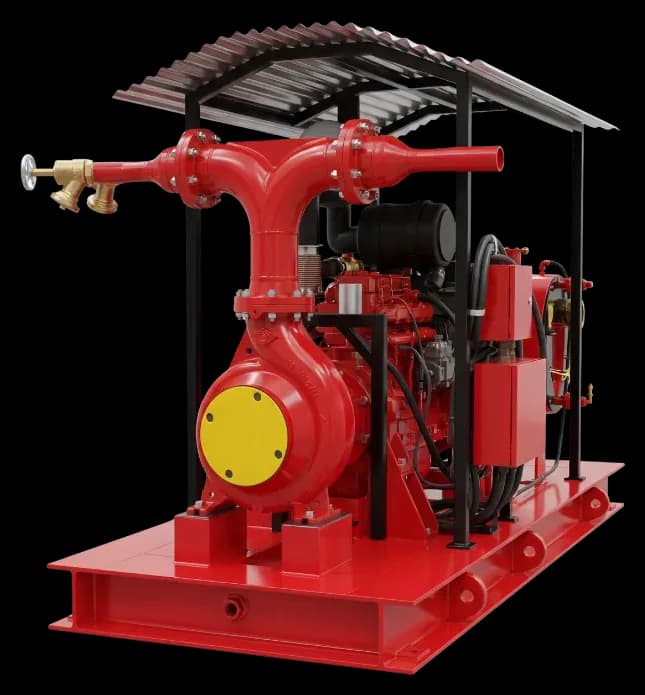
- Main centrifugal pump driven by electric motor or diesel engine
- Small-capacity jockey pump for network pressure maintenance
- Controls and alarms defined by design and adopted standard
- Pressure instruments and devices per selected configuration
- Fuel tank selected for the diesel engine and required design autonomy
- Starting, batteries and chargers per engine and controller documentation
- Exhaust, cooling and ventilation per engine documentation and installation
- Base, assembly, interfaces and site services per contracted scope
Sealing options
- Sealing per selected pump and assembly requirements
- Seal materials compatible with water and operating conditions
- Special arrangements subject to assessment and proposal documentation
Available materials
- Casing and impeller identified in the pump datasheet
- Shaft and internal components per selected model
- Piping and connections per design and water conditions
- Base and finish defined in the supply scope
Who is this manual for
Fire protection designers, engineering, maintenance and procurement teams organizing the information needed to select and procure a pump assembly.
When to use
Consult when preparing a specification or comparing configurations. Provide hydraulic demand, supply, installation and document requirements. Testing scope, Brazilian engineering responsibility registration (ART) and other responsibilities must be defined in the contract; the catalogue does not prove authority or insurer approval.
From the document to your next step.
Keep the equipment identification with the document when continuing the conversation with our team.
Check the identification
If you already have a pump, provide the series and code on its nameplate. A photo helps our team identify the equipment.
Consult the series document
Use the manual code as a reference. Dimensions and construction options must be checked for your equipment model and configuration.
Keep the context
For a question, replacement or new selection, share the model and the page you are consulting. Include the fluid and operating conditions you know.
Explore the subject in more detail.
Related reading to accompany the series documentation.
NBR 16704: Stationary Fire Pump Sets — Requirements, Performance Curve and Acceptance
NBR 16704 is the ABNT standard for the stationary pump sets that supply automatic fire protection systems such as sprinklers. A manufacturer guide to what it covers and where it is required, which pumps NFPA 20 accepts, the curve the pump must meet, the role of the jockey pump and the tests and documents for acceptance.NFPA 25: Fire Pump Inspection, Testing and Maintenance
A manufacturer’s guide to the fire pump routine after handover: what NFPA 25 requires in the no-flow test, the annual flow test, weekly inspection and maintenance, and what NBR 13714 and the technical instructions add in Brazil.Fire Pump Room: Environment Requirements, Components and the Path to Approval
A manufacturer’s guide to the fire pump room: what NFPA 20 requires from the room, what the São Paulo and Goiás technical instructions add, what goes inside and what is checked at acceptance and in periodic inspections.
Need to relate the manual to your equipment?
Talk to our team about the series, model and topic you are reviewing. You can continue the analysis with the information you already have.