

How it works: the
Complete technical guide on internal gear pumps: crescent principle, advantages over external gear, applications for sensitive fluids and how to specify.

At a glance
- The crescent separator organizes liquid travel between suction and discharge. Actual flow reflects speed, pressure and leakage through internal clearances.
- Oils, paints, adhesives and resins call for selection by viscosity, temperature and compatibility. For sensitive fluids, validate process requirements with engineering.
- Relief valve and heating jacket are supply options. Jacket limits differ from pumped-liquid temperature limits.
- Reference document: FBEI technical manual MAN001-10 — principle, parts, dimensions and installation.
- The current FBEI catalog covers HL, KK, LQ, LS, M and N, from 1½ to 6 inches. Earlier records remain available; confirm code, configuration and availability with FB Bombas.
Updated
Answers to guide your selection
How does the crescent principle work?
The crescent separates the suction and discharge regions while liquid travels through the tooth spaces. This does not mean a hermetic seal: internal clearances contribute to volumetric leakage. Actual flow depends on operating conditions and must be checked for the model.
Difference between internal and external gear pumps?
The difference is the gear arrangement: external in FBE and internal in FBEI. This alone does not determine the better equipment. Compare model limits, fluid, materials, sealing, speed, duty point and the process requirements for pulsation or shear.
Can the FBEI operate with hot fluids?
The FBEI catalog gives up to 340 °C as a general series fluid limit, subject to configuration. The heating jacket has separate limits in manual MAN001-10: steam up to 185 °C or thermal fluid up to 232 °C. Do not confuse pumped-product and heating-medium temperatures; confirm pressure, materials and sealing during selection.
Is there a Brazilian manufacturer of internal gear pumps?
Yes. FB Bombas manufactures the FBEI series in Brazil. The current catalog presents sizes from 1½ to 6 inches, including HL, KK, LQ, LS, M and N; earlier records remain available for reference. Confirm the complete code, configuration and commercial availability with engineering.
What Is an Internal Gear Pump?
Crescent principle and smooth positive displacement
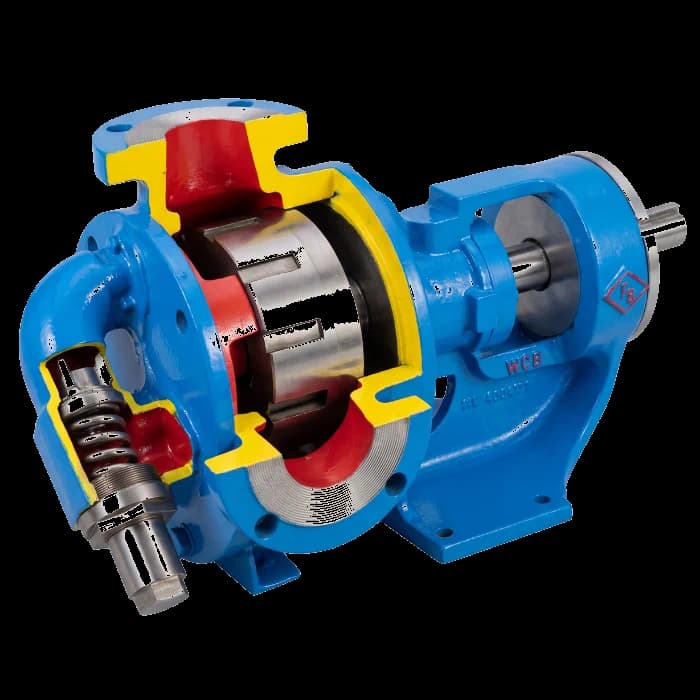
It is a positive displacement pump with internal gearing and a crescent separator. In FBEI, liquid travels through the spaces between the teeth during rotation. Consult the configuration's curve and limits to assess flow, pressure, viscosity and suction conditions.
The FBEI catalog presents relief-valve, heating-jacket and drive options. These items should be identified in the selected configuration proposal. For sensitive products, also provide quality criteria and process pulsation or shear limits.
Internal gearing with a crescent
Relief valve available as an accessory
Jacket with its own heating limits
3-inch FBEI-LS in the current catalog
How Does It Work?
4-phase pumping cycle with crescent separator
Suction
The rotor is driven by the shaft and meshes with the idler ring. In the disengagement zone, volume expands creating partial vacuum that draws fluid.
Crescent Isolation
The crescent separates suction and discharge regions. Clearances do not form a hermetic seal; their leakage is reflected in actual flow.
Volumetric Transfer
Rotation carries liquid through the tooth spaces. The model table or curve relates delivered flow to operating conditions.
Smooth Discharge
Re-engagement reduces available volume and directs liquid to discharge. Assess pulsation, speed and product compatibility during selection.
Internal vs. External
When to choose each gear type
| Criteria | Internal (FBEI) | External (FBE) |
|---|---|---|
| Pulsation | By model and duty conditions | By model and duty conditions |
| Noise | By model and duty conditions | By model and duty conditions |
| Shear | By model and duty conditions | By model and duty conditions |
| Max pressure | Per model (data sheet) | Limit by size and configuration |
| Max flow | Selected configuration curve | Table by size and speed |
| Applications to assess | Adhesives, paints, resins | Oils, asphalt, chemicals |
Internal Gear Advantages
Why choose internal gear for sensitive fluids
Operating conditions
Provide installation noise and vibration limits to assess the configuration and drive.
Process quality
Pulsation and shear must meet product criteria; do not omit accessories without assessment.
Viscosity and speed
Use viscosity at operating temperature to check flow, torque and suction conditions.
Relief valve
Confirm the accessory, setting and system protection. The valve does not control process flow.
Suction conditions
Check supply, piping and pump preparation before start-up according to the manual.
Operating direction
Confirm rotation, relief-valve orientation and connections before changing pumping direction.
Industrial Applications
Sectors that use internal gear pumps
Paints & Coatings
Paints, varnishes, pigments
Adhesives
Hot-melt, PVA, sealants
Pharmaceutical
Emulsions, creams, viscous bases
Petrochemical
Oils and petroleum derivatives
Oils & Lubricants
Lubricants, hydraulic oils
Asphalt
Viscosity and temperature by configuration
Cosmetics
Creams, lotions, soaps
How to Specify
Essential data for selecting the ideal FBEI
Fluid Type
Name, composition, solids presence and chemical compatibility.
Viscosity
Provide viscosity, unit and measurement temperature. Engineering assesses speed, power and suction.
Flow & Pressure
Desired flow rate and differential pressure. Defines FBEI model and required speed.
Temperature
Defines heating jacket need, seal type and construction materials.
Seal Type
Mechanical seal or packing according to application, temperature and fluid characteristics.
Drive System
Define speed, torque, electrical supply and available space to select the motor and transmission.
Frequently Asked Questions
What is an internal gear pump?
It is a positive displacement pump with internal gearing and a crescent separator. In FBEI, liquid travels through the spaces between the teeth during rotation. Consult the configuration's curve and limits to assess flow, pressure, viscosity and suction conditions.
How does the crescent separator principle work?
The crescent separates the suction and discharge regions while liquid travels through the tooth spaces. This does not mean a hermetic seal: internal clearances contribute to volumetric leakage. Actual flow depends on operating conditions and must be checked for the model.
What is the difference from external gear?
The difference is the gear arrangement: external in FBE and internal in FBEI. This alone does not determine the better equipment. Compare model limits, fluid, materials, sealing, speed, duty point and the process requirements for pulsation or shear.
Does the FBEI have a relief valve?
The catalog lists an internal relief valve as an accessory. Confirm whether it is included in the supplied configuration and its required setting. Manual MAN001-10 prohibits using it for pressure or flow control and requires protection for pumps without a relief valve. System protection must be defined in the design.
Can it operate with hot fluids?
The FBEI catalog gives up to 340 °C as a general series fluid limit, subject to configuration. The heating jacket has separate limits in manual MAN001-10: steam up to 185 °C or thermal fluid up to 232 °C. Do not confuse pumped-product and heating-medium temperatures; confirm pressure, materials and sealing during selection.
What is the FBEI-LS?
FBEI-LS is an internal gear series model. The current catalog identifies LS with a 3-inch size. Selection requires checking flow, pressure, speed, materials and accessories. LS is not a generic name for every large pump in the series.
What fluids is it suitable for?
Molasses, hot-melt adhesives, resins, paints, varnishes, lubricating oils, hydraulic oils, bitumen, polymers and pharmaceuticals. Viscosity range and flow are defined per model during engineering selection.
Is there a Brazilian manufacturer of internal gear pumps?
Yes. FB Bombas manufactures the FBEI series in Brazil. The current catalog presents sizes from 1½ to 6 inches, including HL, KK, LQ, LS, M and N; earlier records remain available for reference. Confirm the complete code, configuration and commercial availability with engineering.
Can I replace my current internal gear pump with an FBEI?
FBEI can be assessed to replace an installed internal gear pump. Send its nameplate, interface dimensions, fluid, viscosity, temperature, flow and pressure. Engineering confirms the curve, materials, sealing, drive and overpressure protection. The proposal identifies modifications and included accessories.
Companies that Trust FB Bombas
Brazilian manufacturer since 1944 — internal gear pumps









Need an internal gear pump?
Send us your fluid data and operating conditions. Our team will size the ideal FBEI for your application.
View FBEI SeriesWhere this line is specified
Sector guides with the criteria for selecting the pump in each application.
Compare before you specify
Side-by-side guides with the criteria behind each choice.
- COMPARISON
FBE vs FBEI — external or internal gear?
Two positive-displacement families from FB Bombas. The choice depends on viscosity, tolerable pulsation and installation geometry.
See comparison - COMPARISON
Brazilian-made or imported pump: cost and delivery
Compare proposals for an operation in Brazil using the same duty point, scope of supply and evaluation period. Origin, support and spare parts enter the decision through quoted data.
See comparison